
PP Impex India Insights
Stainless Steel Manufacturing & OEM Insights
Technical articles, manufacturing trends, and global supply chain expertise from an ISO-certified OEM factory.
OEM & Custom Deep Drawing
Precision Engineering & Metal Forming
In-depth analysis of stainless steel grade selection, deep drawing technologies, and tooling options.
Global Trade & Export Standards
B2B Sourcing & Quality Control
Best practices for international buyers sourcing custom kitchenware and private label cookware.
Choosing among the 2026 Best Stainless Steel Rice Washing Bowls requires more than comparing polished surfaces. A reliable bowl should handle repeated rinsing, wet rice, strong stirring, and daily cleaning without bending. Look for food-grade stainless steel, sturdy rims, smooth welds, stable feet, and well-spaced drainage holes. Capacity also matters. A small bowl may suit one person, while family cooking needs deeper walls and better splash control.
Food scientist Dr. Bryan Quoc Le explains, “Stainless steel is valued because it is durable, nonreactive, and relatively easy to clean.” That principle guides this buyer-focused review. However, easy to clean does not mean impossible to stain. Rice starch can cling around seams, perforations, and underside supports. A bowl may look excellent online yet feel thin, noisy, or unstable in a real kitchen. Small details matter.
Our evaluation considers material quality, drainage performance, comfort, maintenance, and long-term value. We also examine whether each design rinses rice efficiently without losing grains through oversized holes. User experience remains important. Some buyers prefer a wide basin; others need a compact bowl for limited counter space. There is no perfect choice. Even premium models may have minor weaknesses, such as sharp-looking edges, awkward handles, or difficult-to-reach corners. That uncertainty deserves honest attention. The following guide compares practical strengths and overlooked flaws, helping buyers choose Stainless Steel Rice Washing Bowls with greater confidence.
What Is a Stainless Steel Rice Washing Bowl?
What Is a Stainless Steel Rice Washing Bowl?
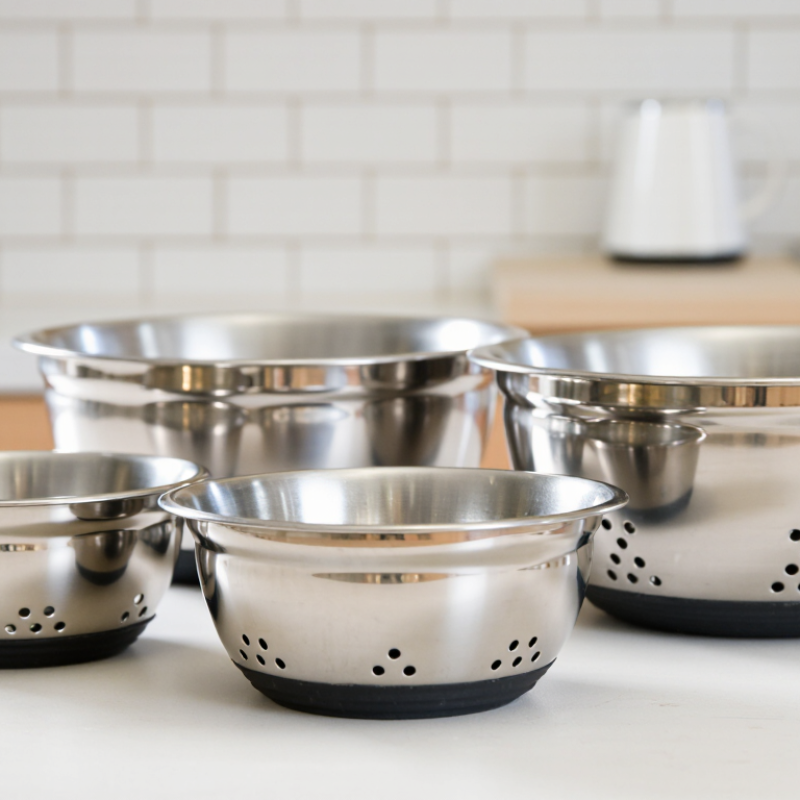
A stainless steel rice washing bowl is a kitchen vessel designed to rinse uncooked rice while draining water efficiently. Many models have fine perforations that retain grains but release cloudy starch water. Others use a solid bowl with drainage holes near the rim. The design changes the washing method.
In practical use, I place rice inside, add cool water, and gently rotate the grains with my fingers. The cloudy water then drains through the holes or side openings. A rounded interior helps prevent rice from hiding in corners. A wide rim also makes pouring safer, especially with wet hands. Small details matter.
Not all stainless steel bowls perform equally. Look for a food-contact grade, smooth welds, firm handles, and evenly spaced holes. A 304 stainless steel construction is commonly valued for corrosion resistance, but specifications should be verified from reliable product information. The bowl should feel stable, not paper-thin.
It is not a magic tool.
I once used a bowl with holes that were too large. Several grains escaped, which made rinsing more annoying than using a normal colander. This is easy to overlook. Check the hole size, capacity, and drainage direction before buying. After use, rinse away starch and dry the bowl fully. Even stainless steel can develop marks when moisture, salt, or harsh cleaners remain on its surface.
2026 Best Stainless Steel Rice Washing Bowls for Buyers - What Is a Stainless Steel Rice Washing Bowl?
| Comparison Dimension | Compact Bowl | Standard Bowl | Large Bowl | Buyer Considerations |
|---|---|---|---|---|
| What it is | A stainless steel bowl with drainage holes designed to rinse and drain rice. | A stainless steel bowl with drainage holes designed to rinse and drain rice. | A stainless steel bowl with drainage holes designed to rinse and drain rice. | The bowl combines washing, soaking, and draining in one utensil. It is not the same as a solid mixing bowl. |
| Typical capacity | 1.5–2.5 L | 3–4.5 L | 5–7 L | Choose capacity based on the amount of dry rice and the extra water needed for comfortable rinsing. |
| Suitable dry rice quantity | Approximately 150–250 g | Approximately 300–500 g | Approximately 500–800 g | Rice expands during cooking, so the bowl should not be filled to the rim during washing. |
| Approximate diameter | 20–22 cm | 24–27 cm | 28–32 cm | A wider diameter gives more room for hand washing but requires more storage space. |
| Approximate height | 9–11 cm | 11–13 cm | 13–16 cm | Moderate depth helps reduce splashing while allowing enough water movement around the rice. |
| Typical empty weight | 250–400 g | 400–650 g | 650–1,000 g | Heavier bowls are usually more stable, while lighter bowls are easier to lift and store. |
| Common stainless steel grade | 304 stainless steel | 304 stainless steel | 304 stainless steel; 316 for specialized corrosion resistance | 304 stainless steel contains chromium and nickel and is widely used for food-contact kitchen equipment. 316 adds molybdenum for improved resistance to chlorides but is usually more expensive. |
| Recommended steel thickness | Approximately 0.5–0.7 mm | Approximately 0.6–0.8 mm | Approximately 0.7–1.0 mm | Thicker steel generally improves rigidity and dent resistance, but the exact weight also depends on the bowl shape and perforation area. |
| Drainage-hole size | Approximately 1–2 mm | Approximately 1.5–2.5 mm | Approximately 2–3 mm | Smaller holes help retain grains, while larger holes drain water faster. Hole spacing and pattern are also important. |
| Drainage performance | Good for small portions | Good for everyday household use | Very good for larger portions | The rim should remain rigid when the bowl is tilted, and the drainage openings should not trap rice grains. |
| Rim and handle design | Rolled rim; handles optional | Rolled rim with one or two handles preferred | Reinforced rim and two large handles recommended | A rolled rim improves comfort and stiffness. Handles should be securely welded and large enough for a wet grip. |
| Surface finish | Smooth satin or polished finish | Smooth satin or polished finish | Smooth satin finish is practical for frequent use | A smooth, burr-free surface is easier to clean and less likely to retain starch residue. |
| Typical applications | Single-person meals, small kitchens, travel use | Daily family cooking and general food preparation | Large families, meal preparation, and commercial-style kitchens | Many models can also rinse quinoa, lentils, beans, vegetables, and other small foods if the holes are suitably sized. |
| Cleaning and care | Hand wash or dishwasher compatible when specified | Hand wash or dishwasher compatible when specified | Hand wash is useful for checking large perforated areas | Rinse starch from the holes promptly, dry after washing, and avoid chlorine bleach or abrasive cleaners that can damage the finish. |
| Best choice for most buyers | Best when storage space is limited | Best overall balance of capacity and handling | Best when washing large batches regularly | For general household use, a 3–4.5 L bowl made from food-contact 304 stainless steel is a practical starting point. |
Note: Capacity, dimensions, weight, hole size, and steel thickness are typical specification ranges for stainless steel rice-washing bowls. Actual measurements vary by bowl geometry, manufacturing tolerance, and drainage pattern.
FAQS
It rinses uncooked rice while allowing cloudy starch water to escape. Fine holes retain most grains. It is not magic.
Place rice inside, add cool water, and gently rotate the grains with your fingers. Drain through the holes or side openings. Small holes matter.
Choose food-contact stainless steel with a smooth surface and clean welds. 304 stainless steel is commonly valued for corrosion resistance. Verify the specification.
A width of 24–28 centimeters gives rice room to move. Families may need wider bowls. Very deep bowls can waste water.
Inspect the hole diameter before buying. Holes should drain water quickly but retain smaller grains. Test the bowl under a strong tap when possible.
A rounded rim feels safer with wet hands. Stable handles help with larger portions. A wide, slightly raised base reduces sliding near the sink.
Rinse away starch immediately after use. Inspect inner corners for trapped residue. Dry the bowl and any silicone base completely.
A thin bowl may dent after one careless drop. Scratches can accumulate faster than expected. I once chose oversized holes and lost several grains.
Treat vague rust-resistance claims carefully without a stated steel grade. Compare weight, dimensions, hole size, and capacity. Specifications are sometimes incomplete. That deserves reflection.
Conclusion
This guide to Stainless Steel Rice Washing Bowls explains why they are a practical choice for rinsing rice, grains, vegetables, and other ingredients. Made for repeated kitchen use, these bowls combine a durable metal body with drainage openings that help remove excess water while keeping food contained. The article compares important buying factors such as material quality, bowl stability, hole size, handle design, rim comfort, and ease of pouring. It also explores different bowl styles, including deep designs for larger portions, compact options for small kitchens, and versatile models suited to everyday food preparation.
Choosing the right size depends on household needs, cooking frequency, and available storage space. Drainage style is equally important, as fine perforations work well for small grains while wider openings may speed up rinsing for larger ingredients. Proper care includes rinsing the bowl after use, washing away starch or food residue, drying it thoroughly, and avoiding harsh treatment that could cause scratches. With suitable maintenance, a well-designed bowl can remain useful and reliable for years.