

PP Impex India Insights
Stainless Steel Manufacturing & OEM Insights
Technical articles, manufacturing trends, and global supply chain expertise from an ISO-certified OEM factory.

OEM & Custom Deep Drawing
Precision Engineering & Metal Forming
In-depth analysis of stainless steel grade selection, deep drawing technologies, and tooling options.
Global Trade & Export Standards
B2B Sourcing & Quality Control
Best practices for international buyers sourcing custom kitchenware and private label cookware.
The global market for commercial cooking equipment is expanding, but Stainless Steel Gas Roaster demand is rarely reported as a separate category. Fortune Business Insights valued the commercial cooking equipment market at approximately USD 12.1 billion in 2023 and projects continued growth through 2032. Technavio also identifies energy efficiency, automation, and foodservice expansion as important market drivers. These figures offer useful direction, not a perfect roaster forecast.
A Stainless Steel Gas Roaster sits where heat control, hygiene, durability, and operating cost meet. Stainless steel surfaces resist corrosion and support faster cleaning, especially around grease, smoke, and high-temperature cooking zones. Yet material grade matters. A bright surface alone does not prove long service life. Weld quality, burner stability, insulation, airflow, and replacement-part access deserve closer inspection. That assumption needs testing.
Dr. Benjamin Chapman, a food-safety specialist at North Carolina State University, has repeatedly stressed a practical principle: “You can’t see, smell, or taste pathogens.” His warning gives supplier comparisons a measurable foundation. Buyers should examine temperature consistency, food-contact materials, safety documentation, and after-sales support, rather than trusting attractive photographs. The U.S. Department of Energy also highlights equipment efficiency as a continuing concern for commercial kitchens, where daily gas consumption quickly becomes significant. Some supplier claims remain difficult to compare because testing methods vary. This is an uncomfortable gap. Reliable sourcing therefore requires technical specifications, independent verification, operating demonstrations, and feedback from kitchens using the equipment under real workloads.
What Stainless Steel Gas Roasters Are and How They Work
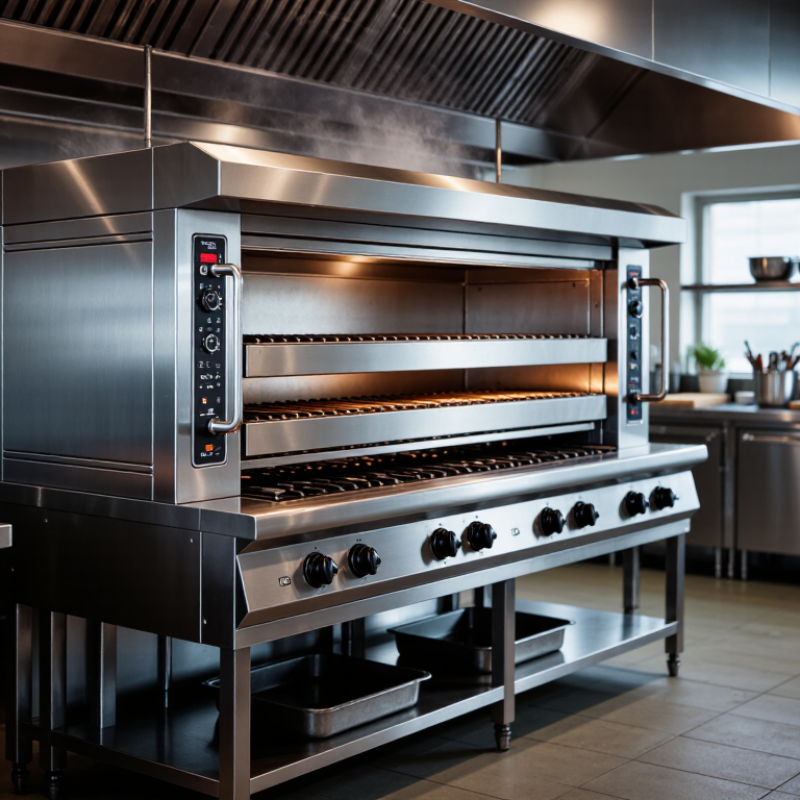
A stainless steel gas roaster is a heat-processing machine designed to roast coffee, nuts, grains, or similar foods. Its stainless steel drum or chamber resists corrosion and holds heat consistently. A gas burner supplies direct or indirect heat beneath the roasting area. The choice depends on the machine’s design. Inside, paddles or a rotating drum keep material moving. This reduces scorching on the hot metal surface.
During operation, the burner heats incoming air or the drum wall. A fan carries hot air through the product, while exhaust removes smoke, moisture, and chaff. Sensors track temperature near the product, not only near the burner. Operators adjust gas flow, airflow, and drum speed during roasting. Small changes matter. A darker batch may need lower gas and stronger airflow near the final stage.
For worldwide sourcing, stainless steel alone does not prove quality. Check welds, door seals, insulation, burner response, and cleaning access. Ask suppliers for test data, operating manuals, spare-part support, and safety certifications for the destination market. The roaster should connect to suitable ventilation and gas systems through qualified technicians. Request a sample roast when possible. A polished exterior can hide uneven airflow. That detail is easy to miss.
| Data Dimension | Typical Technical Data | Why It Matters When Comparing Suppliers |
|---|---|---|
| Equipment Definition | A stainless steel gas roaster is a thermal processing machine that uses gas-fired burners to heat a rotating drum, tray chamber, or roasting vessel. The product is heated by direct hot air, radiant heat, or a combination of both. | Confirm whether the supplier offers the correct configuration for coffee, nuts, seeds, grains, cocoa, meat, or other food products. Roasting methods are not interchangeable for every application. |
| Main Heating Sequence | Gas enters the burner, mixes with combustion air, and is ignited. The flame heats the roasting chamber or a heat exchanger. A fan or natural convection then transfers hot air around the product while the batch is agitated. | A clear heating sequence helps buyers evaluate heat uniformity, energy efficiency, combustion control, and the risk of localized overheating. |
| Common Stainless Steel Construction | Food-contact areas are commonly manufactured from stainless steel grades such as AISI 304. AISI 316 is selected for applications requiring higher resistance to chlorides, salts, or aggressive cleaning chemicals. Exact grades should be confirmed in the quotation. | The material grade affects corrosion resistance, service life, cleanability, and compliance with the hygiene requirements of the destination market. |
| Typical Chamber and Frame Design | Typical designs include an insulated roasting chamber, perforated or solid rotating drum, product inlet and outlet, inspection door, exhaust duct, access panels, and a stainless steel support frame. | A modular and accessible design simplifies cleaning, inspection, maintenance, and replacement of wear parts. |
| Fuel Options | Common fuel choices are natural gas and liquefied petroleum gas, including propane. Fuel selection must match the burner configuration, local utility supply, and approved operating pressure. | Suppliers should state the factory fuel setting and whether conversion components are available. Using the wrong gas configuration can create safety and performance problems. |
| Typical Gas Pressure Reference | Commercial installations in North America commonly use approximately 7 inches water column for natural gas and 11 inches water column for propane, but actual requirements vary by burner and local code. | The buyer should verify inlet pressure, regulator requirements, connection size, and commissioning procedures with the supplier and a qualified gas technician. |
| Heating Capacity | Small and medium commercial gas roasters commonly fall within a broad range of approximately 30,000 to 200,000 BTU/h. Industrial machines may require substantially higher input, depending on throughput and product moisture. | Compare burner input with batch size, evaporation load, roasting time, insulation quality, and expected hourly output rather than comparing burner size alone. |
| Operating Temperature | Many food roasting processes operate roughly between 120°C and 260°C (248°F and 500°F). The suitable range depends on the product, moisture content, batch size, and required color or flavor profile. | A supplier should provide a validated temperature range and explain whether the stated temperature is measured in the chamber, product bed, or exhaust air. |
| Temperature Control | Typical systems use a temperature sensor, gas valve modulation or staged firing, fan-speed control, timer settings, and a programmable controller. More advanced systems may record roast profiles and process data. | Closed-loop control improves repeatability and helps operators reproduce a validated recipe across different batches. |
| Product Agitation | Rotating drums, paddles, tumbling vessels, or vibrating trays are used to expose the product evenly to the heated air and chamber surfaces. | The agitation method affects uniformity, breakage, residence time, cleaning requirements, and suitability for fragile or irregularly shaped products. |
| Airflow and Exhaust | A controlled airflow system removes moisture, smoke, and volatile compounds. Typical equipment includes an exhaust fan, duct connection, adjustable dampers, and sometimes cyclone or filtration equipment. | Check exhaust volume, duct diameter, filtration needs, heat recovery options, and local ventilation requirements before installation. |
| Batch Capacity | Commercial batch roasters may range from a few kilograms to several hundred kilograms per batch. Actual capacity depends on product density, desired fill level, moisture, and required agitation space. | Request capacity data in both kilograms per batch and kilograms per hour. A nominal chamber volume alone is not a reliable measure of production output. |
| Energy Efficiency Factors | Efficiency is influenced by insulation, burner turndown ratio, combustion-air control, exhaust heat recovery, drum sealing, airflow management, and the moisture removed from the product. | Ask for fuel consumption at a defined load and recipe. A fuel figure without product type, batch size, and operating conditions cannot be compared accurately. |
| Gas Safety Systems | Common safety features include flame failure protection, automatic gas shutoff, ignition monitoring, high-temperature protection, airflow proving, emergency stop controls, and pressure monitoring. | Safety functions should be documented in the manual and tested during commissioning. They must also comply with the installation rules of the destination country. |
| Applicable Standards | Depending on the market and equipment category, relevant requirements may include ANSI Z83.11 and CSA 1.8 for commercial gas food-service equipment, EN 203 for gas-heated commercial catering equipment, and applicable electrical and pressure-system rules. | Standards are market-specific. Buyers should request declarations, test reports, manuals, and certification documents that match the actual machine configuration. |
| Supplier Regions and Market Coverage | Worldwide supply commonly comes from manufacturing and engineering markets in Europe, East Asia, South Asia, North America, and other industrial regions. Regional availability, lead time, and service capability vary by product category. | Evaluate suppliers by technical fit, export experience, installation support, spare-parts availability, response time, and compliance documentation rather than by geographic location alone. |
| Installation Requirements | A typical installation requires a level foundation, gas supply and regulator, electrical power, combustion-air provision, exhaust ducting, access for maintenance, and adequate clearance from combustible materials. | Request a utility schedule and layout drawing before ordering. Site conditions can significantly affect the final installation cost. |
| Cleaning and Hygiene | Useful features include smooth welded surfaces, removable contact parts, inspection doors, cleanout ports, minimal product traps, and a design that separates food-contact zones from combustion areas. | Better cleanability reduces cross-contamination risk, downtime, and labor costs, especially when different products are processed on the same machine. |
| Recommended Supplier Evaluation Criteria | Compare validated sample results, throughput, fuel consumption, temperature uniformity, control functions, material certificates, safety documentation, warranty terms, spare parts, and after-sales service. | A structured comparison based on measurable specifications provides a more reliable purchasing decision than advertised capacity or general claims about performance. |
FAQS
It is a heat-processing machine for coffee, nuts, grains, and similar foods. A gas burner supplies heat beneath or around a rotating drum. Stainless steel resists corrosion and supports repeated cleaning.
The burner heats air or the drum wall. A fan moves hot air through the product, while exhaust removes moisture, smoke, and chaff. Operators adjust gas flow, airflow, and drum speed.
Paddles or drum rotation keep the product moving. This reduces scorching against hot metal surfaces. Uneven movement can still create inconsistent color.
Check welds, door seals, insulation, burner response, and cleaning access. Ask for material certificates, test records, drawings, and operating manuals. Shiny steel alone proves little.
Request steel grade, sheet thickness, burner output, batch capacity, and temperature range. Confirm gas type, inlet pressure, electrical needs, and destination requirements. Vague specifications create expensive assumptions.
Give at least three suppliers the same specification sheet. Compare tooling fees, minimum quantities, sample charges, packaging, spare parts, and production time. A low price may hide weak hinges or thin panels.
Request a sample roast using your actual product. Measure heat distribution with an independent thermometer. Check fuel use, batch consistency, discharge temperature, and operator access.
The roaster needs suitable ventilation and compatible gas connections. Qualified technicians should handle installation and commissioning. Confirm pressure testing, emergency shutoff procedures, labeling, and safety certification.
Keep the signed invoice, pre-production drawing, test reports, serial numbers, and packed-machine photographs. Confirm the shipping term and export packaging. I once missed crate dimensions, and freight costs changed sharply.
Do not rely on attractive photographs or polished surfaces. Inspect airflow, cleaning paths, seals, and service access. A drain near the frame may slow cleaning, and I might overlook it again.
Conclusion
A Stainless Steel Gas Roaster is a commercial or industrial cooking machine that uses controlled gas heat to roast food evenly inside a durable stainless steel chamber. Its performance depends on efficient burners, accurate temperature controls, proper airflow, heat insulation, easy cleaning, and safety features such as flame monitoring and automatic shutoff. A reliable supplier should provide consistent construction quality, clear technical specifications, responsive communication, and dependable after-sales support.
When comparing worldwide suppliers, buyers should consider manufacturing experience, production capacity, customization options, testing procedures, and compliance with applicable safety and electrical standards. Certifications, material traceability, warranty terms, spare-part availability, and quality-control documentation can help verify product reliability. It is also important to compare quotations based on total value rather than price alone, including packaging, lead time, shipping conditions, minimum order quantities, and inspection arrangements. Careful evaluation and clearly defined order requirements can reduce purchasing risks and support long-term operational efficiency.