
PP Impex India Insights
Stainless Steel Manufacturing & OEM Insights
Technical articles, manufacturing trends, and global supply chain expertise from an ISO-certified OEM factory.

OEM & Custom Deep Drawing
Precision Engineering & Metal Forming
In-depth analysis of stainless steel grade selection, deep drawing technologies, and tooling options.
Global Trade & Export Standards
B2B Sourcing & Quality Control
Best practices for international buyers sourcing custom kitchenware and private label cookware.
How to Source Stainless Steel Stock Pots Wholesale?
Table of Contents
- Define Your Stainless Steel Stock Pot Wholesale Requirements
- Evaluate Materials, Sizes, Features, and Manufacturing Standards
- Identify and Compare Qualified Wholesale Suppliers
- Verify Product Quality, Certifications, and Factory Capabilities
- Negotiate Pricing, Minimum Orders, Shipping, and Delivery Terms
- FAQS
- Conclusion
- Related Posts
Sourcing Stainless Steel Stock Pots wholesale requires more than comparing factory prices. Buyers must verify material grades, wall thickness, welding quality, capacity accuracy, and food-contact documentation. World Stainless reported approximately 58.4 million metric tons of crude stainless steel production in 2023. That scale suggests broad supply, but it does not guarantee consistent cookware quality.
A practical sourcing process starts with a clear specification sheet. State whether you need 304 or 316 stainless steel, a bonded base, mirror polishing, or induction compatibility. Ask suppliers for mill test certificates, product drawings, inspection records, and sample photos. ASTM A240 and EN 10088 can help confirm stainless steel specifications. For commercial kitchens, NSF/ANSI 2 and applicable FDA Food Code requirements offer useful safety references. Regulations vary by destination, so documents need careful review.
Use platforms such as UN Comtrade and ITC Trade Map to study trade flows and supplier markets. Their customs data can reveal major exporting regions, although product classifications may combine different kitchen articles. This limitation matters. A low quote can still become expensive after uneven handles, thin bases, or failed inspections appear.
Experienced buyers should compare landed cost, not unit cost alone. Include tooling, packaging, freight, duties, testing, and replacement risks. Visit the factory when possible. Watch how workers polish rims and weld handles. Small details often expose large process differences. Supplier audits, pre-shipment inspections, and controlled trial orders improve reliability. Still, no report replaces physical sampling. The best sourcing decision combines documented evidence, technical judgment, and a willingness to question attractive assumptions.
Define Your Stainless Steel Stock Pot Wholesale Requirements
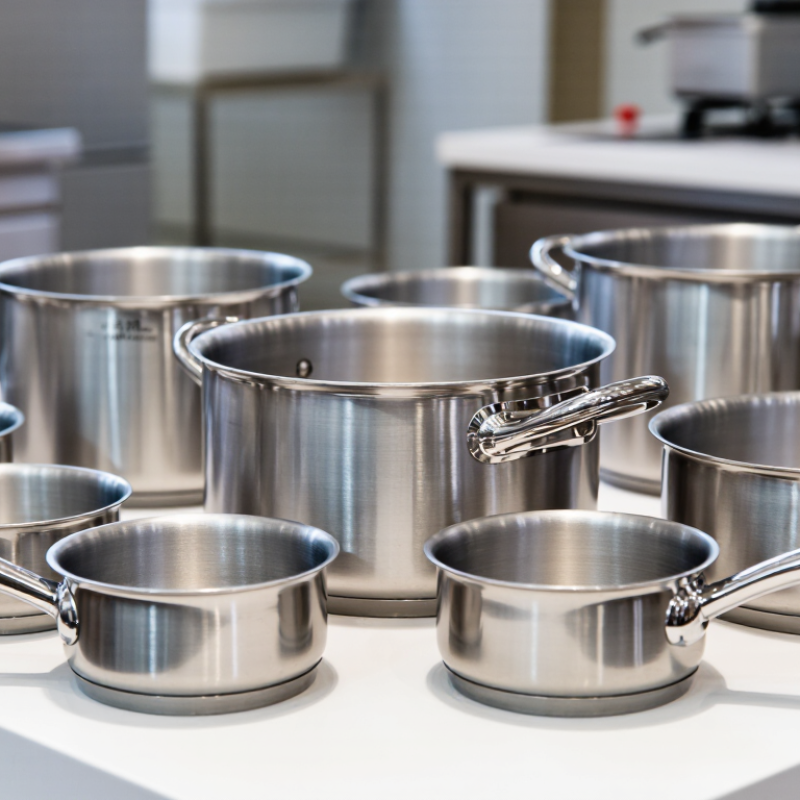
Before requesting quotations, define the stock pot’s exact working conditions. Capacity comes first. A 20-liter pot suits smaller kitchens, while larger operations may require 50 liters or more. Record diameter, depth, wall thickness, lid style, handle shape, and empty weight. These details prevent vague comparisons between suppliers.
Material selection needs equal attention. Ask for the stainless steel grade, surface finish, and material documentation. Food-contact requirements can differ by destination market, so verify applicable testing and certification records. Grand View Research estimated the global cookware market at approximately USD 19.26 billion in 2023, with continued growth expected through 2030. That growth increases supplier choices, but not every quotation reflects equal durability.
Consider heat source, batch volume, stacking needs, packaging, minimum order quantity, and production lead time. A polished exterior looks attractive, yet a satin finish may hide scratches better in commercial use. Handle welds deserve sample testing. A minor weakness there can become an expensive complaint. Request one pre-production sample and inspect its flatness, lid fit, rim smoothness, and resistance to stains. ASTM A240 references stainless steel plate and sheet requirements, but a certificate alone cannot replace physical inspection. A perfect specification rarely exists. Recheck your assumptions after the sample arrives.
Evaluate Materials, Sizes, Features, and Manufacturing Standards
Sourcing stainless steel stock pots wholesale requires more than comparing unit prices. Grand View Research reported that the global cookware market was valued at about USD 19.3 billion in 2023, with continued growth expected through 2030. That expansion increases supplier choices, but also increases quality variation. Ask for the steel grade, thickness, weight, and test documentation before requesting a large quotation.
For commercial stock pots, 304 stainless steel is a practical baseline because it resists corrosion and supports repeated food contact. 316 steel offers stronger resistance in salty or acidic environments, but usually costs more. ASTM A240 provides relevant requirements for stainless steel plate and sheet. Check whether the pot uses food-contact compliant materials, smooth internal surfaces, reinforced rims, and securely welded handles. Small gaps around a handle can trap residue. That detail matters.
Size selection should match cooking volume, storage space, and heating equipment. A 20-liter pot may suit small kitchens, while larger operations may need 50 liters or more. Measure the base diameter, not only the stated capacity. A narrow base can heat unevenly. Request production samples, weld photographs, surface-finish records, and ISO 9001 quality procedures when available. No checklist catches every weak weld. I would still inspect one sample after thermal cycling, because supplier paperwork can look reassuring while the lid fit disappoints. Consider packaging strength too; dented rims create avoidable wholesale losses.
Identify and Compare Qualified Wholesale Suppliers
How to Source Stainless Steel Stock Pots Wholesale?
When sourcing stainless steel stock pots wholesale, supplier comparison should begin with measurable requirements. Define capacity, steel grade, wall thickness, lid fit, handle design, and heating compatibility before requesting quotations. Vague specifications create cheap-looking surprises. Ask suppliers for material certificates, food-contact test reports, and production photographs. Verify that documents are current and match the proposed product, not an older sample.
A qualified supplier should explain quality controls clearly. Request a pre-production sample, then inspect welds, rims, handles, base flatness, and surface finish under strong light. Check whether the lid sits evenly and whether the pot remains stable on a commercial cooker. A polished website proves little. Ask about factory capacity, minimum order quantities, inspection procedures, packaging strength, and replacement handling. References from comparable buyers can reveal shipment consistency and communication speed.
Compare the full landed cost, not only the unit price. Include tooling, freight, duties, packaging, inspection, and possible defect allowances. I once treated a low unit price as the best offer; freight and dented lids changed that judgment. That mistake still informs my comparisons. Still, one sample cannot represent every shipment. Ask how the supplier controls thickness and polishing across production batches. Clear answers matter. Suppliers that avoid basic evidence may create delays later. A written specification sheet, approved sample, and agreed inspection standard make the relationship more reliable.
Verify Product Quality, Certifications, and Factory Capabilities
When sourcing stainless steel stock pots wholesale, verify quality before discussing price. Ask for the exact steel grade, thickness, diameter, and weight tolerance. A reliable supplier should provide material certificates with heat numbers and traceable records. Inspect the pot surface under bright light. Look for uneven polishing, pinholes, rough welds, or warped bases. Test the lid fit and handle strength, too. Small defects often become costly during large production runs.
Tips: Request a pre-production sample and compare it with the approved specification. Check food-contact declarations, quality management certificates, and inspection reports. Confirm that each certificate matches the factory’s legal entity, product scope, and current validity. Documents can look convincing but still lack useful details. An independent laboratory test may be worthwhile for large orders.
Factory capability matters beyond equipment photos. Ask how the factory controls stamping, welding, polishing, passivation, and final cleaning. Review its monthly capacity, defect rate, maintenance records, and corrective-action process. I once trusted an excellent sample, but later found inconsistent wall thickness in bulk goods. That mistake changed my inspection plan. Now, I request production-line videos, batch records, and random inspections before shipment. Clear packaging standards and written acceptance criteria also reduce disputes.
| Verification Dimension | Wholesale Specification or Benchmark | How to Verify | Required Evidence | Acceptance Guidance |
|---|---|---|---|---|
| Stainless Steel Grade | Common food-service grades include AISI 304; AISI 316 is preferred for higher chloride or salt exposure. AISI 430 may be used for some magnetic or cost-sensitive components. | Use a handheld X-ray fluorescence (XRF) test on the body, base, lid, and handles. Confirm the alloy designation against the purchase specification. | Material test certificate (MTC), heat number, grade declaration, and independent XRF inspection report. | Pass Grade and test results match the approved specification and certificate. |
| Material Standard | Stainless steel sheet may be specified to ASTM A240/A240M or EN 10088, depending on the target market and contract requirements. | Check whether the certificate identifies the applicable standard, chemical composition, mechanical properties, thickness, and heat number. | Mill certificate issued for the actual production batch, not only a generic supplier statement. | Pass Certificate details are traceable to the delivered material. |
| Wall and Base Thickness | For commercial stock pots, a typical specification may use approximately 0.8–1.2 mm walls and a thicker or bonded base. Exact values depend on diameter, capacity, and intended use. | Measure multiple points with a calibrated ultrasonic thickness gauge or micrometer where accessible. Inspect the base separately from the side wall. | Approved technical drawing, tolerance table, and incoming inspection report. | Check carefully Do not accept a nominal thickness without a stated tolerance and measurement method. |
| Base Construction | Suitable options include impact-bonded, diffusion-bonded, or encapsulated bases designed for the declared cooktop type. | Inspect for a flat, firmly attached base without gaps, lifting edges, cracks, or visible separation. Test heating uniformity on representative samples. | Cross-sectional sample or construction drawing, bonding-process description, and flatness inspection record. | Pass Base remains secure after thermal cycling and sits flat without rocking. |
| Capacity and Dimensions | Define nominal capacity, usable capacity, diameter, height, rim diameter, lid fit, and dimensional tolerances. Usable capacity should be distinguished from brim-full capacity. | Verify dimensions with calibrated gauges and determine volume by a controlled water-fill test. | Approved drawing, capacity test record, and sample measurement report. | Pass Measurements remain within the agreed tolerance on production samples. |
| Surface Finish | Typical finishes include polished, satin, or brushed stainless steel. The surface should be uniform, cleanable, and free from sharp defects. | Use visual inspection under consistent lighting. Check for pits, deep scratches, discoloration, weld burn, dents, and polishing lines. | Golden sample, approved finish standard, defect limit sample, and final inspection checklist. | Pass No sharp edges, exposed contamination, deep pits, or unacceptable cosmetic defects. |
| Weld and Joint Quality | Handles, brackets, and fittings should be securely welded or mechanically fixed, with smooth and clean joints. | Inspect weld continuity and alignment. Apply a controlled load to handles and examine the joint after repeated handling. | Welding procedure or work instruction, handle-load test result, and sampling plan. | Check carefully Reject loose handles, incomplete welds, sharp projections, and excessive weld discoloration. |
| Food-Contact Compliance | Compliance depends on the destination market. Common frameworks include FDA food-contact requirements for the United States and Regulation (EC) No 1935/2004 plus applicable specific measures for the European Union. | Confirm the exact food-contact scope, stainless-steel grade, surface treatments, coatings, elastomers, and migration or composition requirements. | Declaration of compliance, laboratory test report, material composition records, and traceability documentation. | Pass Documents cover every food-contact component and the intended sales market. |
| Chemical and Corrosion Resistance | The selected grade and finish should suit the expected exposure to water, salt, acidic foods, detergents, and heat. Chloride-rich conditions increase corrosion risk. | Conduct an agreed corrosion or staining evaluation using representative cleaning and food-contact conditions. Inspect after washing and drying. | Test protocol, test photographs, laboratory report where required, and cleaning-care instructions. | Check carefully Avoid unsupported claims such as “rust-proof” or “corrosion-proof.” |
| Cooktop Compatibility | State compatibility separately for gas, electric, ceramic, and induction cooking. Induction performance requires a suitable magnetic base or magnetic stainless-steel construction. | Test representative samples on the specified cooktops for heating response, stability, base deformation, and temperature distribution. | Cooktop compatibility test report and approved product specification. | Pass Only claim compatibility with the cooktops tested and listed in the documentation. |
| Lid and Handle Safety | Lids should fit securely and handles should remain stable during normal lifting and pouring. Knobs and grips must tolerate the stated operating conditions. | Check fit, clearance, grip temperature, attachment strength, and repeated-use durability on production-equivalent samples. | Assembly drawing, load-test record, thermal-use test, and user-care instructions. | Pass No excessive movement, loosening, sharp edges, or unsafe contact points. |
| Factory Quality System | A documented quality system should control incoming materials, in-process checks, final inspection, nonconforming products, corrective actions, and traceability. | Audit the factory’s procedures, inspection equipment, calibration status, personnel responsibilities, and retained records. | Quality manual, inspection forms, calibration certificates, corrective-action records, and audit report. | Pass Records demonstrate repeatable controls rather than inspection performed only after complaints. |
| Production Capability | Evaluate forming, deep drawing, spinning, welding, polishing, base bonding, assembly, testing, and packaging capacity against the required order volume. | Review the production flow and observe the actual equipment. Compare declared monthly capacity with open orders, staffing, and bottleneck processes. | Process-flow chart, equipment list, capacity calculation, production schedule, and sample order history with confidential information removed. | Check carefully Separate in-house operations from subcontracted processes and audit critical subcontractors. |
| Quality Control Sampling | Use a written sampling plan covering dimensions, appearance, function, material identity, packaging, and labeling. AQL levels should be agreed before production. | Perform pre-production, during-production, and pre-shipment inspections using defined sample sizes and acceptance criteria. | Inspection plan, sampling records, defect classification, and signed inspection reports. | Pass Results are recorded by batch and linked to the purchase order. |
| Packaging and Transit Protection | Packaging should prevent scratches, dents, moisture damage, lid movement, and mixed-size loading during transport. | Perform a packaging drop or handling assessment appropriate to the shipping method and inspect packed samples for movement and abrasion risk. | Packaging specification, carton dimensions, palletization plan, drop-test record, and shipping marks. | Pass Product protection is consistent with the planned transport and storage conditions. |
| Supplier Approval Decision | Approve the source only after product samples, technical documents, factory capability, compliance records, and inspection results are consistent. | Use a weighted supplier scorecard and require corrective action for any critical nonconformity before mass production. | Signed sample approval, supplier audit report, corrective-action closure, and purchase specification. | Pass All critical requirements are verified before issuing the production order. |
Negotiate Pricing, Minimum Orders, Shipping, and Delivery Terms
When sourcing stainless steel stock pots wholesale, negotiate the landed cost, not only the unit price. World Stainless reported approximately 58.4 million tonnes of crude stainless steel production in 2023, showing a large but volatile supply base. Ask suppliers to separate steel, forming, polishing, packaging, and tooling costs. Request prices for 304 and 316 grades, because their nickel and molybdenum content can change the quotation significantly. A fixed price for 30 days helps, but it may not cover sudden metal movements. I learned that a low quote can hide thin walls, rough welds, or costly packaging.
Minimum order quantities need practical testing. Request a sample batch before accepting a large commitment. Compare 100, 300, and 1,000 units, then calculate the cost per usable pot. Smaller orders may carry higher prices, but they reduce warehouse exposure. Define acceptable defects, handle strength, lid fit, and carton damage in writing. Photographs are useful. They are not enough.
Shipping terms deserve equal attention. UNCTAD’s Review of Maritime Transport 2024 reported continued growth in maritime trade, while disruptions kept freight costs uncertain. Compare FOB, CIF, and DDP quotations using the same port, insurance coverage, and customs responsibility. Confirm carton dimensions, pallet quantity, loading date, transit time, and demurrage liability. Use a delivery schedule with inspection and replacement terms. A 15-day production promise may sound attractive, yet port congestion can erase it. Build a small buffer. Realistically, even careful planning can fail.
FAQS
Confirm the steel grade, wall thickness, diameter, weight tolerance, and total capacity. Ask for heat numbers and traceable material records. Price comes later.
Examine the surface under bright light. Look for pinholes, uneven polishing, rough welds, and warped bases. Test the lid fit and handle strength. Small flaws can multiply in bulk production.
Request material certificates, food-contact declarations, quality management certificates, and inspection reports. Check the legal entity, product scope, and expiry dates. Documents can still be incomplete.
Compare the sample with the approved specification before mass production. Measure the wall thickness and inspect the welds carefully. One excellent sample does not guarantee consistent bulk goods.
Ask about stamping, welding, polishing, passivation, and final cleaning controls. Review monthly capacity, defect rates, maintenance records, and corrective actions. Production-line videos and batch records add useful evidence.
Compare landed cost, not only the unit quotation. Request separate costs for steel, forming, polishing, packaging, and tooling. Compare 304 and 316 grades because material composition can change prices.
Request sample batches before accepting a large commitment. Compare orders of 100, 300, and 1,000 units. Calculate the cost per usable pot, including defects and storage exposure.
Compare shipping quotations using the same port, insurance coverage, and customs responsibility. Confirm carton dimensions, pallet quantity, loading date, transit time, and demurrage liability. Add a delivery buffer. Plans can fail.
Conclusion
Sourcing Stainless Steel Stock Pots wholesale begins with clearly defining your purchasing requirements, including capacity, pot dimensions, intended applications, handle design, lid options, finish, and estimated order volume. Evaluate stainless steel grades, thickness, durability, heat distribution, and manufacturing standards to ensure the products meet your market’s performance and safety expectations. Consider whether you need standard models or customized specifications, and compare suppliers based on production experience, consistency, communication, and ability to support long-term orders.
Before placing an order, verify product samples, quality-control procedures, relevant certifications, factory capabilities, and inspection processes. A reliable supplier should provide transparent specifications, accurate production timelines, and clear documentation. During negotiations, review unit pricing, minimum order quantities, tooling or customization fees, packaging, payment arrangements, shipping methods, delivery schedules, and responsibility for transportation risks. Careful comparison and written agreement on every term can help reduce purchasing risks and establish a stable wholesale supply of Stainless Steel Stock Pots.

Blog Tags: