
Featured Deep Drawn & Stainless Steel Equipment Showcase
Direct factory production lines engineered for commercial kitchenware, hotel equipment, Gastronorm containers, and custom industrial sheet metal deep-drawn components.

Star Hotel Supplies Full Set Eco Friendly Stainless Steel Hotel Equipment
- Material: AISI 304 / 201 Stainless Steel
- Deep Drawing Depth: Up to 220mm
- Surface Finish: Mirror / Satin Polish
- Certification: ISO9001, RoHS, REACH
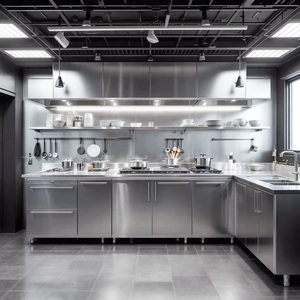
Customized Commercial Restaurant Kitchen Setup Stainless Steel Equipment
- Stamping Press: 500-Ton Hydraulic
- Thickness Tolerance: ±0.03mm
- Application: Commercial Hospitality
- Feature: Seamless Corner Radius
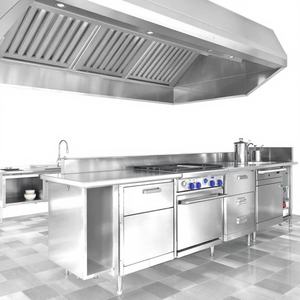
Stainless Steel Professional Commercial Kitchen All-in-One Equipment Set
- Custom Geometry: Multi-stage Draw
- Corrosion Rating: High Salt Spray Standard
- Edge Treatment: Deburred Rim / Bead
- OEM Custom Logo: Laser Engraved
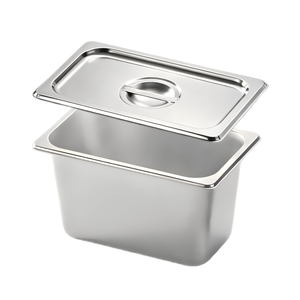
Gastronorm GN Pan 1/4 150mm Stainless Steel Food Container with Lid
- Standard: European EN 631-1 Spec
- Thickness: 0.6mm - 0.8mm Solid Gauge
- Anti-Jamming: Precision Stamped Rims
- Grade: Food-Grade Stainless Steel
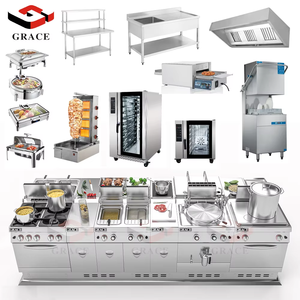
GRACE Commercial Fast Food & Catering Stainless Steel Equipment Set
- Target Market: Industrial Kitchen & Fast Food
- Tooling Method: High-Speed Progressive Die
- Finish: Electropolished Anti-Fingerprint
- Compliance: CE, BSCI Factory Audited
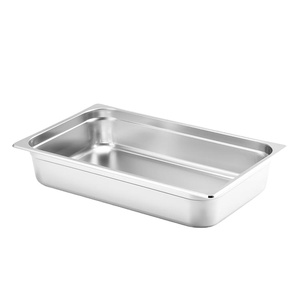
Stainless Steel 1/1 Gastronorm Pan Food Container (AISI 304/201)
- Dimension: 530 x 325 mm Full Size
- Depth Options: 20mm to 200mm
- Strength: Reinforced Rim Corners
- Heat Resistance: Up to 300°C Oven Safe
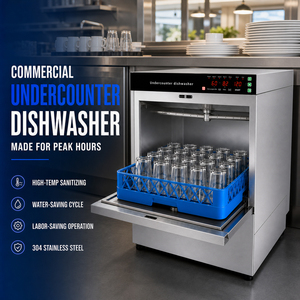
Under-Counter Commercial Dishwasher & Glass Washer Deep Drawn Tank Shell
- Chamber Cavity: Single-Piece Deep Draw
- Weld Integrity: Leak-Proof Hydro Tested
- Thickness: 1.0mm - 1.2mm Heavy Duty
- Sanitation: Round Hygienic Corners
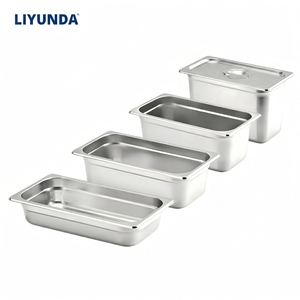
European Standard Stainless Steel GN Pan 1/3 Commercial Gastronorm Container
- Dimensions: 325 x 176 mm
- Cold Forming: Multi-Pass Hydraulic Cushion
- Defect Prevention: Zero Tearing / Wrinkling
- Export Destinations: EU, USA, Middle East
Why Top Global Brands Partner with China's Precision Deep Drawing Leaders
Combining vertical raw material coil processing, specialized die tool engineering, and strict lab-grade quality assurance to power OEM supply chains across North America, Europe, and Asia.
Vertically Integrated Raw Coil Supply
Unlike standard stamping workshops that buy commercial cold-rolled sheets from external distributors, our direct partnership and internal rolling mills handle over 500,000 kg of stainless steel monthly. This gives our engineers full control over grain size orientation, chemical composition purity, and surface smoothness right from metal melting to slitting, guaranteeing zero lot-to-lot mechanical property variation.
In-House Tool & Die Engineering Center
Deep drawing requires delicate calculations of punch nose radii, blank holder forces, and die clearances. Our master tooling department features dedicated CNC machining centers, EDM wire-cutting, and AutoForm finite element FEA simulation software. We design multi-stage progressive dies and deep draw press tools in-house, cutting die development time by 35% while extending tool life beyond 1,000,000 stroke cycles.
International Lab Testing & Certifications
Our manufacturing site operates under strict ISO 9001:2015 Quality Management Protocols. Every export batch undergoes spectrum chemical analysis, micro-hardness testing, Erichsen cupping strain evaluations, and salt-spray corrosion tests. Fully compliant with international export standards including CE, RoHS, REACH, and BSCI social compliance audits.
Metallurgical Fundamentals of Deep Draw Sheet Metal Stamping
An engineering breakdown of stress-strain distributions, draw ratio limitations, blank holder dynamics, and strain hardening prevention in austenitic stainless steel press forming.
1. Limiting Draw Ratio (LDR) & Anisotropy Control
Deep drawing involves converting a flat sheet metal blank into a hollow cylindrical or rectangular cup through plastic deformation without fracturing or localized necking. The primary benchmark of formability is the Limiting Draw Ratio (LDR), defined as the ratio of maximum blank diameter ($D_{max}$) to punch diameter ($d$):
$$LDR = \frac{D_{max}}{d}$$
For standard AISI 304 austenitic stainless steel, the plastic strain ratio (r-value) typically ranges from 1.0 to 1.3, with a strain hardening exponent ($n$-value) exceeding 0.45. To achieve ultra-deep draw depth ratios ($H/D > 2.2$) without wall rupture, our engineers utilize multi-pass progressive deep drawing integrated with intermediate hydrogen-shielded solution annealing at 1,050°C to release work-hardening stresses.
2. Blank Holder Force (BHF) Optimization Mechanics
A main challenge during deep sheet drawing is balancing tangential compressive stresses in the flange region with radial tensile stresses over the punch corner. Insufficient blank holder force results in flange wrinkling due to structural buckling, whereas excess force induces excessive friction, leading to tensile fracture along the bottom wall radius.
Our 800T to 1,200T double-action servo hydraulic presses feature micro-computer controlled hydraulic cushions. By applying a dynamic multi-stage pressure profile—starting high to prevent flange wrinkling and decreasing during mid-stroke as the metal flows into the die cavity—we reduce localized thinning to under 12% across deep drawn shells.
The die corner radius ($R_d$) strongly dictates metal flow resistance. If $R_d$ is too small, high bending stress causes material thinning and tearing. Conversely, if $R_d$ is overly generous, the unguided blank area increases, promoting wrinkle formation. The optimal die shoulder radius is calculated as $R_d = (4 \sim 8) \times t$ (where $t$ is sheet thickness). Die clearance is set precisely to $c = t_{max} + 0.07 \sqrt{10t}$, avoiding excessive ironing while preventing wall bowing in precision hotelware, food containers, and dishwasher sinks.
Future Procurement Trends in Precision Sheet Metal Manufacturing
Strategic analysis for international sourcing directors, OEM buyers, and supply chain executive planners facing carbon regulations, automation shifts, and tight tolerances.
1. Decarbonization & Green Steel Compliance
Global enterprise buyers are under pressure to meet Scope 3 emissions goals. Future OEM contracts prioritize factories using scrap-recycled stainless steel (>75% recycled content) processed in electric arc furnaces (EAF). Additionally, bio-degradable, water-soluble drawing lubricants are replacing traditional chlorinated oils to satisfy EU REACH and zero-VOC discharge mandates.
2. Digital Twin FEA & Rapid Prototyping
Physical tool trials are being replaced by numerical finite element simulation (AutoForm / Pam-Stamp). B2B procurement managers now request virtual forming limit diagrams (FLD) during the design stage to forecast thinning and springback. This approach drops NRE tooling risk to near zero and shortens sample delivery cycles from 45 days down to under 14 days.
3. Automated Optical Sorting & 3D Scanning
Manual caliper inspections are giving way to high-speed 3D structured light optical scanners and machine vision camera lines. Inline blue-light 3D inspection captures total part geometry profiles in seconds, instantly verifying flange flatness, wall thickness, and hole concentricity against CAD models with ±0.01mm accuracy.
4. Specialized Functional PVD Coatings
Modern commercial hotelware and architectural metal components demand enhanced scratch resistance and customized branding. High-speed Physical Vapor Deposition (PVD) titanium vacuum plating allows stainless steel deep-drawn products to sport matte black, rose gold, or anti-fingerprint hydrophobic nano-coatings that endure 100+ industrial dishwashing cycles.
Frequently Asked Questions for Deep Drawing Manufacturing
Direct technical answers addressing engineering challenges, tooling investments, alloy selection, and global shipment parameters for enterprise buyers.
AISI 316: Contains 2-3% Molybdenum, delivering unmatched protection against pitting in high-chloride or marine environments, though it requires ~15% higher press tonnage.
AISI 201: Replaces a portion of Nickel with Manganese; it provides higher yield strength at lower cost, but possesses a higher work-hardening rate, making it best suited for shallow draw depths or cost-sensitive hotelware applications.
Ready to Scale Your Metal Part Production with Precision Tooling?
Whether you require high-volume Gastronorm food pans, commercial kitchen dishwasher cavities, or engineered custom sheet metal deep-drawn shells, our metallurgical team provides complete DFM feedback, FEA simulations, and competitive factory-direct pricing.