
Featured Bulk Stainless Steel Cookware & Commercial Stock Pot Catalog
Explore our factory-direct wholesale inventory engineered for commercial hospitality, food service distributors, and brand owners worldwide.

Technical Whitepaper: Metallurgical Standards & Deep Drawing Engineering in Commercial Stock Pots
A rigorous engineering evaluation for procurement directors, commercial kitchen equipment importers, and OEM brand buyers.
1. Alloy Selection & Corrosion Resistance Mechanics (SUS304 vs. SUS316 vs. 201)
When sourcing china wholesale stainless steel stock pot bulk supplies, understanding the underlying metallurgical structure is paramount to long-term commercial performance. Commercial kitchen stock pots undergo relentless thermal cycles, exposure to acidic food ingredients (such as tomato purée, wine reductions, and vinegar bases), and high-salinity brines. Selecting the correct alloy grade directly influences heat transfer efficiency, structural longevity, and sanitation compliance.
Austenitic SUS304 (18/8 Stainless Steel): The industry benchmark for premium commercial cookware. Containing 18% Chromium and 8% Nickel, SUS304 forms a passive, self-healing Chromium Oxide (Cr₂O₃) surface film. This protective layer prevents oxygen diffusion into the iron matrix, offering exceptional resistance to organic acids and atmospheric oxidation. Its high ductility allows for complex deep drawing without micro-cracking.
Marine-Grade SUS316 (18/10 with Molybdenum): Engineered for extreme culinary environments. The inclusion of 2% to 3% Molybdenum (Mo) significantly boosts resistance to localized pitting corrosion caused by high chloride concentrations (e.g., heavily salted stocks and seafood boiling). SUS316 is favored by fine-dining manufacturers and institutional soup factories operating under strict hygiene standards.
Austenitic 201 Series (Manganese Substitution): Designed for cost-conscious bulk procurement. By replacing a portion of nickel with manganese and nitrogen, 201 alloy offers enhanced tensile strength at a competitive cost. While suitable for dry storage and moderate heating applications, it requires precise surface passivization to ensure performance in acidic simmer environments.
Encapsulated Capsule Bottoms
To resolve the low thermal conductivity of austenitic stainless steel (approx. 15 W/m·K), our factory utilizes impact-bonded 3-ply capsule bottoms. A pure aluminum core (205 W/m·K, 4.0mm to 6.0mm thick) is friction-bonded under 2,500-ton hydraulic pressure between the inner SUS304 wall and a magnetic SUS430 outer disc. This ensures rapid lateral heat distribution, eliminates hotspot scorching, and provides universal induction cooktop compatibility.
Deep Drawing & Strain Hardening
Commercial stock pots require high aspect ratios (depth-to-diameter ratio exceeding 1.2). Our manufacturing facility deploys multi-stage hydraulic deep drawing presses with precision die tooling. By controlling blank holder forces and applying specialized synthetic lubricants, we prevent wall thinning, grain boundary stretching, and rim wrinkling—yielding uniform side-wall thickness across capacities from 10 Liters to 150 Liters.
Ergonomic & Structural Welding
Handles on heavy-duty stock pots bear extreme mechanical loads. We implement high-frequency multi-point spot welding and Argon TIG welding for handle brackets. Solid tubular stainless steel handles are engineered with hollow heat-break zones to keep touch points cool. Every welded joint undergoes non-destructive mechanical pull testing exceeding 350 kg payload capacity.
Global Commercial Cookware Sourcing & Procurement Trends (2025–2030)
Key macro trends shaping B2B purchasing, supply chain diversification, and sustainable manufacturing compliance.
1. Universal Induction Transition
Commercial kitchens globally are transitioning from open-flame gas ranges to high-efficiency induction hobs to comply with zero-emission regulations and reduce HVAC cooling costs. B2B buyers must source stock pots featuring flat, non-warping 3-layer induction bases (SUS430 magnetic exterior) that maintain planarity under intense 5000W thermal cycles.
2. ESG & Non-Toxic Passivation
Environmental guidelines such as EU REACH, FDA food-contact standards, and BSCI social compliance demand complete elimination of toxic chemical polishes and heavy metal residues. Modern B2B sourcing requires electro-polished interiors and chemical-free mechanical buffing processes that guarantee chemical inertness.
3. Custom Private Labeling
Wholesale distributors are expanding private-label brand equity. Factory partners offering in-house laser etching for brand logos, custom box design, barcode integration, and modular volume graduation marks (stamped inside pot walls) provide critical operational advantages for global market expansion.
Manufacturing Enterprise Advantages: Vertical Integration & OEM Scale
Leveraging 19+ years of contract manufacturing expertise to deliver consistent quality and competitive factory-direct pricing.
Vertically Integrated Supply Chain Architecture
Unlike trading companies or outsourced assemblers, our manufacturing infrastructure operates with full vertical integration. Our parent group controls an in-house stainless steel cold-rolling facility with a monthly raw material processing capacity of 500,000 kg. This capability grants us direct control over coil thickness tolerances, surface roughness (2B/BA finish), and metallurgical composition before deep drawing begins.
Our in-house tooling and die-making division houses high-precision CNC spark erosion machines, lathe systems, and dedicated toolmakers with over two decades of die-engineering experience. Whether your procurement specification demands standard Euro-style stock pots, deep-drawn colanders, GN pans, or custom catering kettles, we transition from CAD models to physical prototypes in record turnaround times.
Rigorous In-House Laboratory & Quality Control
Quality assurance is structured across every production stage:
- Spectrometric Material Verification: XRF analyzer testing of raw steel coils to verify exact Chromium, Nickel, and Molybdenum content prior to blanking.
- Hydrostatic Bottom Bonding Audit: Thermal shock testing (heating to 350°C followed by immediate cold water quenching) to ensure zero capsule delamination.
- Salt Spray Corrosion Testing: ASTM B117 salt fog exposure tests ensuring 72+ hours without surface pitting.
- Handle Load Strength Testing: Static strain loads applied to spot-welded and riveted handles exceeding international commercial cookware standards.
Technical Specification & Material Comparison Matrix
Comprehensive engineering benchmark for commercial stock pots and GN container series.
| Series Category | Material Alloy | Wall Thickness Range | Bottom Construction | Heat Source Compatibility | Recommended Application |
|---|---|---|---|---|---|
| Heavy-Duty Commercial Stock Pot | SUS304 (18/8) / SUS316 | 1.0mm - 1.5mm Heavy Gauge | 5.0mm Impact-Bonded 3-Ply Capsule | Induction, Gas, Electric, Radiant, Oven | High-volume soup kitchens, hotel catering, stock reductions |
| Standard Wholesale Stock Pot | SUS201 / SUS304 | 0.7mm - 1.0mm Standard | 3.5mm Encapsulated Aluminum Disc | Gas, Electric, Ceramic Hobs | Commercial restaurants, buffet service, institutional canteens |
| Tri-Ply Clad Stock Pot | 3-Ply (304 Interior + Al + 430 Exterior) | 2.3mm - 3.0mm Full Body Clad | Full-Body Uniform Heat Distribution | Universal Induction & High-Heat Gas | Delicate sauces, simmered stews, premium culinary brands |
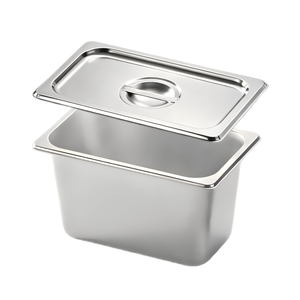
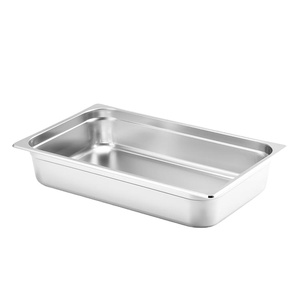
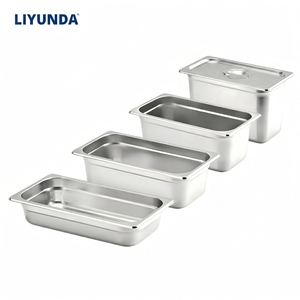
| Gastronorm GN Pan Series | SUS304 / SUS201 Grade | 0.6mm - 0.8mm Formed Sheet | Single Sheet Deep Drawn | Bain-Marie, Steam Tables, Refrigeration | Buffet displays, food prep counters, hot/cold storage |
Frequently Asked Questions (FAQ) for Bulk Procurement
Direct, expert answers to key purchasing, engineering, and logistics inquiries.
For general commercial cookware and high-volume food service, SUS304 (18/8) is highly recommended due to its excellent balance of corrosion resistance, mechanical strength, and cost-effectiveness. For highly acidic cooking environments (e.g., vinegar or high-salinity broths), SUS316 offers enhanced pitting resistance. SUS201 is a cost-effective option for dry food handling, lighter heating applications, or budget-sensitive wholesale markets.
Austenitic stainless steel has a relatively low thermal conductivity coefficient. By applying an high-pressure impact-bonded aluminum disk (4.0mm–6.0mm thick) to the bottom of the pot, heat rapidly spreads laterally across the entire base before moving vertically into the food. This uniform heat distribution eliminates localized hot spots, preventing food scorching and reducing energy consumption.
We offer complete OEM/ODM solutions including laser-etched brand logos, custom dimensional sizing, customized wall thickness, internal stamped capacity graduations (liters/quarts), tailored handle designs (cast stainless steel or heavy tubular spot-welded), and custom retail or master-carton packaging.
For standard catalog products, our baseline MOQ starts at 300 to 500 units per size specification. For custom OEM deep-drawn tooling, MOQs depend on pot dimensions. Standard mass production lead time ranges from 30 to 45 days after sample approval and deposit confirmation, supported by our 500,000 kg monthly raw material processing capacity.
Yes. All our products comply with major global food-contact safety standards, including FDA, EU LFGB, REACH, and RoHS directives. Our factories operate under strict ISO9001 quality management systems and BSCI social compliance standards.
Large stock pots (up to 150L) experience high shear stress when full. We utilize multi-point industrial spot welding reinforced with heavy-duty backing plates or solid rivet joints. Each production batch undergoes mechanical load testing to withstand pulling forces exceeding 350 kg without structural failure or seam leakage.
Each stock pot is packed in an anti-scratch polybag, fitted with reinforced corner foam protectors, and housed in heavy-duty 5-ply or 7-ply corrugated export cartons. Nesting packaging configurations (placing smaller pots inside larger ones) are available to optimize container load factors and reduce sea freight expenses per unit.
Vertical integration eliminates middleman margins and raw material supply bottlenecks. By processing steel coils in-house, we guarantee consistent gauge thickness, precise grain structure for deep drawing, surface finish purity, and stable pricing even during global raw material price fluctuations.
Partner with a Premier China Stainless Steel Stock Pot Manufacturer
Elevate your product portfolio with industrial-grade stock pots, custom OEM deep-drawn components, and reliable factory-direct global supply chain solutions. Contact our engineering team today for pricing, technical specifications, and factory audit inquiries.