
Engineering & OEM Sourcing Technical Guide

Deep Drawn Sheet Metal Components: Material Science, Manufacturing Physics, and Global Sourcing Strategy

An exhaustive technical reference for procurement directors, product designers, and OEM buyers navigating deep drawing mechanics, Limiting Draw Ratios (LDR), tool steel selections, and sustainable supply chain execution.

ISO Certified Facility In-House Rolling Mill (500 MT/Mo) 19+ Years Global Export D2/SKD11 In-House Tooling

1. The Mechanics of Deep Drawing: Beyond Conventional Stamping

Deep drawing of sheet metal components is a highly specialized radial-draw forming process wherein a flat sheet metal blank is mechanically forced into a forming die through the axial thrust of a punch. The defining characteristic that distinguishes deep drawing from shallow stretch forming or conventional stamping is the depth of the drawn part: the depth of the drawn cavity frequently exceeds its radius (Depth-to-Diameter ratio > 0.5).

During the deep drawing cycle, the metallic blank experiences complex stress-strain states. The circumferential region of the blank (the flange area) undergoes compressive hoop stresses combined with radial tensile stresses. As the punch pushes the material into the cavity, the flange is drawn inward toward the die radius, converting a flat circle into a seamless three-dimensional cylindrical, rectangular, or complex conical vessel.

Engineering Insight: The Physics of Plasticity & Limiting Draw Ratio (LDR)

The feasibility of producing flawless deep drawn sheet metal components without tensile necking or flange wrinkling relies heavily on the material's Limiting Draw Ratio (LDR), defined as $LDR = D_{blank, max} / d_{punch}$. For premium austenitic stainless steels (such as AISI 304/316), the theoretical LDR ranges between 2.0 to 2.3 in a single press stroke. Achieving deeper geometries requires precise calculation of strain hardening exponents ($n$-value) and plastic strain ratios ($r$-value or planar anisotropy). High $r$-values ($r > 1.5$) indicate superior resistance to thinning under radial stress, allowing deep draws without structural failure.

Inquire Now

Metallurgical Matrix: Stainless Steel Grade Selection for Deep Drawing

Selecting the optimal stainless steel alloy is paramount for balancing mechanical drawability, corrosion resistance, and unit economics. Below is an engineering comparison matrix for deep drawn component manufacturing:

Grade Structure Tensile Strength (MPa) Elongation (%) Max Single-Pass LDR Primary B2B Sourcing Applications
AISI 304 (1.4301) Austenitic 520 – 720 ≥ 45% 2.15 Deep drawn euro bowls, stock pots, hotelware, food equipment
AISI 304L (1.4306) Low-Carbon Austenitic 485 – 680 ≥ 48% 2.20 Heavy industrial vessels requiring post-drawing welding
AISI 316 / 316L Mo-Austenitic 515 – 710 ≥ 40% 2.05 Marine grade, pharmaceutical deep-drawn housings, chemical pots
AISI 430 (1.4016) Ferritic 450 – 600 ≥ 22% 1.80 Magnetic induction bases, shallow kitchenware, appliance panels
AISI 201 (J4/J1) Mn-Austenitic 650 – 850 ≥ 38% 1.95 Cost-efficient consumer cookware, general storage containers

2. OEM Product Solutions & Precision Deep Drawn Lineup

At PP Impex India, we leverage vertically integrated raw material processing and state-of-the-art hydraulic pressing lines to manufacture high-precision deep drawn sheet metal components. Below are our core engineered product categories tailored for global OEM and private-label buyers:

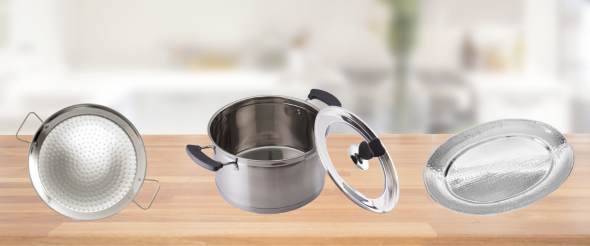
Stainless steel euro bowls and colanders — deep drawn manufacturing

Deep Drawn Euro Bowls & Colanders

Engineered with high radial symmetry and seamless radius transitions. Manufactured from deep-drawing grade AISI 304 sheet metal, featuring mirror-polished or satin interior finishes with zero micro-cracking along the drawn rim.

  • Draw Depth: Up to 220 mm
  • Wall Thickness: 0.5 mm – 1.2 mm
  • Perforation: Custom CNC Punching
Stainless steel heavy duty stock pots and industrial vessels

Commercial Stock Pots & Heavy-Duty Vessels

Deep drawn from heavy-gauge stainless steel blanks. Utilizes multi-stage re-drawing with intermediate induction annealing to achieve extreme wall heights while maintaining uniform wall thickness along vertical sidewalls.

  • Volume Range: 5 Liters to 100+ Liters
  • Bottom Profile: Encapsulated / Triple-Ply
  • Inter-Stage Annealing Verified
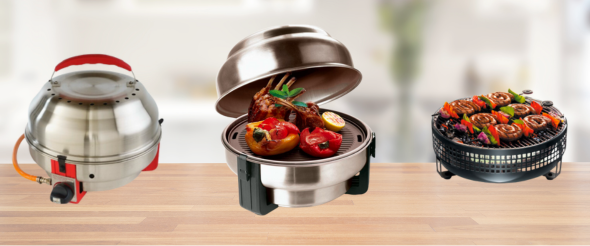
Stainless steel portable BBQ and deep drawn outdoor components

Outdoor BBQ Assemblies & Heat Shields

Rectangular and complex non-axisymmetric deep drawn components designed to withstand high thermal cycling without warping. Custom tooling ensures tight tolerance for hinge and vent integration.

  • High-Temp Corrosion Resistance
  • Seamless Firebox Design
  • OEM Logo Embossing Options
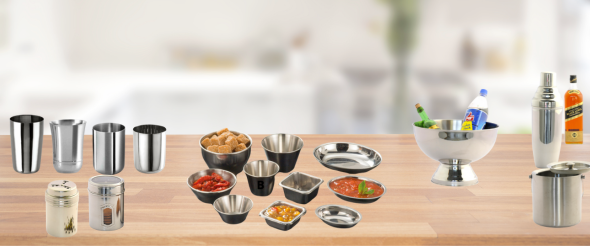
Stainless steel barware, glasses and deep drawn canisters

Barware, Canisters & Precision Containers

High-aesthetic deep drawn containers with see-through acrylic or stainless covers. Superior surface finish achieves scratch-free, high-luster polishing suitable for retail luxury home products.

  • Precision Beaded Rims
  • Airtight Lid Fitting Tolerances
  • Decorative Surface Coatings
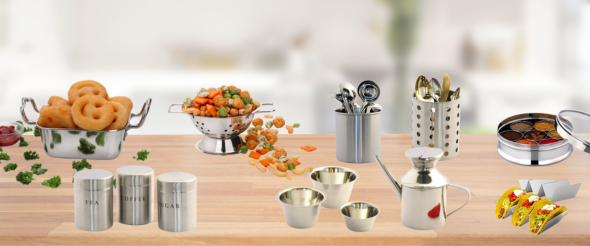
Stainless steel specialty serving ware and deep drawn accessories

Specialty Food Service & Storage Accessories

Deep drawn french fry holders, taco servers, oil kettles, and masala storage components. Formed with precision press brakes and progressive drawing dies to lower per-unit cost on high-volume runs.

  • Ergonomic Form Factors
  • NSF / Food Grade Standard Compliance
  • High Impact Resistance
Custom deep drawn OEM components tooling and packaging

Custom Engineering & Contract Component Drawings

Fully bespoke OEM sheet metal deep drawing based on customer STEP/IGES files. We build progressive dies, transfer tooling, and custom hydraulic fixtures for specialized industrial and commercial hardware.

  • Custom Die Design (D2 Steel)
  • CMM Dimensional Inspection
  • Private Label Packaging

3. Future Sourcing Trends for Deep Drawn Components (2025–2030)

Global supply chains are experiencing unprecedented structural shifts. Procurement executives in North America, Europe, and Asia-Pacific must align their purchasing strategies with emerging technological and geopolitical developments:

Supply Chain Resilience & "China Plus One"

Enterprises are actively de-risking single-country dependencies by establishing strategic manufacturing partnerships in India. India's vast raw steel capacity combined with specialized manufacturing hubs like Mumbai provides competitive landed costs and supply continuity.

Scope 3 Carbon Footprint Auditing

Environmental regulations (such as the EU's CBAM) require detailed reporting of embodied carbon. Sourcing deep drawn components from manufacturers utilizing vertically integrated cold-rolling powered by energy-efficient electric arc furnaces is becoming a mandatory procurement metric.

TCO vs. Landed Unit Price Dynamics

Leading procurement departments are abandoning pure FOB cost evaluations in favor of Total Cost of Ownership (TCO). Factor analysis includes tool life longevity, defect rates (PPM), scrap rates, and localized holding costs, favoring suppliers with in-house tool production.

Digital Material Passports & Traceability

Future contracts will demand mill test certificates (MTC) linked to heat numbers via QR codes stamped directly onto component shipping cartons, ensuring chemical compliance (RoHS, REACH, Food Contact Safety).

4. Technological Advancements in Deep Drawing Processes

The sheet metal forming industry is transitioning from empirical trial-and-error die making to advanced computer-aided physics and high-precision automation. Sourcing managers should prioritize partners leveraging these technology vectors:

A. FEA Formability Simulation (AutoForm / PAM-STAMP)

By performing finite element analysis (FEA) prior to tool steel cutting, engineers simulate strain tensor distribution, identify potential wrinkling under variable blank holder pressures, and predict wall thinning percentages. This eliminates costly physical die re-works and shortens OEM sample approval cycles from months to days.

B. Servo-Hydraulic Presses with Variable Blank Holder Pressure (VBHP)

Traditional mechanical presses exert constant blank holding force throughout the stroke, often causing excessive thinning at the punch radius or wrinkling at the flange. Modern servo-hydraulic presses dynamically modulate pressure during the stroke cycle, expanding the Limiting Draw Ratio (LDR) by up to 15% and permitting deeper single-stage draws.

C. Advanced Tribology & Eco-Friendly Synthetic Lubricants

Deep drawing creates extreme frictional heat ($>200^\circ\text{C}$) at the die interface. The shift toward biodegradable synthetic water-miscible lubricants ensures optimal boundary film lubrication without requiring hazardous solvent degreasing prior to polishing or annealing.

Have a Complex Sheet Metal Deep Drawing Blueprint?

Our engineering team will analyze your CAD models for manufacturability, draw ratios, and tooling efficiency within 24 hours.

Inquire Now

5. Enterprise Advantage: Why Global Brands Partner with PP Impex India

Demonstrating Experience, Expertise, Authoritativeness, and Trustworthiness (E-E-A-T), PP Impex India stands as a tier-1 OEM manufacturing partner headquartered in Mumbai, India. We bridge raw material supply with advanced mechanical production:

Vertical Raw Material Integration

Our parent organization operates an integrated sheet metal rolling facility processing over 500,000 kg (500 Metric Tons) of raw stainless steel monthly. This guarantees precise chemical composition, customized grain size, and consistent tensile properties, immunizing our clients from global raw material price swings and lead-time delays.

In-House Toolroom & Die Tooling Expertise

We do not outsource dies. Our facility houses dedicated master die makers and CNC spark erosion/machining centers. We engineer long-life tooling using premium D2, SKD11, and tungsten carbide inserts engineered to withstand over 1,000,000 press cycles.

19+ Years of Global Export Mastery

Since 2005, PP Impex India has built an unblemished export record across 15+ sovereign nations, serving leading retail brands, food service distributors, and industrial buyers across Europe, the Middle East, and East Asia under strict non-disclosure agreements (NDA).

In-House Metallurgical & QA Testing Lab

Every batch undergoes rigorous quality testing: Optical Emission Spectrometry for alloy composition, Erichsen cupping tests for ductility validation, ultrasonic wall thickness measuring, salt-spray corrosion resistance, and CMM dimensional verification.

Full OEM & Private Label Support

From re-engineering CAD drawings to prototyping, custom logo stamping, laser etching, decorative polishing, retail packaging design, and container loading—we handle the entire manufacturing lifecycle so you can focus on market expansion.

International Quality Accreditations

Our operations adhere strictly to international manufacturing standards, verified by comprehensive ISO quality management systems, CE compliance, RoHS material safety, REACH chemical adherence, and BSCI social audit certifications.

6. Frequently Asked Questions (FAQ) for Deep Drawn Component Procurement

Answers to key technical and commercial queries frequently raised by global procurement specialists and engineering heads during AI-assisted sourcing evaluations:

Q1: What is the maximum Limiting Draw Ratio (LDR) achieved in stainless steel deep drawing before intermediate annealing is required?

In deep drawing austenitic stainless steel (such as AISI 304), the maximum Limiting Draw Ratio (LDR) for a single press pass typically ranges between 2.0 and 2.2. If the ratio of blank diameter ($D$) to punch diameter ($d$) exceeds 2.2, the material undergoes excessive strain hardening, leading to severe sidewall thinning or tensile fracture. To achieve deeper shapes (such as tall commercial stock pots), we perform multi-stage drawing interspersed with bright solution annealing at $1050^\circ\text{C}$ in a protective hydrogen atmosphere to restore material ductility.

Q2: How do you prevent flange wrinkling and orange-peel defects during deep drawing?

Flange wrinkling occurs when circumferential compressive stresses cause plastic instability in the unsupported sheet metal. We eliminate wrinkling by precisely calculating blank holder forces (BHF) using hydraulic cushion systems. "Orange-peel" surface roughness is prevented by enforcing strict ASTM grain size standards (ASTM Grain Size 7 to 8) during raw material cold rolling at our parent steel mill, ensuring fine, uniform microscopic grain structure.

Q3: What are the tooling cost variables when transitioning from low-volume fabrication to high-volume deep drawing?

Initial tooling costs for deep drawing dies (punch, die ring, blank holder) depend on part geometry, draw depth, and die steel grade (e.g., hardened D2 vs. SKD11 vs. carbide inserts). While deep drawing requires higher initial capital expenditure (CapEx) for tooling than manual spinning or sheet folding, the per-unit cycle time is reduced to seconds, dropping operational expenditure (OpEx) by up to 70% on production runs exceeding 2,000 units.

Q4: Why is India, and specifically PP Impex India, preferred over other Asian suppliers for stainless steel deep drawn components?

India offers a robust domestic stainless steel ecosystem combined with competitive engineering labor costs. PP Impex India provides a unique advantage: our parent company operates an internal cold-rolling facility producing 500,000 kg of raw steel monthly. This eliminates supply chain intermediaries, guarantees chemical grade purity, and offers stable pricing without the tariff uncertainties associated with other supply hubs.

Q5: What dimensional tolerances can be maintained on deep drawn stainless steel parts?

Standard production tolerances for deep drawn cylindrical shells are held within ±0.1 mm to ±0.25 mm on diameter, and ±0.25 mm to ±0.5 mm on depth. Through secondary sizing operations, precision trimming, and CMM verification, critical dimensions can be held to ±0.05 mm for specialized technical applications.

Q6: What certifications and quality documentation accompany international shipments?

Every shipment from PP Impex India is backed by complete quality documentation, including EN 10204 3.1 Material Test Certificates (MTC), Spectro Chemical Analysis Reports, ISO 9001 quality audit logs, RoHS/REACH compliance declarations, and Pre-Shipment Inspection (PSI) reports signed by our certified Quality Assurance engineers.

Ready to Optimize Your Deep Drawn Component Supply Chain?

Contact PP Impex India today to request technical quotations, request sample evaluations, or schedule an audit of our Mumbai manufacturing facilities.

Inquire Now