

Advanced Precision Deep Drawing Engineering for Sri Lankan Industrial & Commercial Sectors
The manufacturing landscape of Sri Lanka is undergoing a major structural evolution. Driven by rapid expansion in coastal luxury tourism, food processing modernization, and specialized industrial equipment assembly across Colombo, Galle, Kandy, and Hambantota, the demand for engineered deep-drawn sheet metal components has surged exponentially. Achieving structural stability, high draw-depth ratio, and superior corrosion resistance in tropical maritime climates requires deep metallurgical expertise and rigorous press-tool engineering.
1. Metallurgical Dynamics & Deep Drawing Mechanics
Deep drawing is a radial-draw metal forming process that transforms flat sheet metal blanks into seamless cylindrical, rectangular, or complex contoured vessel shapes through controlled punch displacement into a die cavity. The metal undergoes intense plastic deformation under multi-axial tensile and compressive stresses. In marine-adjacent and high-humidity environments like Sri Lanka, material selection is critical to prevent stress corrosion cracking (SCC) and intergranular degradation.
We specialize in manufacturing precision components utilizing premium austenitic stainless steel grades (AISI 304, AISI 316, and AISI 316L) alongside high-yield structural alloys. For cost-sensitive commercial food display applications, modified low-nickel high-manganese alloys (AISI 201 Cu grade) are precision-formed using specialized lubricants and multi-stage intermediate annealing to maintain optimal ductility and anti-galling performance.
| Stainless Steel Grade | Yield Strength (MPa) | Tensile Strength (MPa) | Max Draw Ratio (LDR) | Recommended Sri Lankan Application |
|---|---|---|---|---|
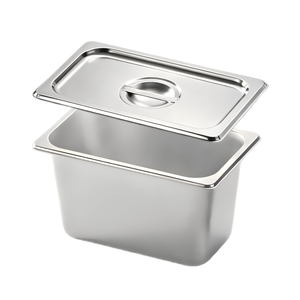
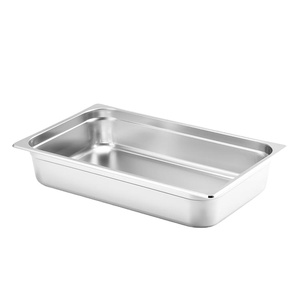
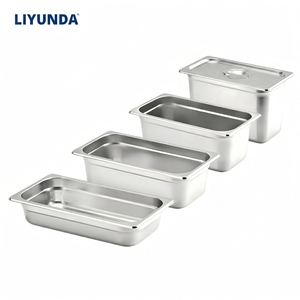
| AISI 304 (1.4301) | ≥ 205 | 515 - 700 | 2.10 - 2.20 | Commercial Gastronorm Pans, Hotel Catering Equipment, Buffet Ware |
| AISI 316L (1.4404) | ≥ 220 | 520 - 720 | 2.15 - 2.25 | Marine Food Equipment, Coastal Hotel Kitchens, Chemical Processing |
| AISI 201 Cu (Low Ni) | ≥ 275 | 650 - 750 | 1.85 - 1.95 | Dry Food Containers, Economy Hotelware, Indoor Storage Canisters |
| Ferritic 430 (1.4016) | ≥ 260 | 450 - 600 | 1.75 - 1.80 | Induction-Compatible Cookware Bases, Outer Enclosures |
2. In-House Tooling Design & Hydraulic Press Capabilities
Our parent manufacturing ecosystem operates fully automated multi-stage hydraulic and mechanical press lines ranging from 60 Tons to 600 Tons pressing force. Tooling geometry, blank holder pressure (BHP), draw bead placement, and punch nose radii are meticulously optimized using finite element simulation (FEA) to eliminate wrinkling, flange puckering, and localized wall thinning.
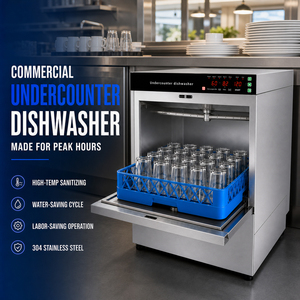
By leveraging an in-house tool room staffed by veteran toolmakers with over 19 years of practical die design experience, we produce progressive dies, transfer dies, and single-action deep drawing tools capable of keeping wall thickness variation within micro-tolerances (±0.05 mm). This level of precision is essential for automated assembly lines in commercial dishwasher production, industrial cup washers, and hermetically sealed food storage systems.
3. Surface Integrity & Tropical Passivation Protocols
The ambient humidity in Sri Lanka, combined with airborne sea salts along coastal resort strips (such as Negombo, Wadduwa, and Bentota), poses severe oxidation risks for standard metalware. Our deep drawn components undergo automated multi-stage degreasing, ultrasonic cleaning, electro-polishing, and chemical nitric-citric passivation. This guarantees an enriched chromium-oxide protective passive layer, yielding zero rust formation even under prolonged exposure to high-salinity ambient air and hot organic food acids.