
Precision Metal Pressing & Commercial Equipment Showcase
Direct OEM manufacturing solutions engineered for high-durability commercial catering, HORECA, and industrial food processing applications across Eurasia.

1. Executive Summary & Market Intelligence: Stainless Steel Metal Pressing Dynamics in Russia
The industrial procurement landscape for stainless steel metal pressing components factories & factory in Russia is undergoing a structural transformation. Driven by national import substitution policies (Импортозамещение), rapid expansion in local commercial catering networks, and localized industrial processing infrastructure, Russian enterprise buyers are actively seeking high-precision OEM metal stamping and deep-drawing manufacturing partners. Key industrial clusters located across Moscow, St. Petersburg, the Urals (Ekaterinburg, Chelyabinsk), and Siberian logistics centers demand robust, cold-resilient, food-grade metal components that strictly comply with Eurasian Economic Union (EAEU) standards and GOST certifications.
Metal pressing—encompassing progressive die stamping, deep drawing, hydraulic forming, and precision edge curling—serves as the backbone for critical products ranging from EN 631 Gastronorm (GN) food containers and commercial kitchenware to heavy-duty equipment enclosures and transport infrastructure components. Achieving competitive advantage in the Russian market requires direct integration with vertically integrated production facilities capable of controlling the manufacturing chain from raw steel sheet coil processing down to sub-micron surface electropolishing.
2. Technical Engineering & Metallurgy: Deep Drawing Mechanics and Alloy Selection
Deep drawing of stainless steel involves complex plastic deformation where a sheet metal blank is radially drawn into a forming die by a mechanical or hydraulic punch. The metallurgical composition of the raw steel dictates limiting draw ratios (LDR), work-hardening coefficients (n-value), and planar anisotropy (r-value).
| Alloy Grade | Chemical Composition | Tensile Strength (MPa) | Sub-Zero Ductility (-40°C) | Primary Russian B2B Application |
|---|---|---|---|---|
| AISI 304 (08Х18Н10) | 18% Cr / 8% Ni | 520 - 720 | Superior (No brittle transition) | HORECA GN pans, medical trays, hotelware, severe cold transport |
| AISI 201 (12Х15Г9Н4) | 15% Cr / 1% Ni / 9% Mn | 650 - 850 | Moderate (High work hardening) | Cost-optimized buffet containers, indoor shelving, dry food storage |
| AISI 316 (10Х17Н13М2) | 16% Cr / 10% Ni / 2% Mo | 580 - 750 | Exceptional (Pitting resistant) | Chemical processing containers, marine catering, high-saline food vats |
| AISI 430 (12Х17) | 17% Cr / Ferritic | 450 - 600 | Fair (Sensitised to impact) | Under-counter dishwasher outer panels, magnetic kitchen backsplashes |
During deep drawing on 100-ton to 800-ton hydraulic presses, the metal undergoes significant strain hardening. High-grade AISI 304 (GOST 08Х18Н10) possesses an austenitic crystal structure that prevents low-temperature embrittlement—a crucial performance attribute for metal pressings operating in extreme Russian climate zones where ambient storage during rail transit across the Trans-Siberian corridor routinely drops to -40°C.
In-House Tooling & Die Making
Equipped with high-precision CNC spark erosion, wire-cut EDM, and master toolmakers capable of engineering multi-stage progressive stamping and deep drawing dies to tight tolerances (±0.05mm).
Vertically Integrated Raw Steel Supply
Direct ownership of cold-rolling sheet processing facilities producing 500,000 kg of raw stainless steel monthly, guaranteeing raw material purity, consistent gauge thickness, and price stability.
Passivation & Surface Passivity
Fully automated electropolishing and citric/nitric acid passivation lines create a uniform Chromium Oxide (Cr₂O₃) layer exceeding SanPiN 2.3/2.4.3590-20 Russian hygienic food-contact safety standards.
3. Russian Regional Application Scenarios for Pressed Stainless Steel Components
The physical geography and industrial breakdown of Russia dictate highly specialized requirements for pressed stainless steel products. Sourcing strategies vary greatly between urban commercial hubs and remote resource-extraction installations:
A. Moscow & St. Petersburg Urban Commercial HORECA Infrastructure
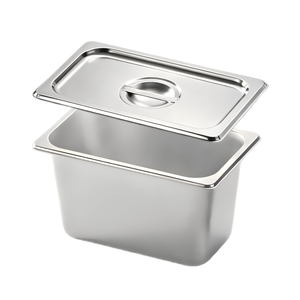
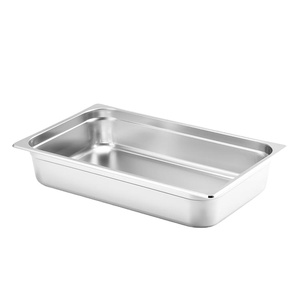
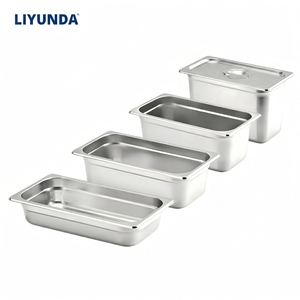
Central Russia accounts for the highest concentration of commercial kitchen rollouts, hospitality expansion, and ghost-kitchen (dark kitchen) platforms. High-density operations demand standardized EN 631 Gastronorm (GN 1/1, GN 1/2, GN 1/3, GN 1/4, GN 1/6) containers with engineered anti-jamming perimeter rims. These rim pressings allow effortless vertical stacking and high-speed retrieval in fast-paced commercial kitchens without vacuum binding.
B. Siberian & Far-Eastern Industrial Mining & Oilfield Catering Camps
In major mining sectors across the Urals, Sakha-Yakutia, and Yamal-Nenets Autonomous Okrug, institutional food service catering feeds thousands of workers in shift camps (Вахтовые посёлки). Equipment deployed in these facilities operates under continuous 24/7 duty cycles. Pressed stainless steel components—such as heavy-gauge deep-drawn stock pots, paella pans, and insulated thermal food transport containers—must feature high structural rigidity to withstand mechanical impacts and thermal cycling between indoor cooking temperatures (+100°C) and unheated ambient storage (-40°C).
C. Russian Railways (RZD) & Mobile Transport Food Logistics
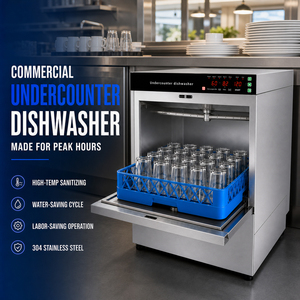
Railway dining cars and containerized mobile field kitchens require lightweight yet structurally resilient stamped metal hardware. Precision-pressed under-counter glass washers, compact drop-in GN basins, and lockable stainless steel storage canisters are engineered to absorb constant micro-vibrations without seam fatigue or weld joint failure.
4. Eurasian Market Dynamics, GOST-R Compliance & Trade Corridors
Procuring stamped stainless steel components for import into the Russian Federation requires navigating technical regulations established by the Eurasian Customs Union (EAC). Technical Regulations TR CU 005/2011 (On Packaging Safety) and GOST 5632-2014 mandate strict chemical composition verification to ensure zero toxic heavy metal leaching into foodstuffs.
Forward-thinking enterprise procurement officers in Russia prioritize direct-from-factory OEM manufacturers over intermediaries to streamline customs valuation, secure direct certificates of origin, and optimize multimodal logistics. Modern trade corridors increasingly utilize direct rail freight via Manzhouli/Zabaikalsk and sea freight lanes connecting major Asian manufacturing ports directly to Vladivostok, Novorossiysk, and St. Petersburg. Direct Ruble-Yuan cross-border payment settlements through major financial institutions further de-risk transactions and eliminate currency conversion friction.
Need Custom Deep-Drawn Components Engineered for Russia?
Upload your STEP/CAD drawings or request a technical consultation with our engineering team for immediate tooling and unit pricing evaluations.
5. Comprehensive B2B Procurement FAQ for Russian Enterprise Buyers
How do imported AISI 304 pressings perform in Russian winter transport?
AISI 304 (08Х18Н10) is an austenitic stainless steel grade with a face-centered cubic (FCC) crystal structure. Unlike ferritic steels, it does not exhibit a ductile-to-brittle transition temperature, maintaining high impact toughness and fracture resistance even at cryogenic temperatures below -100°C.
What is the standard gauge thickness for deep-drawn GN pans?
Standard Gastronorm containers are produced in wall thicknesses ranging from 0.6mm to 0.8mm for standard commercial use, and up to 1.0mm - 1.2mm for heavy-duty institutional pans. Thicker gauge pressings resist bottom bowing under high thermal loads during commercial baking or steam-table heating.
Can tooling be developed directly from CAD / STEP files?
Yes. Our in-house engineering team utilizes SolidWorks and AutoCAD to convert customer CAD models directly into CNC machining pathways for die manufacture. Rapid prototype samples can be produced and delivered for dimensional verification prior to mass production tooling authorization.
What compliance documentation is provided for Eurasian Customs clearance?
Every export shipment includes detailed Mill Test Certificates (MTC) to EN 10204 3.1, chemical spectrographic analysis reports, ISO 9001 quality certificates, Certificate of Origin (Form A / COO), and packing lists fully compliant with Russian customs clearance regulations.
What are the lead times for FCL container shipments to Moscow logistics hubs?
Standard manufacturing lead times for full container loads (FCL 40' HQ) range from 20 to 30 days depending on tooling requirements. Direct express rail freight from factory loading to Moscow terminals typically takes 14 to 18 days, ensuring rapid supply chain replenishment.
How are cross-border payments handled for Russian B2B accounts?
We support direct cross-border trade settlements in RMB (Chinese Yuan) and RUB (Russian Rubles) through non-sanctioned financial institutions and CIPS payment networks, eliminating FX conversion losses and ensuring smooth banking compliance.
What edge treatments are applied to prevent worker injury during handling?
All pressed stainless steel edges undergo automated mechanical deburring and perimeter hem-curling. This creates a smooth, rounded edge profile that enhances structural rigidity while protecting kitchen personnel and washing staff from sharp cut hazards.
How does electropolishing improve hygiene over standard mechanical polishing?
Electropolishing microscopically levels the metal surface by selectively removing surface peaks. This reduces micro-roughness (Ra < 0.2 µm), eliminates microscopic crevices where bacteria can harbor, and significantly improves ease of CIP (Clean-In-Place) sanitation cycles.
6. Quality Control Protocol & Manufacturing Integrity
To ensure zero-defect delivery across 15+ export countries, our manufacturing operations adhere to a 5-stage quality management framework:
- Spectrographic Chemical Analysis: Raw coil stock is tested via optical emission spectrometry to confirm exact Nickel, Chromium, and Molybdenum composition prior to press feeding.
- Dimensional & Gauge Ultrasonic Testing: Automated laser and ultrasonic sensors measure wall thickness variations across deep-drawn corner radii to guarantee structural integrity.
- Salt Spray & Corrosion Testing (ASTM B117): Sample pressings undergo continuous 96-hour neutral salt spray testing to verify passivity layer effectiveness against aggressive pitting.
- Thermal Shock Cycling: Formed components are subjected to rapid thermal transitions from -40°C to +250°C to ensure zero micro-cracking or weld seam delamination.
- Pre-Shipment Container Inspection: Every batch is palletized with moisture-absorbent desiccant packs and wrapped in VCI (Vapor Corrosion Inhibitor) stretch films for trans-continental sea and rail transport.
7. Partnering with PP Impex India: Your Direct OEM Advantage
With over 19 years of contract manufacturing leadership and a dedicated monthly raw material rolling capacity of 500,000 kg, PP Impex India provides Russian enterprise importers, brand owners, and industrial equipment factories with an unmatched combination of scale, precision, and cost efficiency. By combining in-house die making, heavy hydraulic pressing infrastructure, and rigorous lab testing, we deliver custom-engineered metal pressings and commercial kitchenware systems tailored to your exact market requirements.
Request OEM Pricing & Technical Catalog
Connect directly with our engineering sales team to discuss wholesale procurement, OEM private labeling, or custom die development.