

1. Strategic Expansion of the Philippine Foodservice & Hotelware Sector
The Philippine commercial kitchenware market is undergoing a massive transformation. Propelled by rapid urban infrastructure development in Metro Manila, Metro Cebu, and Metro Davao, as well as booming eco-tourism projects across Boracay, Palawan, and Bohol, the demand for high-durability, food-grade commercial kitchenware has hit an all-time high. Philippine hotel chains, Quick Service Restaurant (QSR) conglomerates (such as those operating under major local fast-food ecosystems), and institutional central commissaries require supply chain partners who can deliver consistent metallurgical quality, strict dimensional tolerances, and high-volume output.
As a direct manufacturer with vertical integration, our enterprise bridges the gap between raw sheet rolling mills and finished OEM stainless steel products. Unlike trading intermediaries, we control raw material processing at our parent rolling facility, which processes up to 500,000 kilograms of high-grade stainless steel coils monthly. This structural advantage translates directly into competitive container-load pricing, stable lead times, and custom customization capabilities for Philippine procurement managers and wholesale distributors.
2. Metallurgical Precision for Tropical Maritime Climates (AISI 304 vs 201)
Operating commercial kitchen equipment in an archipelagic environment like the Philippines introduces severe environmental stress. High ambient humidity, airborne salinity in coastal resorts, and exposure to acidic food ingredients (such as vinegar-heavy Filipino adobo preparations and citrus-based marinades) quickly degrade sub-standard sheet metal. Understanding the material science behind stainless steel grades is essential for long-term ROI:
| Performance Metric | AISI 304 Stainless Steel (18/8) | AISI 201 Stainless Steel | Commercial Impact in Philippines |
|---|---|---|---|
| Chemical Composition | 18% Cr / 8% Ni (High Nickel) | 16-18% Cr / 0.5-1.5% Ni (High Manganese) | Nickel content dictates passivation stability in high-salt environments. |
| Pitting Corrosion Resistance | Superior (PREN ~18-20) | Moderate (PREN ~10-12) | 304 resists pitting in humid coastal resorts (Boracay, Palawan). |
| Thermal Shock Performance | Extreme (-40°C to 800°C) | Standard (Up to 300°C) | 304 handles rapid shifts from walk-in freezers to high-heat steam tables. |
| Primary Application | Heavy Cookware, Gastronorm Pans, Outdoor Grills | Dry Storage Containers, Trays, Economy Hotelware | Optimizes cost vs longevity based on specific kitchen zone exposure. |
Our manufacturing lines utilize state-of-the-art Spectrometric Material Verification to guarantee that every batch of steel meets international ASTM and EN standards. For Philippine buyers, we offer tailored material selection: 18/8 AISI 304 for wet-kitchen and high-salinity coastal applications, and engineered AISI 201 for dry storage and cost-effective food display pans.
3. Advanced Deep-Drawing Tooling & In-House Manufacturing Strength
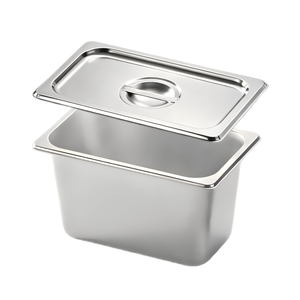
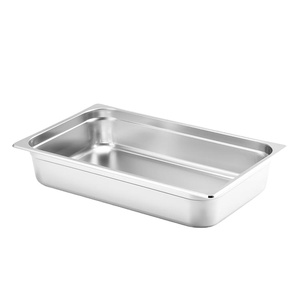
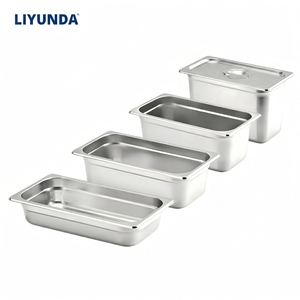
The core of modern kitchenware OEM manufacturing lies in deep-drawing technology. Products such as Gastronorm (GN) pans, stock pots, Euro bowls, and rice washing containers require precise hydraulic press controls to prevent thinning along corner radiuses and structural micro-cracking.
- In-House Tooling & Die Making: Our facility features a dedicated die-making workshop staffed by senior metallurgical tooling engineers. We design, machine, and maintain custom press dies for seamless client-specific shapes within 15–20 days.
- Hydraulic Deep Drawing Presses: Utilizing multi-stage hydraulic press systems ranging from 100 to 800 tons, we produce drawn components with uniform wall thickness and anti-jamming edge geometries.
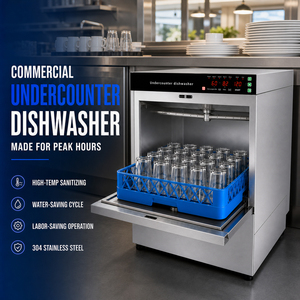
- Electrolytic Polishing & Surface Finishing: Every GN pan and serving vessel undergoes automated electrolytic deburring and satin brushing. This creates a hydrophobic surface finish (low roughness Ra value) that prevents bacterial buildup and facilitates rapid commercial dishwasher cycles.
- In-House Salt-Spray & Stress Testing: Our ISO-certified laboratory executes continuous 48-hour ASTM B117 salt-spray tests and mechanical drop-impact evaluations to ensure zero failure during trans-oceanic shipping and heavy kitchen use.