
Metallurgical Foundations of Commercial Stainless Steel Cutlery Holders
Understanding raw material composition, corrosion resistance profiles, and cold-working response in deep-drawn cutlery organizer manufacturing.
In high-intensity commercial foodservice, hospitality, and modern residential kitchen environments, a stainless steel cutlery holder serves as far more than a basic storage container. It represents an essential hygienic interface subject to continuous moisture exposure, aggressive organic acids, high-temperature commercial dishwashing detergents, and mechanical impacts from heavy flatware. For global B2B procurement directors, sourcing agents, and private label brand owners, selecting the correct structural design and alloy specification directly influences product lifecycle, brand reputation, and profit margins.
At PP Impex India, our engineering processes leverage over 19 years of dedicated manufacturing experience. Supported by our parent entity’s integrated cold-rolling mill—which processes 500,000 kg (500 metric tons) of raw stainless steel sheet monthly—we exercise absolute control over raw sheet thickness tolerances, grain orientation, tensile strength, and surface passivation. This vertical integration allows us to solve complex manufacturing challenges such as wall thinning during deep drawing, stress corrosion cracking, and edge burr removal in high-density perforated cutlery cylinders.
Grade Selection: Chemical Composition & Performance Trade-Offs
Selecting the optimal stainless steel alloy determines whether a cutlery holder can withstand acidic environments and automated chemical sanitization without pitting or flash rusting. Below is a comparative metallurgical matrix detailing the standard stainless steel grades utilized in our OEM production facility:
| Stainless Steel Grade | Chromium (Cr %) | Nickel (Ni %) | Manganese (Mn %) | Corrosion Resistance | Ideal Application Profile |
|---|---|---|---|---|---|
| AISI 304 (18/8 Standard) | 18.0 - 20.0% | 8.0 - 10.5% | ≤ 2.0% | Exceptional (Pitting resistant) | High-end HoReCa, commercial dishwashing racks, premium retail lines. |
| AISI 316 (Marine/Medical) | 16.0 - 18.0% | 10.0 - 14.0% | ≤ 2.0% | Superior (2% Mo added for chloride resistance) | Coastal resorts, industrial marine catering, specialized sanitization units. |
| AISI 201 (High-Mn Austenitic) | 14.0 - 16.5% | 1.0 - 3.5% | 8.5 - 10.5% | Moderate (Cost-optimized indoor use) | Budget retail catalog lines, dry cutlery storage, fast-turnaround consumer goods. |
| AISI 430 (Ferritic Stainless) | 16.0 - 18.0% | ≤ 0.75% | ≤ 1.0% | Standard (Magnetic properties) | Magnetic countertop organizers, dry-environment display racks. |
Deep Drawing & Perforation Mechanics: Producing a seamless stainless steel cutlery holder requires progressive deep drawing stamping presses. Raw coil is blanked into circular disks, then hydraulic press rams draw the steel into deep cylindrical or rectangular shapes. For perforated variants, high-speed CNC punching presses stamp uniform drainage patterns across the sheet prior to drawing or via post-draw rotary piercing. Proper clearance maintenance during piercing is critical to eliminate micro-burrs that could trap food particles, harbor bacterial biofilms, or tear washing gloves.
Commercial-Grade Stainless Steel Cutlery Holder Product Categories
Explore our precision-engineered OEM product lines manufactured for global distributors, catalog houses, and hospitality supply brands.
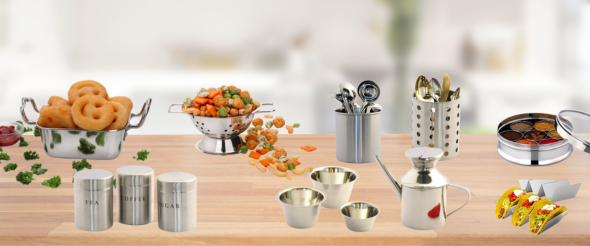
Deep-Drawn Perforated Cylinders
The industry standard for commercial dishwashing stations and buffet counter drop-ins. Features a rolled safety rim, uniform circular or slotted perforation pattern, and reinforced base concavity for optimal water evacuation.
- Material: AISI 304 / 201
- Height Range: 130mm – 180mm
- Base Diameter: 90mm – 120mm
- Finish: Electro-polished / Satin
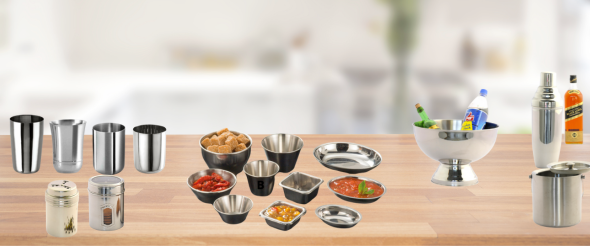
Multi-Compartment Restaurant Caddies
Designed for table service, fast-casual dining, and commercial kitchens. Combines 3 to 6 interior dividers with heavy-gauge carry handles. Offers segregated storage for forks, knives, spoons, and condiments.
- Compartments: 3, 4, or 6 Slots
- Handle: Integrated Wire / Die-Cast
- Wall Thickness: 0.6mm – 0.9mm
- Custom Logo: Laser Etched / Embossed
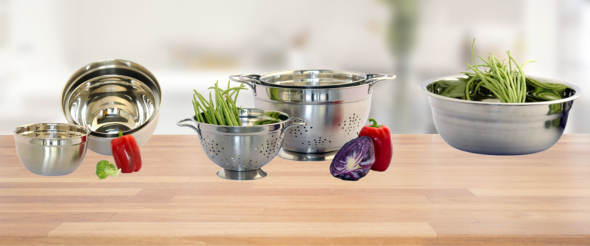
Heavy-Duty Wire Mesh Utensil Holders
Constructed using high-tensile stainless steel wire frames and electro-welded wire mesh. Engineered for maximum airflow, accelerating drying times in high-volume banquet halls and commercial dish pits.
- Wire Gauge: 2.5mm Outer / 1.2mm Mesh
- Structure: Fully Welded Frame
- Feet: Non-Slip Rubber / SS Knobs
- Dishwasher Safe: 100% Thermal Proof
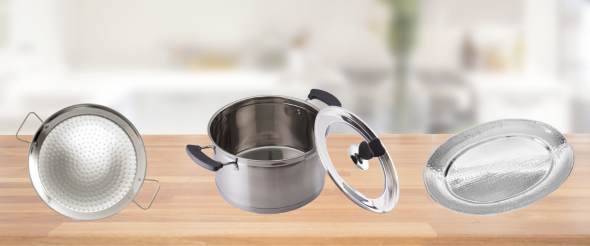
Rotating Carousel Countertop Organizers
360-degree ball-bearing rotating bases holding multiple cylindrical cutlery inserts. Ideal for luxury hotel breakfast buffets, executive lounges, and high-end residential kitchenware catalog collections.
- Base Mechanism: Encapsulated Ball-Bearing
- Capacity: 4 to 6 Cylinders
- Finish: Brushed Matte / PVD Gold
- Stability: Weighted Anti-Tip Base
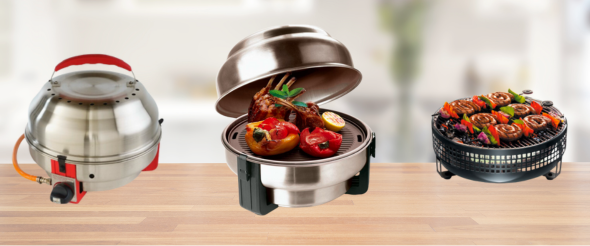
Outdoor BBQ & Grill Cutlery Caddies
Rugged cutlery and tool holders built specifically for outdoor kitchen environments, patio dining, and BBQ accessories brands. Resistant to humidity, weather fluctuations, and airborne grease.
- Secondary Feature: Paper Towel Bar Attachment
- Corrosion Grade: AISI 304 High-Passivated
- Mounting: Counter Free-Standing / Rail
- OEM Branding: Private Label Color Box
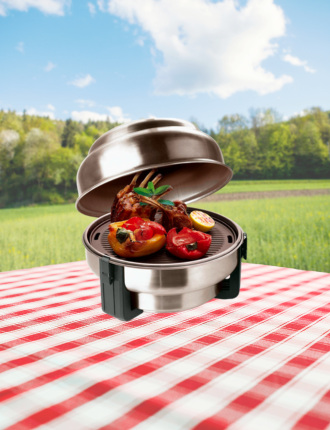
Custom Private Label OEM Designs
Tailor-made geometry, proprietary hole laser-cut patterns, unique silhouette shapes, and integrated branded packaging engineered according to technical buyer drawings and CAD specifications.
- Tooling Facility: In-House Die Shop
- Prototyping: Rapid 3D & Sample Tooling
- Certifications: FDA, LFGB, REACH, RoHS
- MOQ: Flexible Container Loads
Procurement Trends & Future Outlook for Stainless Steel Cutlery Holders (2025–2030)
How evolving hygiene regulations, eco-conscious material mandates, and automation in commercial kitchens are reshaping cutlery holder engineering.
Global trade dynamics and regulatory frameworks surrounding food-contact materials are undergoing significant shifts. Commercial buyers who anticipate these changes can protect their supply chains against disruption, quality claims, and compliance penalties. Below are key macro trends shaping the global manufacturing and procurement of the stainless steel cutlery holder sector over the coming decade:
1. Transition from Single-Use Plastics to 100% Recyclable Circular Stainless Steel
Stringent European Union directives on single-use plastics and sustainable packaging (such as the EU Packaging and Packaging Waste Regulation - PPWR) are accelerating the replacement of plastic utensil trays with stainless steel alternatives across commercial catering and QSR (Quick Service Restaurant) chains. Stainless steel is 100% recyclable without quality degradation. Procurement directors are increasingly favoring suppliers like PP Impex India who utilize ethically sourced raw coils with documented recycled scrap content percentages.
2. Advanced Electropolishing & Hydrophobic Surface Passivation
Standard mechanical polishing leaves microscopic surface fissures where water droplets cling and limescale deposits form. The market is rapidly shifting toward high-grade electropolished stainless steel cutlery holders. Electropolishing chemically removes iron particles from the outer surface layers, creating a chromium-rich passive layer (Cr₂O₃) that repels moisture, reduces drying time by up to 40%, and significantly decreases bacterial adhesion (such as E. coli and Salmonella) in commercial sanitization cycles.
3. Modular & Nestable Design Engineering for Shipping Freight Optimization
Given volatility in global maritime container rates, volumetric efficiency is a core engineering priority. Traditional cylindrical cutlery holders consume vast shipping volumes when packaged loosely. Future procurement specs demand tapered, nestable geometries that allow cutlery holders to stack compactly inside one another without binding. PP Impex India's CAD design team optimizes taper angles to maximize container load factors by up to 35%, dramatically reducing landed unit shipping costs for overseas buyers.
4. Integration with Automated Commercial Conveyor Dishwashers
As modern hospitality enterprises transition to automated rackless conveyor dishwashers and robotic cutlery sorters, cutlery holders must feature standardized exterior dimensions and reinforced perimeter beads. Precision geometry prevents caddies from jamming in automated transport tracks, while high open-area perforation ratios ensure full 360-degree wash spray penetration and rapid thermal drying under infrared hot-air blowers.
5. Supply Chain Diversification: The "India OEM Advantage"
Global procurement teams seeking to mitigate supply chain risks and tariff uncertainties are expanding their OEM manufacturing partnerships in India. With mature metallurgical infrastructure, competitive labor costs, raw sheet self-sufficiency, and favorable bilateral trade agreements, Indian manufacturers like PP Impex India provide a stable, scalable alternative for international catalog distributors.
Vertically Integrated Manufacturing & OEM Expertise
Founded in 2005 in Mumbai, India, PP Impex India has built a global reputation as an ISO-certified manufacturer and exporter of stainless steel kitchenware, houseware, hotelware, and custom deep-drawn metal components. Our operational scale and technical capabilities provide distinct commercial advantages to our global procurement partners:
- In-House Sheet Rolling Integration: Our parent enterprise operates its own stainless steel rolling plant, converting raw ingots into premium sheets with a monthly output of 500,000 kg. This provides total raw material traceability, cost stability, and guaranteed chemical grade consistency.
- Dedicated Tool & Die Shop: We design, machine, and maintain complex stamping tools and deep-drawing dies in-house, drastically shortening prototyping timelines for custom cutlery holder designs.
- In-House Metallurgical & QA Lab: Every production heat undergoes spectrographic alloy analysis, salt spray corrosion testing (ASTM B117), dimension verification, and edge burr inspection prior to assembly.
- 19+ Years Global Export Experience: Exporting to over 15 countries across Europe, North America, the Middle East, and East Asia with complete export documentation, container loading supervision, and NDA protection.

Frequently Asked Questions by Global OEM Buyers & Importers
Technical insights addressing common procurement, manufacturing, compliance, and logistical inquiries regarding stainless steel cutlery holders.
Which stainless steel grade (AISI 201, 304, or 316) is recommended for commercial cutlery holders?
For standard commercial dishwashing environments, high-end hospitality caterers, and food contact applications, AISI 304 (18/8 stainless steel) is the optimal industry choice. It offers superior resistance against atmospheric corrosion, organic food acids, and harsh alkaline dishwashing detergents. AISI 201 is suitable for dry cutlery display caddies or cost-sensitive retail promotions, but may experience surface oxidation if left immersed in water or high-salinity solutions over prolonged periods. AISI 316 is recommended specifically for marine vessels, coastal outdoor dining, or medical sterilizing trays.
How does deep drawing manufacturing ensure wall thickness consistency in cutlery caddies?
During deep drawing, raw metal sheets are subjected to high tensile stress as they enter the die cavity. Without precise press control, stretching can cause severe wall thinning near the bottom radius. PP Impex India utilizes multi-stage hydraulic drawing presses with blank-holder pressure controls and custom-formulated drawing lubricants. This engineering control maintains uniform wall thickness (e.g., maintaining 0.6mm thickness from rim to base within a ±0.03mm tolerance), ensuring structural resistance against crushing or denting.
What surface finishing options prevent rusting and water staining in commercial dishwashers?
We offer electropolishing, satin mechanical brushing, high-mirror polishing, and PVD titanium vapor coating. For commercial dishwasher compatibility, electropolishing is highly recommended. It creates an ultra-smooth finish that removes surface iron inclusions and creates a thick, chromium oxide passive film. This prevents water spots, lime build-up, and chemical staining under repeated 85°C sanitizing wash cycles.
How do perforation design and hole density ratios impact structural strength and drainage efficiency?
Perforation ratios balance open surface area for drainage against the flexural rigidity of the metal cylinder. A perforation open-area ratio of 35% to 45% (typically 3mm to 5mm diameter staggered holes) provides rapid water drainage and airflow while retaining structural column strength. If hole density is too high, structural integrity under heavy utensil loads is compromised; if too low, trapped moisture leads to slow drying times and potential water spots.
What customization options exist for OEM branding and private label cutlery holders?
We provide full turnkey OEM/ODM customization services: custom geometric shapes, proprietary laser-cut hole patterns, fiber laser logo etching, mechanical deep-stamped branding, color PVD coatings (Gold, Rose Gold, Matte Black, Rainbow), and custom retail packaging (color display boxes, inner polybags with barcodes, master shipping cartons compliant with Amazon FBA or distribution center drop tests).
What are the Minimum Order Quantities (MOQ) and production lead times for custom orders?
For standard catalog models, our MOQ starts at 1,000 units per item. For custom OEM designs requiring new die tooling, MOQ is typically 2,000 to 5,000 units depending on size and material grade. Prototype sample lead time is 10 to 14 days, tooling fabrication takes 21 to 30 days, and full container-load production is completed within 30 to 45 days after sample approval.
How does sourcing cutlery holders from India compare with other sourcing destinations regarding tariffs and reliability?
Sourcing from PP Impex India offers key strategic advantages: zero anti-dumping duties in many Western nations, favorable trade tariffs, direct access to domestically produced raw material coils, and strong intellectual property protection under Indian contract law. Furthermore, our Mumbai location provides close proximity to major deep-water ports (Nhava Sheva / JNPT), ensuring reliable container shipment schedules.
What quality control protocols are applied to verify cutlery holders prior to global export?
Our quality assurance workflow follows a strict 4-stage inspection model: (1) Raw material coil chemical spectro-analysis; (2) In-line press dimensional check and deburring verification; (3) 48-hour salt spray corrosion testing (ASTM B117) and passivated surface verification; (4) Final AQL 2.5/4.0 pre-shipment visual, weight, and drop-test packaging inspections.
How does PP Impex India resolve burrs on internal drainage holes to prevent user injuries?
Burrs are eliminated using multi-stage automated deburring processes. After perforation punching, cutlery holders undergo rotary mechanical deburring, ceramic media vibratory tumbling, and thermal deburring where necessary. This guarantees that all perforated edges—both internal and external—are completely smooth to the touch, eliminating glove tears and user injury during handling.
Are PP Impex India stainless steel cutlery holders certified for global food contact compliance?
Yes. Our stainless steel cutlery holders comply with international food contact material regulations including US FDA guidelines, European Union REACH (EC 1907/2006), LFGB (Germany), and RoHS directives. Certificates of compliance and independent lab test reports are provided with commercial shipping documentation.
Verified International Standards
Manufacturing Certifications & Quality Compliance
 ISO Certified
 CE Compliant
 RoHS
RoHS
 REACH
REACH
Ready to Accelerate Your Stainless Steel Cutlery Holder Sourcing?
Contact our OEM engineering team today to request complete product catalogs, factory audit reports, technical CAD drawings, and wholesale volume pricing schedules.