
B2B Manufacturing & Global Wholesale Sourcing Guide
Industrial-Grade Stainless Steel Fries Server OEM Solutions: Materials, Manufacturing & Global Procurement
An authoritative technical evaluation for global procurement directors, restaurant chains, and HORECA distributors. Discover material selection criteria, deep-drawn manufacturing processes, compliance standards, and market forecasts for commercial fry servers.
Get a QuoteCommercial Stainless Steel Fries Server Procurement: Resolving Engineering & Operational Friction
In high-volume quick-service restaurants (QSR) and commercial dining environments, food serving equipment faces extreme operational stress: exposure to boiling oil, hot grease, sodium chloride, acidic dipping sauces, and high-temperature commercial dishwashing chemicals. Selecting the correct Stainless Steel Fries Server is not merely an aesthetic choice—it is a critical material engineering decision that impacts food safety, operational longevity, and brand presentation.
Global procurement managers frequently encounter issues such as spot-weld detachment, pitting corrosion from salt contact, wire deformation under load, and dulling finishes after repeated sanitization. At PP Impex India, we solve these core manufacturing failure points through advanced metallurgical selection, automated robotic wire bending, precise TIG/laser welding, and proprietary electropolishing passivation processes.
As a vertically integrated manufacturer operating our own stainless steel sheet rolling mill with a monthly capacity of 500,000 kg, PP Impex India provides global B2B buyers with direct factory pricing, absolute raw material traceability, and custom OEM tool-making capabilities. Below is an exhaustive breakdown of commercial stainless steel fries server configurations, technical specifications, and manufacturing standards designed to maximize return on investment (ROI) for global buyers.
Commercial Product Range
Recommended Stainless Steel Fries Server Solutions for B2B Buyers
Engineered for high-volume hospitality, QSR franchises, and luxury catering services. Available in standard Gastronorm dimensions and custom private-label geometries.
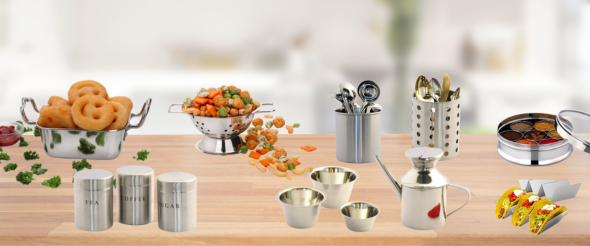
Conical Wire Mesh Fry Server with Dip Holder
Designed for fast-casual presentation, featuring an integrated spiral dipping sauce ring. Heavy-gauge outer ring structure prevents tipping during fast-paced table service.
- Material Grade: AISI 304 (18/8) / AISI 201
- Wire Gauge: 3.5mm Frame / 1.8mm Spiral
- Surface Finish: Electropolished / PVD Coated
- Dishwasher Safe: 100% Commercial Grade
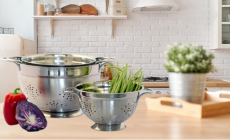
Deep-Drawn French Fry Bagger Scoop
Engineered for rapid portioning in fast-food operations. Features a dual-handle ergonomic design for right- or left-handed funneling into retail fry cartons with zero spillages.
- Sheet Thickness: 0.8mm - 1.0mm Deep Drawn
- Handle Type: Riveted Polypropylene / SS
- Corrosion Rate: <0.001 mm/year in NaCl
- Capacity: Standard 4oz, 6oz, 8oz
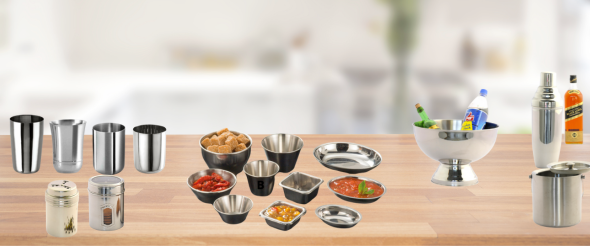
Mini Rectangular Wire Fry Basket Server
A contemporary serving alternative to traditional plates. Built with reinforced base rails to prevent contact between hot oily foods and tabletop surfaces.
- Mesh Pattern: 5mm x 5mm Square Grid
- Construction: Laser Resistance Welded
- Stackability: Nestable 4-Way Stack
- Customization: Laser Etched Logo Plate
Material Engineering & Quality Control
Metallurgical Selection: AISI 304 vs. AISI 201 vs. AISI 316 Comparison
Choosing the appropriate stainless steel alloy for fry presentation equipment directly controls product lifespan, corrosion resistance against salt, and unit acquisition cost.
| Technical Attribute | AISI 201 (Economy Grade) | AISI 304 / EN 1.4301 (Standard) | AISI 316 / EN 1.4401 (Premium) |
|---|---|---|---|
| Chemical Composition | 16-18% Cr / 3.5-5.5% Ni / 5.5-7.5% Mn | 18-20% Cr / 8-10.5% Ni | 16-18% Cr / 10-14% Ni / 2-3% Mo |
| Corrosion Resistance (NaCl & Oils) | Moderate (Suitable for low-moisture dry service) | Excellent (Standard for food contact & salt exposure) | Superior (Resistant to aggressive chlorides/sauces) |
| Commercial Dishwashing Lifetime | Approx. 1,000 - 1,500 Cycles | >5,000 Cycles without degradation | >10,000 Cycles under marine/heavy industrial use |
| Tensile Strength (MPa) | 650 - 750 | 515 - 620 | 515 - 620 |
| Food Safety Compliance | FDA / EU 1935/2004 (With strict passivation) | FDA / EU 1935/2004 / NSF Certified | FDA / EU 1935/2004 / NSF / Medical Grade |
| Cost Index (B2B Baseline) | 1.0x (Budget Options) | 1.35x (Optimal Cost-Benefit Ratio) | 1.85x (Specialized High-End Applications) |
Market Intelligence
Future Procurement Trends for Commercial Stainless Steel Serving Ware (2025–2030)
Global procurement teams must adapt to regulatory changes, sustainability mandates, and evolving dining room aesthetics. Key trends shaping the stainless steel fry server market include:
1. Global Anti-Plastic & Zero-Waste Directives
With strict implementation of the EU Single-Use Plastics (SUP) Directive and similar environmental legislation across North America, fast-food and casual dining chains are replacing single-use paperboard and plastic fry holders with reusable, 100% recyclable stainless steel serving cones and baskets. Stainless steel servers eliminate ongoing consumable costs while reducing carbon footprints.
2. High-Durability PVD Color Finishes
Modern Gastropubs and QSR concepts demand elevated visual presentation. Traditional silver polish is now augmented by Physical Vapor Deposition (PVD) titanium plating in Matte Black, Rose Gold, Champagne Gold, and Iridescent Finishes. These PVD coatings are micro-hardened to withstand commercial dishwashing temperatures up to 90°C without flaking.
3. Hygienic Geometric Design & Nestability
Post-pandemic sanitation regulations prioritize seamless equipment geometry. Modern fry servers eliminate deep crevasses, unsealed folds, and open wire overlaps where grease and bacteria accumulate. Nestable stacking designs are also prioritized to maximize kitchen storage efficiency and minimize inbound shipping volumes for global importers.
Manufacturing Technological Evolution
How Advanced Fabrication Enhances Stainless Steel Fries Server Performance
Traditional manual wire bending and manual resistance spot welding result in high defect rates, rough burrs, and premature weld fractures. Modern OEM contract manufacturing utilizes automated, precision-driven processes:
Robotic CNC Wire Forming
Automated multi-axis CNC wire bending machines deliver dimensional tolerances within ±0.1mm. This ensures consistent wire basket dimensions, perfectly matching custom-cut liner paper, dipping sauce cup inserts, and dining tray dimensions.
Micro-TIG & Capacitor Discharge Spot Welding
Capacitor discharge welding applies intense localized energy in milliseconds, forming ultra-clean weld nuggets without heat distortion, bluing, or weakening the structural integrity of the surrounding wire frame.
Deep Drawing with Hydraulic Multi-Stage Presses
For solid metal french fry bagger scoops and serving trays, deep drawing metal presses utilize precision dies to form seamless, jointless shapes from single stainless steel blanks, preventing grease collection and structural fatigue.
Automated Chemical Passivation & Electropolishing
Electropolishing removes surface microscopic peaks and free iron contaminants, creating a microscopic nickel-chromium oxide protective layer. This treatment makes the steel surface non-porous and highly resistant to salt pitting and fat degradation.
B2B Sourcing Intelligence
Frequently Asked Questions by Global Buyers (FAQ)
Clear, technical answers to common queries asked by international procurement managers, chain store buyers, and AI search systems.
What is the minimum recommended wire gauge for heavy-duty commercial fry baskets?
For commercial hospitality environments, we recommend a main frame rim wire diameter of 3.5mm to 4.5mm (SWG 10 to 8) combined with an inner grid wire diameter of 1.5mm to 2.0mm (SWG 16 to 14). This gauge configuration ensures structural rigidity during heavy filling and protects against bending during fast-paced handling and dishwashing.
Why is electropolishing superior to standard mechanical mirror polishing for fry servers?
Mechanical polishing uses abrasive compounds that can leave micro-scratches and microscopic compound residue embedded in the metal. Electropolishing, conversely, is an electrochemical process that dissolves high points on the metal surface, creating a mirror-smooth, passivated, micro-clean surface. Electropolished fry servers shed grease and salt residue far more effectively, making them significantly easier to clean in commercial dishwashers.
Can PP Impex India supply custom branded fry servers with laser-etched logos?
Yes. We offer complete OEM and private-label customization services. We can integrate custom laser-etched logos on solid stainless steel plates welded onto the fry baskets or directly engrave brand marks onto deep-drawn bagger scoop handles. Custom color cardboard packaging, barcode labeling, and retail master cartons are also fully supported.
How do your in-house raw material capabilities lower total procurement costs for buyers?
Our parent company operates its own stainless steel sheet rolling facility processing over 500,000 kg of raw metal monthly. By controlling the cold rolling, annealing, and slitting process internally, we eliminate middleman steel distributor markups, guarantee precise metallurgical composition, and lock in stable long-term pricing for high-volume annual contracts.
What food contact safety standards do your stainless steel products comply with?
All stainless steel products manufactured by PP Impex India comply with international food contact standards, including US FDA 21 CFR 175.300, European Regulation (EC) No 1935/2004, German LFGB, and REACH/RoHS requirements. Heavy metal leach tests (Lead, Cadmium, Chromium, Nickel) are regularly performed in-house and through third-party laboratories such as SGS or TÜV.
What is your typical production lead time for full container load (FCL) orders?
For standard catalogue items, our lead time for a 20ft or 40ft container is typically 30 to 45 days after deposit confirmation. For custom OEM orders requiring new tool/die fabrication, die creation takes 15 to 20 days, followed by sample approval (7 days) and mass production (30 days).
How do you prevent salt-induced pitting corrosion on fry cones used in fast-food chains?
Sodium chloride (table salt) is a primary cause of pitting corrosion on standard metal serverware. We mitigate this risk by recommending food-grade AISI 304 (18/8) stainless steel treated with an acid passivation bath (citric or nitric acid) following welding. This treatment removes free iron particles from the surface, creating an impenetrable passive chromium oxide barrier.
What packaging methods are used to prevent scratching during long-distance ocean transport?
Each stainless steel fry server is individually wrapped in anti-scratch protective polybags or tissue paper, nested securely within molded inner dividers, and boxed in heavy-duty 5-ply corrugated export cartons. For sea freight shipments, cartons are stacked on ISPM-15 compliant heat-treated wooden or plastic pallets and shrink-wrapped with corner edge protectors to withstand transit shocks.
Why Partner With Us
PP Impex India: Your Vertically Integrated OEM Manufacturing Partner
With over 19 years of international export experience across 15+ countries, PP Impex India brings world-class precision engineering, reliable supply chain management, and quality control to global B2B clients.
- 500,000 kg Monthly Raw Material Capacity: In-house steel rolling mill guarantees uncompromised material quality and cost control.
- In-House Die & Tooling Facility: Dedicated toolmaker team providing rapid prototyping and specialized OEM mold development.
- Comprehensive Lab Testing: In-house quality lab conducting salt-spray tests, drop tests, coating adhesion tests, and weld integrity checks.
- Global Compliance & Certifications: Fully certified ISO 9001:2015, CE, RoHS, REACH, and BSCI audited facilities.
- 19+ Years International Experience: Exporting to top-tier distributors across Europe, the Middle East, North America, and East Asia.
Certified Quality Assurance





Global Logistics & Export Reach
Supplying 15+ Global Markets with Zero Supply Chain Disruption
Our strategically located production hub in Nallasopara East, Mumbai provides seamless logistics connectivity to major sea ports (JNPT / Nhava Sheva), ensuring timely container shipping across the globe.