Executive Sourcing Overview: The Strategic Imperative of Stainless Steel Gas Roasters
In the evolving landscape of commercial catering, outdoor hospitality, and industrial food processing, the demand for high-efficiency, durable, and hygienic thermal cooking apparatuses has surged exponentially. Among these specialized appliances, the Stainless Steel Gas Roaster stands as a critical capital investment for commercial distributors, hotelware importers, and brand owners worldwide. Operating under extreme thermal gradients—where burner temperatures regularly exceed 600°C (1112°F)—a gas roaster must withstand rapid thermal expansion, violent oxidative flame atmospheres, and aggressive fat/acid exposure without undergoing structural warping or surface degradation.
Global procurement officers and OEM buyers searching for high-performance gas roasters consistently encounter technical pitfalls: premature stress cracking along deep-drawn seams, uneven thermal distribution leading to hot-spots, carbon monoxide formation from poor venturi air-gas mixing, and severe corrosion caused by hot fat drippings interacting with inferior steel alloys. Addressing these challenges requires an intimate understanding of metallurgical composition, high-precision hydraulic stamping, and burner manifold geometry.
At PP Impex India, established in 2005 and headquartered in Mumbai, we bridge the gap between heavy industrial engineering and commercial kitchenware refiners. Supported by our parent company's state-of-the-art stainless steel rolling facility processing over 500,000 kilograms of raw metal every month, we provide complete vertical integration from raw slab cold-rolling to finished OEM gas roaster assembly. This guide provides comprehensive, actionable insights into material selection, manufacturing economics, thermal mechanics, and strategic supply chain planning for international procurement teams.
Core Product Portfolio: Commercial & OEM Stainless Steel Gas Roasters
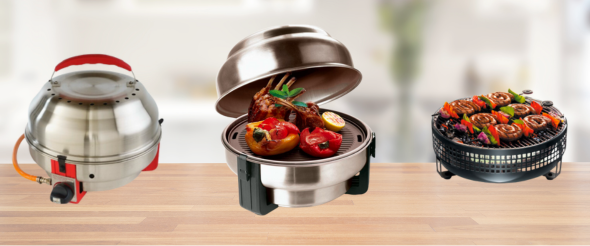
Our OEM product lines are precision-engineered to meet diverse commercial applications, ranging from high-capacity hotel rotisseries and commercial BBQ setups to compact table-top gas roasters for modern urban kitchens. Below are our core benchmark configurations available for contract manufacturing and global private label export.
Commercial Series
Heavy-Duty Multi-Burner Gas Roaster
- Grade AISI 304 Stainless Steel Frame
- Multi-Zone Cast Iron / SS Tubular Burners
- Deep-Drawn Removable Fat Collection Tray
- CE & RoHS Safety Compliant Manifold
Inquire Now Portable & Catering
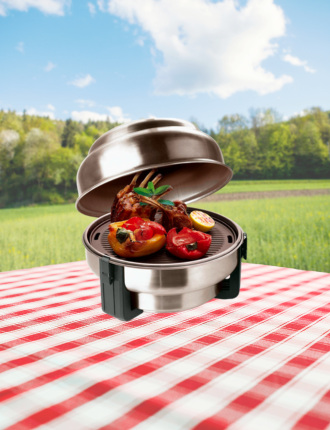
Compact Tabletop Gas Roaster & Grill Container
- Ferritic AISI 430 High Heat Shell
- Infrared Ceramic Gas Heating Plate
- Seamless Deep-Drawn Outer Basin
- Foldable Transport Handles & Wind Shield
Inquire Now Industrial Hotelware
Industrial High-Output Flame-Rotary Gas Roaster
- Dual LPG / Natural Gas Orifice System
- Reinforced Heavy Gauge Base Frame
- Automated Flame Failure Safety Device (FFD)
- Mirror Polished & Satin Dual Finish
Inquire Now Hybrid Cooking Tech
Hybrid Dual-Fuel Roasting & Stock Pot Engine
- Modular Interchangeable Burner Grates
- Heavy Duty Riveted Handles
- In-house Spectro-Lab Verified Metallurgy
- Full OEM Private Label Packaging
Inquire Now Technical Benchmark & OEM Customization Matrix
To assist technical buyers in defining product specifications for custom production runs, the following engineering matrix outlines standard versus customizable OEM parameters:
| Engineering Parameter | Standard Commercial Spec | Custom OEM Options (PP Impex India) | Quality Test Standard |
| Primary Alloy Steel | AISI 304 (18/8 Austenitic) | AISI 430, AISI 316, or Dual-Grade Alloy | Spectrometer Chemical Analysis |
| Sheet Thickness (Gauge) | 1.0 mm to 1.5 mm (18 - 16 Gauge) | 0.8 mm up to 2.5 mm Heavy Duty Plate | Digital Micrometer Verification |
| Burner Rating (BTU/hr) | 12,000 BTU per burner tube | High-Output 25,000+ BTU / Infrared Ceramic | Gas Pressure & Combustion Testing |
| Surface Finishing | Satin Brush (Ra < 0.4 µm) | Electro-Polished, Mirror Finish, Matte PVD | Glossmeter & Roughness Tester |
| Fat Drip Tray Geometry | Deep-Drawn Seamless Box | Sliding Tray with Drain Valve Spout | Hydrostatic Leakage Test |
| Safety Controls | Manual Piezo Ignition | Thermocouple FFD Safety Valves / Auto Spark | CE EN 498 Gas Appliance Safety |
Metallurgical Mechanics & Thermal Engineering: Information Gain for Technical Buyers
When engineering a commercial Stainless Steel Gas Roaster, metallurgical choices dictate operational lifespan and safety. Many low-cost suppliers utilize low-nickel 200-series stainless steel (such as SS201 or SS202) to diminish production costs. However, under direct open flame exposure and thermal cycling, 200-series steels undergo rapid phase transformation. Manganese substitution destabilizes the passive chromium oxide layer, causing severe intergranular corrosion and scale flaking when exposed to acidic meat fats, salty marinades, and high humidity.
AISI 304 vs. AISI 430 in Gas Roaster Applications
Professional gas roasters demand a strategic hybrid selection of stainless steel alloys based on distinct thermal zones within the appliance:
- Austenitic Stainless Steel (AISI 304 / EN 1.4301): Containing 18% Chromium and 8% Nickel, SS304 provides supreme chemical corrosion resistance against organic acids and saline solutions. It is the gold standard for the roasting chamber, meat grates, spit rods, and exterior chassis. Its austenitic crystal structure prevents rust even after hundreds of cooking cycles.
- Ferritic Stainless Steel (AISI 430 / EN 1.4016): Containing 16-18% Chromium with zero nickel content, SS430 exhibits a lower coefficient of thermal expansion compared to SS304 (10.4 x 10⁻⁶ /K vs 17.2 x 10⁻⁶ /K at 100-500°C). This makes SS430 exceptionally resistant to heat-induced warping ("oil-canning") in flame tamers, radiant heat shields, and burner baffles positioned directly above gas flames.
Mitigating Thermal Distortion via Deep-Drawn Structural Ribbing
Uneven thermal expansion poses a severe challenge in flat sheet metal roaster bodies. When one surface of a metal panel reaches 400°C while the adjacent wall remains at 80°C, differential stresses cause buckling. At PP Impex India, we overcome this structural strain through advanced cold-forming techniques:
- Deep-Drawn Stamped Ribbing: Utilizing high-tonnage hydraulic presses, we stamp linear stiffening ribs directly into the chassis panels. These geometric contours increase the moment of inertia, absorbing thermal stress without expanding outward.
- Radius Corner Bending: Eliminating sharp 90-degree welded corners prevents stress concentration points where fatigue cracking normally originates during repetitive heating and cooling phases.
- Seamless Deep-Drawn Drip Pans: Welded joints in grease collection trays frequently fail due to thermal fatigue and acid accumulation. Our in-house deep-drawing press capacity produces single-piece, joint-free drip trays that guarantee 100% leak-proof performance and easy sanitation.
Global Sourcing & Procurement Trends (2025–2030)
The global trade environment for commercial foodservice equipment is shifting rapidly. Supply chain managers and enterprise buyers must align their procurement strategies with emerging regulatory, economic, and technological trends:
1. Modular & Knock-Down (KD) Engineering
Rising international ocean freight tariffs have made shipping bulky assembled equipment economically inefficient. Modern buyers demand modular gas roaster designs that can be flat-packed in high-density cartons, reducing total CBM volume by up to 65% while maintaining rapid 15-minute job-site assembly.
2. Transition to Infrared Burner Technology
Traditional direct-flame blue burners are increasingly replaced by ceramic infrared gas burners. Infrared radiation delivers uniform directional heat up to 900°C, reducing gas consumption by 30% to 40% while virtually eliminating flare-ups caused by dripping fats.
3. Strict Traceability & Heavy-Metal Safety
Importers into the European Union and North America face rigorous enforcement of food-contact material standards (EU Regulation No 1935/2004, FDA 21 CFR, REACH, and RoHS). Buyers require factory-certified spectro-analysis certifying zero toxic heavy metal migration (Lead, Cadmium, Nickel leeching) under acidic thermal testing conditions.
4. Multi-Fuel Dual Orifice Systems
To cater to diverse commercial markets, gas roasters must feature convertible gas manifold systems capable of switching between Liquid Petroleum Gas (LPG/Propane) and Natural Gas (NG/Methane) through quick-interchange brass orifice jets.
Industry Development & Technological Innovation Trends
The manufacturing methodology behind stainless steel food equipment is undergoing a technological revolution. Factory automation, automated surface finishing, and green manufacturing practices are reshaping production performance:
Automated Fiber Laser Cutting & Robotic TIG Welding
Manual welding techniques often introduce thermal degradation, burn-through, and iron contamination onto stainless steel surfaces, creating micro-zones vulnerable to localized pitting corrosion. Modern OEM factories utilize 12kW fiber laser cutting machines for clean edge profiling, combined with robotic TIG/plasma welding cells. This produces ultra-smooth, hermetically sealed weld seams requiring minimal post-weld grinding and preserving the steel's native passivation layer.
Hygienic Design & Easy-Clean Surface Texturing
Post-pandemic commercial kitchen standards prioritize hygiene and rapid sanitation protocols. Smooth satin brush textures with controlled surface roughness (Ra < 0.4 µm) prevent grease buildup and microbial attachment. Additionally, electro-passivated chemical rinses strip free iron particles from the exterior surface, accelerating the automatic formation of a protective chromium oxide film.
Frequently Asked Questions (FAQ) for Global B2B Sourcing Managers
Addressing core technical, financial, and logistical queries submitted by international buyers during procurement evaluations for Stainless Steel Gas Roasters.
Q1: Why is AISI 304 preferred over AISI 201 for commercial gas roasters despite the price differential?
Answer: While AISI 201 reduces upfront bill-of-materials costs, its low nickel content (1.0–1.5%) and high manganese composition make it structurally unstable under high-temperature thermal cycling. Direct gas flames cause micro-cracking and destructive oxidation in SS201, while food acids accelerate pitting corrosion. AISI 304 contains 18% Chromium and 8% Nickel, maintaining structural integrity, oxidation resistance up to 870°C, and complete compliance with global food-contact standards.
Q2: How does PP Impex India prevent structural warping ("oil-canning") in large gas roaster bodies?
Answer: Structural warping is mitigated through three distinct engineering practices: 1) Precision-stamped reinforcement ribs across long sheet spans to increase structural rigidity, 2) Strategic application of ferritic AISI 430 grade steel for flame tamers due to its low coefficient of thermal expansion, and 3) Deep-drawn single-piece pressings for trays and pans that eliminate welded seams, allowing uniform stress distribution under intense heat.
Q3: What are the minimum order quantities (MOQs) and lead times for OEM private-label production?
Answer: Standard production MOQs for custom OEM gas roasters start at 200 to 500 units depending on size and tooling complexity. For standard catalog models with private-label laser etching, MOQs start at 100 units. Prototype fabrication and die creation require 20 to 30 days, while full container-load (FCL) production runs are completed within 35 to 45 days ex-factory Mumbai.
Q4: Can the gas valves and burner assemblies be certified to regional safety regulations?
Answer: Yes. We engineer gas manifold assemblies to meet specific target market certifications, including CE (EN 498 / EN 30) for Europe, CSA/UL standards for North America, and regional gas mark standards for Australia and the Middle East. Burner orifices can be factory-calibrated for LPG (28-30/37 mbar) or Natural Gas (20 mbar) based on destination country requirements.
Q5: How does PP Impex India's raw material rolling facility benefit bulk wholesale buyers?
Answer: Our parent company operates a dedicated stainless steel rolling mill processing over 500,000 kg of raw material monthly. This vertical integration eliminates intermediary steel distributor markups, guarantees precise gauge thickness tolerances (±0.02 mm), and shields our global buyers from volatile raw metal price fluctuations, yielding a direct 10% to 15% cost advantage over unintegrated assemblers.
Q6: What food contact and chemical safety documentation is provided with export shipments?
Answer: Every export shipment is accompanied by a comprehensive Quality Assurance dossier, including Mill Test Certificates (MTC) according to EN 10204 3.1, in-house spectro-lab chemical analysis reports, salt spray corrosion test data (ASTM B117), and heavy metal non-migration certificates complying with EU 1935/2004 and FDA guidelines.
Q7: What packaging standards are used to protect stainless steel finishes during transoceanic transit?
Answer: All exposed stainless steel surfaces are coated with 50-micron UV-resistant protective PE film. Units are wrapped in moisture-barrier polybags, reinforced with high-density EPE foam corner protectors, and packed inside 7-ply heavy-duty corrugated export cartons. Full palletization with plastic strapping and stretch-wrapping ensures zero transit denting or sea-water moisture damage.
Why Partner with PP Impex India: Enterprise Strengths & OEM Excellence
With over 19 years of dedicated manufacturing and export experience, PP Impex India has earned a global reputation as a premier OEM contract manufacturer of stainless steel kitchenware, hotelware, and gas cooking equipment. Operating from our expansive manufacturing complex in Nallasopara East, Mumbai, we serve leading brands, distributors, and hotel supply chains across 15+ countries in Europe, the Middle East, and East Asia.
Integrated Manufacturing Superiority
You Design, We Manufacture
Scale your brand with an ISO-certified contract manufacturer operating full vertical raw-material to finished-product control.
We provide complete OEM/ODM solutions tailored to your market specifications. From initial 3D CAD modeling and rapid rapid tooling prototyping to mass press stamping, polishing, and export packaging, our engineering team manages every step with rigorous precision.
- Parent Steel Rolling Mill: 500,000 kg Monthly Capacity
- In-House High-Precision Tool & Die Making Facility
- Advanced Deep-Drawing Pressing & Hydraulic Stamping
- Spectrometer Chemical Analysis & In-House Testing Lab
- Strict Non-Disclosure Agreements (NDA) for Private IP
- ISO 9001:2015, CE, RoHS, REACH & BSCI Certified
Inquire Now