1. Industry Executive Overview
The Structural Advantage of Vertically Integrated OEM Manufacturing
Navigating the international landscape of Stainless Steel Kitchenware OEM Manufacturing requires more than evaluating superficial finished product samples. Modern global buyers—ranging from European retail chains to North American food service distributors—face complex volatility across raw material pricing, metallurgical inconsistencies, micro-fracturing in deep-drawn geometries, and stringent chemical safety enforcement under food-contact directives. Competent OEM sourcing hinges on upstream control of the raw material value chain.
At PP Impex India, our manufacturing philosophy is grounded in complete structural integration. Founded in 2005 and headquartered in Mumbai, India, our parent organization owns and operates an advanced cold-rolling mill with a massive raw material processing capacity of 500,000 kilograms per month. This upstream integration allows us to directly specify, melt, and roll stainless steel coils to exact thickness tolerances (down to ±0.02mm), grain structures, and hardness profiles optimized specifically for heavy hydraulic deep drawing and precision pressing.
With over 19 years of dedicated export experience serving buyers across 15+ countries, PP Impex India mitigates supply chain risks through in-house mold and die creation, rigorous spectro-laboratory testing, and comprehensive international compliance certifications including ISO 9001:2015, CE, RoHS, REACH, and BSCI. Below is an engineering-focused analysis designed to empower procurement directors in selecting, specifying, and scaling high-margin custom stainless steel product lines.
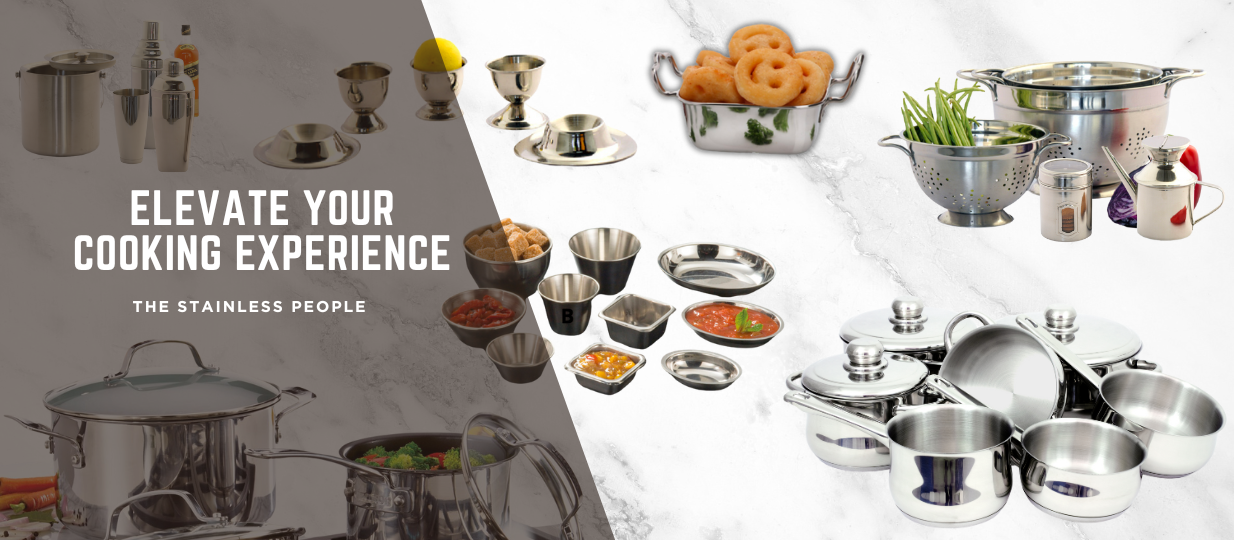
Figure 1: High-precision stainless steel deep drawn components manufactured at PP Impex India facility.
2. Precision Product Categories & OEM Recommendations
Engineering Specs & Sourcing Recommendations for Global Buyers
Selecting the appropriate material grade, gauge thickness, and surface finishing methodology is critical to optimizing unit cost versus durability. Here are our primary product recommendations engineered for global OEM procurement:
Category 01 — Deep Drawing Excellence
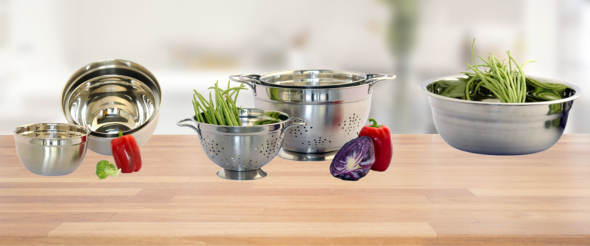
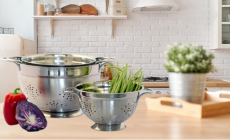
Stainless Steel Euro Bowls & Specialty Colanders
Designed specifically for European and North American culinary standards, our Euro Bowls and Rice Washing Colanders utilize deep drawing techniques to eliminate stress-crack propagation. Formed with smooth rolled rims and non-porous polished interiors.
- ◆ Material Alloys: AISI 304 (18/8) Food Grade or AISI 201 J4 High-Nickel options
- ◆ Wall Thickness: 0.5mm to 1.2mm deep draw uniform distribution
- ◆ Surface Finishes: Mirror Exterior, Satin Matte Interior, or Electro-polished
- ◆ Compliance: EU LFGB & US FDA 21 CFR 175.300 compliant
Inquire About Euro Bowls Category 02 — Heavy-Duty Cookware
Heavy-Gauge Stock Pots & Commercial Cookware
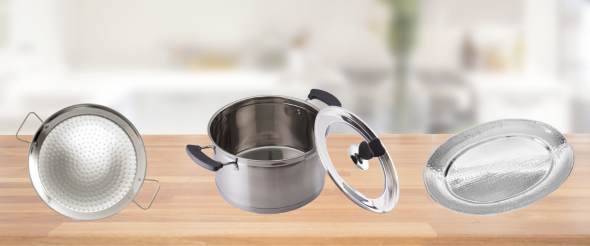
Built to endure the rigorous thermal cycles of commercial hospitality kitchens, our OEM stock pots feature encapsulated impact-bonded sandwich bottoms (Stainless Steel + Pure Aluminum Core + Magnetic SS 430 Base) ensuring rapid, uniform thermal conductivity across gas, electrical, and induction cooktops.
- ◆ Capacity Range: 5 Liters to 100 Liters commercial volume
- ◆ Thermal Bottom: 4mm to 6mm Impact Bonded 3-ply disc
- ◆ Handle Welds: Heavy-duty spot welding & hollow-core stay-cool rivets
- ◆ Private Label: Custom laser-etched volume gradations & logo stamping
Inquire About Stock Pots Category 03 — Specialty Barware & Storage
Precision Barware, Glasses & See-Thru Canisters
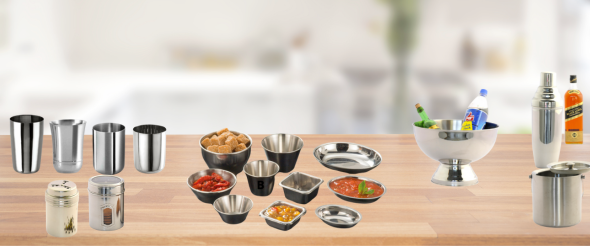
Precision-formed stainless steel cocktail shakers, double-walled insulated ice buckets, sauce cups, and airtight storage canisters. Engineered with hermetic silicone seals and food-grade acrylic viewing windows for premium kitchenware collections.
- ◆ Insulation: Vacuum double-wall stainless steel technology
- ◆ Custom Coatings: PVD Matte Black, Rose Gold, Brass Electroplating, Powder Coat
- ◆ Accessories: Tempered glass lids, BPA-free acrylic, silicone rim gaskets
Inquire About Barware 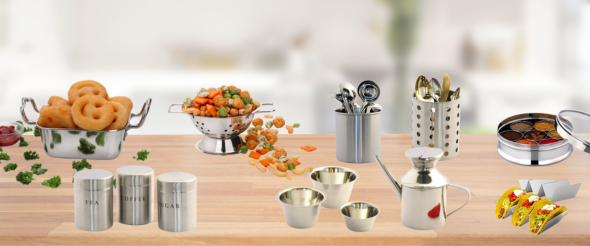
Custom Restaurant Serving Ware
Specialty taco servers, french fry cones, oil kettles, masala spice containers, and perforated cutlery holders built with corrosion-resistant SS 304 wire mesh and stamped sheet metal.
Request Servingware OEM Catalog → 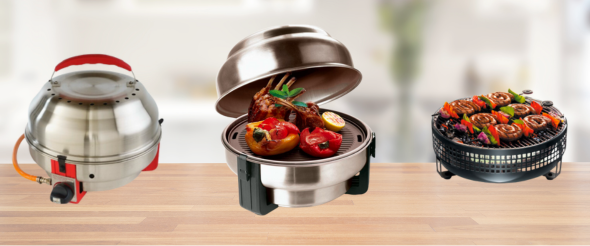
Portable BBQ Grills & Gas Roasters
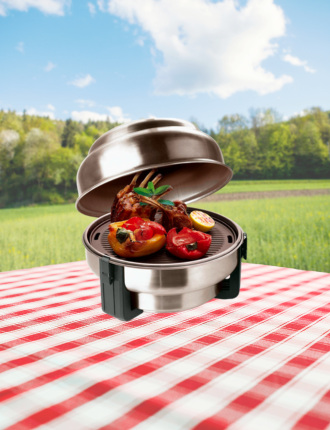
Foldable outdoor charcoal grills, gas roasters, paella pans, and heavy-gauge camp cookware. Features high-heat resistance, laser-cut ventilation ports, and knock-down retail packaging.
Request Outdoor Cookware OEM Details → 3. Technological & Market Evolution
Product & Material Development Trends in Stainless Steel Kitchenware
The global kitchenware industry is undergoing a technological transformation driven by changing consumer lifestyle preferences, health awareness, and sustainability mandates. OEM buyers who fail to adapt their product specifications risk margin compression and product obsolescence. Below are the key engineering trends reshaping stainless steel manufacturing:
Multi-Clad & Tri-Ply Composite Metallurgy
Transitioning from traditional single-ply stamped bottoms to full-body 3-ply clad sheets (SS 304 interior + Aluminum core + SS 430 induction exterior). Provides 35% faster heat distribution, reducing energy consumption during cooking.
Physical Vapor Deposition (PVD) Eco Finishes
Global environmental regulations are restricting traditional chemical wet electroplating. PVD titanium vacuum deposition offers abrasion-resistant, food-safe colors (Matte Gold, Champagne, Copper, Black Oxide) with zero toxic chemical runoff.
Seamless Deep Drawing & Hygienic Geometry
Modern commercial kitchens demand zero-crevice designs to eliminate bacterial harboring zones. Single-draw progressive hydraulic pressing enables seamless transitions between wall and base without internal fillet welds.
4. Future Procurement Dynamics
Global Procurement Shifts: 2025–2030 Supply Chain Outlook
Global procurement directors are actively recalibrating their sourcing footprints to hedge against geopolitical friction, anti-dumping tariffs, and supply single-points-of-failure. Key structural shifts include:
"China Plus One" Diversification to India
Major European and US brands are reallocating 25% to 40% of their kitchenware tooling to Indian manufacturing centers. India offers abundant domestic raw stainless steel capacity, skilled metallurgical labor, favorable duty structures, and English-fluent engineering communication.
ESG & Carbon Footprint Transparency
Under upcoming EU Corporate Sustainability Due Diligence Directives (CSDDD), importers must prove supply chain auditability. Sourcing from factories with BSCI certification and integrated cold-rolling facilities drastically simplifies Scope 3 emissions reporting and material origin verification.
5. Enterprise Strengths
Why Leading Brands Partner with PP Impex India
PP Impex India bridges the gap between conceptual product engineering and high-volume export execution. Our integrated infrastructure eliminates vendor hand-offs and ensures complete quality accountability:
- Parent Company Cold-Rolling Mill: 500,000 kg monthly raw material processing for ultimate cost & thickness control
- In-House Tooling & Die Making: Dedicated master die makers enabling rapid prototyping within 15–21 days
- In-House Testing Laboratory: Spectrometric chemical analysis, salt spray testing, and drop test verification
- 19+ Years Global Export Experience: Proven shipping logstics across Europe, Middle East, and East Asia
- Strict Non-Disclosure Guarantee: Complete design protection and confidential private-label manufacturing
Connect With Our Engineering Team Global Logistics & Footprint
Delivering Stainless Excellence Across 15+ Nations
Under strict Non-Disclosure Agreements (NDA), we serve global brand leaders, hotel supply chains, and departmental hypermarket chains across Western Europe, North America, the Middle East, and East Asia. Seamless FOB, CIF, or DDP shipping execution through major West Coast Indian ports (Jawaharlal Nehru Port Trust - JNPT / Nhava Sheva).
500k
Kg Monthly Steel Capacity
6. Strategic Procurement FAQ
Frequently Asked Questions by Global OEM Buyers & Importers
Q1: How do I evaluate material grade suitability (AISI 304 vs 201 vs 316) for custom OEM kitchenware? +
AISI 304 (18/8 Austenitic Stainless Steel): The global benchmark for premium cookware, Euro bowls, and food containers. Contains 18% Chromium and 8% Nickel, delivering superior corrosion resistance against acidic foods, salt spray, and dishwashers.
AISI 201 J4 / High-Manganese Alloys: Economical alternative for dry food storage, decorative serving trays, and budget retail items. Replaces a portion of Nickel with Manganese to maintain strength while reducing material costs by 20–30%.
AISI 316 (18/10 Marine/Medical Grade): Contains 2–3% Molybdenum for exceptional resistance to high-saline and extreme acidic food processing. Highly recommended for heavy commercial food service equipment. PP Impex India provides mill test certificates (MTC) according to EN 10204 3.1 with every batch.
Q2: What are the main technical challenges in deep drawing sheet metal components and how do you prevent cracking? +
Deep drawing cylindrical or deep-tapered kitchenware (such as deep euro bowls or stock pots) subjects the steel blank to extreme tensile and compressive stress. Defects like wall thinning, wrinkling, or "orange peel" cracking occur when drawing ratios exceed material work-hardening limits.
PP Impex India eliminates these defects through:
- In-house controlled cold rolling: Maintaining uniform grain size and elongation rate (>50%).
- Multi-stage progressive redrawing: Utilizing intermediate annealing cycles to relieve internal stress.
- Custom Die Lubrication: Applying specialized synthetic lubricants to reduce friction coefficients during hydraulic press cycles.
Q3: Why does sourcing from an OEM with an in-house cold-rolling mill lower total landed costs? +
Traditional fabricators buy pre-cut stainless steel sheets from secondary distributors, incurring 12%–18% middleman markups and suffering long raw material lead times. Because PP Impex India's parent company processes 500,000 kg of steel monthly in its own rolling facility, we bypass steel stockists entirely.
This vertical integration allows us to pass raw material savings directly to OEM clients, guarantee precise sheet gauge consistency, and buffer against global market price fluctuations.
Q4: What certifications are mandatory for importing stainless steel houseware into Europe and North America? +
European Union markets require compliance with Regulation (EC) No 1935/2004 and German LFGB Section 30 & 31 heavy metal release testing (verifying zero leaching of Lead, Cadmium, Nickel, or Chromium). Items imported into the United States must meet US FDA 21 CFR 175.300 regulations.
For social compliance, retail audits mandate BSCI (Business Social Compliance Initiative) or SMETA facility certification. PP Impex India holds full accreditation across ISO 9001, CE, RoHS, REACH, and BSCI, enabling rapid customs clearance.
Q5: How does PP Impex India protect client intellectual property and custom tooling molds? +
We execute binding Non-Disclosure Agreements (NDA) prior to receiving CAD drawings or physical 3D samples. Proprietary tooling built in our in-house die room remains exclusively assigned to the client. Tooling is permanently cataloged, maintained, and never utilized for third-party production.
Q6: What is the typical lead time and process for custom die engineering and pre-production approval? +
Our standard OEM workflow encompasses five controlled steps:
- 2D/3D CAD Drawing & DFM Review: 2 to 4 business days.
- Prototype / Sample Tooling Development: 10 to 14 days.
- Golden Sample Inspection & Lab Testing: Courier sample dispatched for buyer sign-off.
- Mass Production Dies Creation: 15 days upon sample approval.
- Mass Production & Export Packaging: 25 to 35 days for FCL orders.
Q7: How do you optimize shipping container space for nested hollowware like bowls and colanders? +
Volumetric freight costs can severely impact landed profit margins on hollowware products. PP Impex India designs products with precision draft angles to allow tight nesting without surface scratching (using inter-leaf tissue or eco-poly sleeves). Nesting increases container load density by up to 300%, drastically reducing freight cost per unit.
Ready to Engineer Your Next Private Label Kitchenware Line?
Partner with an ISO-certified, vertically integrated Indian manufacturer with 19+ years of global export mastery. Speak directly with our technical engineering team for RFQs, die feasibility, and sample requests.