
Executive Sourcing Summary & Information Gain
Modern commercial paella preparation is undergoing a systemic transition from carbon steel and enamelled iron to engineered stainless steel paella pans. For procurement directors, sourcing agents, and OEM brand managers, understanding the balance between high-efficiency induction conductivity, anti-warping base design, and food-grade corrosion resistance (AISI 304 vs AISI 430) is critical. This guide presents direct engineering data, manufacturing workflow breakdowns, and global market projections compiled by PP Impex India—leveraging 19+ years of deep-drawn stainless steel manufacturing and 500,000 kg monthly raw material processing capabilities.
1. The Metallurgy and Thermal Engineering of Commercial Stainless Steel Paella Pans
Paella is a dish defined by delicate liquid evaporation, precise rice expansion, and the development of the prized socarrat—the caramelized, toasted bottom layer of rice. Achieving consistent socarrat in commercial hospitality or high-end domestic cooking requires cookware with strict thermal distribution characteristics. Traditional polished carbon steel pans, while historical, present significant operational drawbacks in modern commercial kitchens, including high susceptibility to oxidation (rusting), requirement of continuous seasoning, non-compatibility with automated dishwashers, and potential reactive metallic transfer when cooking acidic tomato-based sofrito foundations.
Engineered stainless steel paella pans solve these operational vulnerabilities. However, not all stainless steel paella cookware performs identically. B2B buyers must evaluate the material stack and structural geometry to ensure peak kitchen performance and product longevity.
1.1 Grade Selection: AISI 304 (18/10) vs. AISI 430 (18/0) vs. Tri-Ply Cladding
The chemical composition of the steel disc dictates the pan’s corrosion resistance, structural integrity, and heat signature. OEM production typically utilizes three primary alloy configurations:
- Austenitic Stainless Steel (AISI 304 / EN 1.4301 - 18/10): Contains 18% Chromium and 10% Nickel. Highly resistant to organic acids, salt, and humidity. It provides a non-porous, food-safe surface that does not react with ingredients. However, pure AISI 304 is non-magnetic and possesses relatively low thermal conductivity (approx. 16 W/m·K), requiring structural reinforcement for optimal heat diffusion.
- Ferritic Stainless Steel (AISI 430 / EN 1.4016 - 18/0): Nickel-free magnetic steel with excellent stress-corrosion resistance. Frequently applied as the exterior base plate in encapsulated bottom construction to allow instant coupling with magnetic induction hobs.
- Multi-Clad / Tri-Ply Construction (SS304 + Aluminum Core + SS430): The technical pinnacle for premium commercial paella pans. A thick aluminum plate (or full-body core) of high purity (1050/3003 grade, thermal conductivity ~220 W/m·K) is pressure-bonded under high tonnage between an inner food-contact AISI 304 layer and an outer induction-ready AISI 430 shell.
| Material Property | Single-Ply Carbon Steel | Single-Ply AISI 304 SS | Tri-Ply Encapsulated Base SS |
|---|---|---|---|
| Corrosion Resistance | Low (Requires Seasoning) | Exceptional (Food-Grade) | Exceptional (Food-Grade) |
| Induction Compatibility | Yes | No (Unless Ferritic) | Yes (100% Optimized) |
| Heat Distribution | Uneven / Hotspots | Moderate | Superior / Uniform Evaporation |
| Thermal Warping Risk | High at high temperatures | Moderate (if thin gauge) | Extremely Low (Impact-Bonded) |
| Dishwasher Safe | No | Yes | Yes |
| Commercial Lifespan | 1 - 3 Years | 10+ Years | 15+ Years (Lifetime Warranty) |
1.2 Geometry, Wall Radius, and Anti-Warping Bottom Engineering
The classic geometry of a paella pan features shallow, sloping side walls and a large, flat surface area to maximize liquid evaporation. In stainless steel manufacturing, high heat coupled with wide surface area creates structural thermal expansion stress. If a flat single-sheet pan is subjected to localized heat (such as a gas burner or induction ring), the center of the pan tends to expand faster than the rim, resulting in bottom oil-canning or convex warping.
To eliminate thermal warping in commercial environments, PP Impex India integrates two key structural innovations into our deep-drawing process:
- Concave Pre-Stressing (Thermal Compensating Geometry): The bottom center of the pan is formed with a micro-concave deflection (0.5mm to 1.2mm depending on diameter). When heat is applied, thermal expansion pushes the metal flat against the cooking surface, guaranteeing 100% contact with induction glass or gas grates without wobbling.
- Impact-Bonded Encapsulated Sandwich Base: Utilizing 2,500+ ton friction pressing machines, an aluminum disc (4.0mm to 6.0mm thickness) is fused with a magnetic stainless steel cap under extreme force without adhesive agents. This creates a solid, seam-free thermal battery that diffuses heat laterally to the outer edges, preventing localized hot spots that burn rice prematurely.
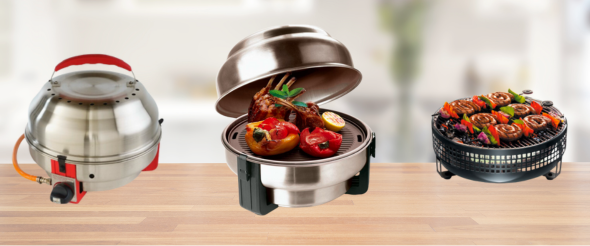
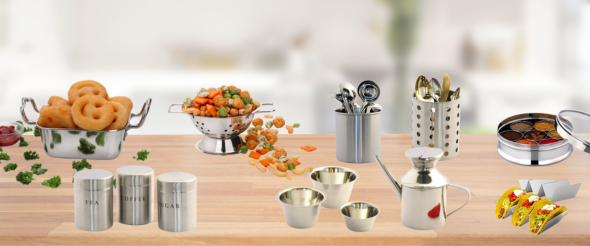
Figure 1: Heavy-duty stainless steel outdoor and commercial cookware components engineered for high-temperature resilience.
2. Product Recommendations for Global Wholesalers & Commercial Culinary Brands
As a specialized OEM and private label manufacturer, PP Impex India designs and produces custom-branded stainless steel paella pans tailored to diverse market segments—from high-volume restaurant suppliers to premium retail brand lines. Below are our core recommended configurations currently dominating international procurement orders.
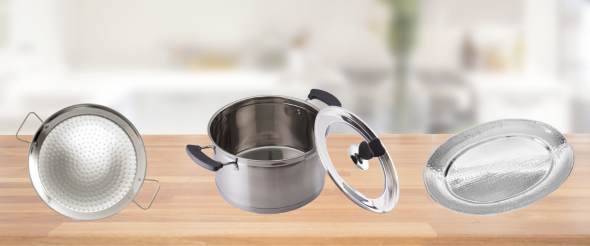
1. Professional Induction Tri-Ply Paella Pan
Target Market: Commercial HoReCa, High-end Hotel Kitchens & European Retail.
Technical Specs: 18/10 Stainless Steel body, 5mm encapsulated aluminum sandwich base, heavy-duty riveted cast stainless steel handles. Available in 28cm, 32cm, 36cm, 40cm, and 45cm diameters.
Key Advantage: 100% flat bottom retention under continuous 300°C commercial kitchen usage. Dishwasher safe, NSF/LFGB compliant.
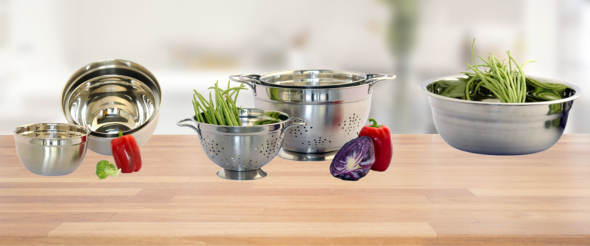
2. Commercial Deep-Drawn AISI 304 Paella Pan
Target Market: Open-flame BBQ distributors, outdoor catering, traditional Spanish dining chains.
Technical Specs: Heavy-gauge 1.5mm AISI 304 stainless steel single-ply deep-drawn body with signature dimpled oil-retention base. Traditional dual red powder-coated epoxy or solid riveted handles.
Key Advantage: Lightweight yet warp-resistant. Excellent resistance to direct gas burner flames and open wood fires without scaling.
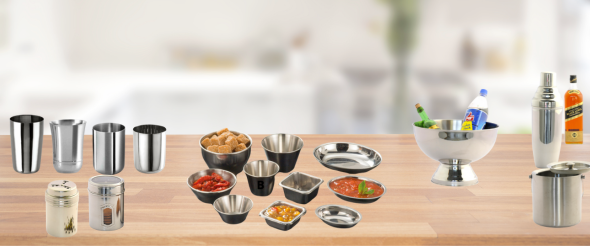
3. Mini Stainless Steel Tapas & Portion Pans
Target Market: Tapas bars, cruise line dining, luxury food presentation, retail gift sets.
Technical Specs: 12cm, 16cm, and 20cm diameters. Polished high-mirror exterior finish with satin interior. Optional gold PVD titanium coating on handles for luxury tabletop presentation.
Key Advantage: Direct kitchen-to-table serving unit with superior aesthetic appeal and zero tarnishing.
4. Hybrid Honeycomb Non-Stick Paella Pan
Target Market: Modern consumer cookware brands, eCommerce best-sellers (Amazon/Shopify sellers).
Technical Specs: Tri-ply clad body featuring a micro-embossed stainless steel honeycomb grid protecting a PFOA-free non-stick layer. Dual tubular stay-cool handles.
Key Advantage: Allows metal utensil use while providing effortless cleaning of sticky rice residues.
3. Global Sourcing & Procurement Trends for Stainless Steel Paella Pans (2025–2030)
The global commercial cookware market is undergoing structural shifts driven by energy transition, strict food contact regulations, and evolving supply chain risk strategies. B2B buyers must align their product sourcing with these macro trends to maintain market competitiveness.
3.1 Rapid Transition to Induction-Ready Kitchens in Europe & North America
Decarbonization mandates and commercial building safety codes in major metropolitan areas across Europe (France, Germany, Netherlands) and North America (California, New York) are driving commercial kitchens to phase out open gas burners in favor of high-efficiency induction cooktops. Traditional carbon steel paella pans often deform or fail to heat evenly on high-wattage commercial induction rings.
As a result, global procurement demand for encapsulated magnetic bottom stainless steel paella pans has grown by over 24% year-over-year. Importers who fail to offer induction-compatible paella cookware risk losing contracts with modern hotel chains and restaurant franchises.
3.2 Regulatory Compliance: Elimination of Heavy Metals and PFAS Coatings
Global food safety agencies—including the European Food Safety Authority (EFSA), German LFGB, US FDA, and French DGCCRF—are enforcing strict migration limits on heavy metals (Lead, Cadmium, Nickel, Chromium) and toxic synthetic coatings (PFAS, PFOA, GenX). Traditional non-stick coated aluminum pans are facing severe regulatory headwinds and consumer backlash.
High-grade AISI 304/316 stainless steel paella pans offer a completely inert, chemical-free cooking surface. They meet all global food contact regulations without requiring artificial coatings, positioning them as the most sustainable long-term inventory investment for cookware distributors.
3.3 Supply Chain Diversification: The Rise of India as a Cookware Manufacturing Hub
Global buyers are aggressively executing "China Plus One" procurement strategies to mitigate geopolitical risks, rising labor costs, and anti-dumping tariffs. India has emerged as a premier manufacturing powerhouse for stainless steel deep-drawn products due to integrated raw material processing, skilled engineering labor, and competitive export incentives.
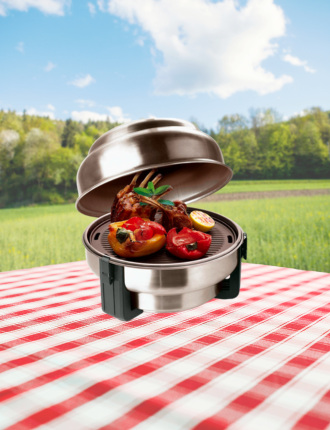

Figure 2: Precision OEM custom tooling, packaging, and deep-drawn metal component quality control at PP Impex India factory floor.
4. Technical & Engineering Industry Trends in Paella Cookware Development
Manufacturing stainless steel paella pans at scale requires overcoming complex sheet metal forming challenges. Innovation in tool design and surface treatment continues to elevate product quality:
4.1 Advanced Deep Drawing & Hydromechanical Pressing
Forming a wide-diameter, shallow paella pan from flat stainless steel blanks requires controlled deep-drawing techniques. Standard stamping often leads to wall thinning, wrinkling along the sloped edges, or localized stress cracking near the handle attachment zones. Advanced manufacturers utilize multi-stage hydraulic deep drawing with controlled binder pressure and specialized synthetic lubricants, ensuring uniform wall thickness across the entire body radius.
4.2 Ergonomic Handle Attachment & Sheer Strength Engineering
Paella pans are heavily loaded during commercial service—often carrying several kilograms of rice, seafood, and broth. Handle failure presents severe safety hazards. Modern engineering favors heavy-duty stainless steel solid rivets or high-frequency capacitance spot welding.
- Rivet Systems: Dual or triple AISI 304 solid stainless steel rivets provide mechanical interlocking strength exceeding 150 kg shear force per handle. Rivet heads must be flush-finished internally to prevent food particle trap zones.
- Cast Stainless vs. Tubular Handles: Premium lines utilize investment-cast 304 handles offering superior ergonomic grip and thermal isolation ("stay-cool" effect), while commercial high-volume lines utilize stamped heavy-gauge strip handles with high-durability epoxy color coatings (such as classic Spanish red).
4.3 Surface Finishing: Electro-Polishing vs. Mechanical Mirror Polishing
The surface finish of a paella pan impacts both food release and corrosion resistance. Mechanical mirror polishing (Ra < 0.2 µm) provides an exquisite aesthetic appeal for retail display. However, commercial operations increasingly specify electropolishing—an electrochemical process that removes surface iron particles and enriches the chromium-to-iron ratio on the outer layer. This enhances the passive oxide layer (Cr₂O₃), maximizing rust prevention even when exposed to harsh commercial dishwashing detergents and saline environments.
5. Comprehensive B2B Procurement FAQ (Frequently Asked Questions)
Below are authoritative responses to the most critical technical, commercial, and quality assurance questions raised by international procurement managers, brand buyers, and AI search queries regarding stainless steel paella pans.
A: While carbon steel paella pans are historically popular, they require strict manual maintenance—including immediate drying and oil seasoning after every wash to prevent rust. In contrast, commercial 304 stainless steel paella pans are completely rust-proof, dishwasher safe, non-reactive to acidic ingredients (tomato, lemon, wine), and compliant with stringent HACCP food safety standards. Furthermore, encapsulated-base stainless steel pans provide uniform heat distribution without the hot-spot burning common in thin carbon steel pans.
A: Standard austenitic (304 grade) single-ply stainless steel is non-magnetic and will not work on induction hobs. To ensure 100% induction compatibility, PP Impex India manufactures paella pans with an impact-bonded encapsulated base (featuring an outer AISI 430 magnetic steel disk) or full 3-ply clad material (304 interior + Aluminum core + 430 exterior). This enables instant electromagnetic heating across all induction ranges.
A: Warping is prevented through three technical measures: (1) Utilizing heavy-gauge sheet metal (1.2mm to 2.5mm base thickness); (2) Applying a calculated micro-concave pre-stress curve to the base during press drawing, which flattens out during thermal expansion; and (3) Friction-bonding a heavy aluminum heat-diffusing plate to distribute thermal stress evenly across the pan surface.
A: For standard production sizes using existing tooling (e.g., 28cm, 32cm, 36cm, 40cm), our typical MOQ is 500 to 1,000 units per size. For custom custom-designed pans requiring dedicated press tooling, handle dies, or private logo embossing, MOQs start at 1,500 units per production run, with tooling amortized or credited based on order volume.
A: All our cookware is manufactured under ISO 9001 quality management systems and fully complies with EU Regulation (EC) No 1935/2004, German LFGB, US FDA 21 CFR, French DGCCRF, REACH, and RoHS standards. Heavy metal migration test reports from accredited third-party laboratories (SGS, TÜV, Intertek) are available for all export shipments.
A: We offer comprehensive private label services, including: high-precision fiber laser etching of brand logos on the pan interior/exterior, custom stamped bottom logos, custom handle color powder coating (classic red, matte black, PVD gold), specialized color gift boxes, barcode/FBA labeling, and eco-friendly bulk master carton packaging.
A: Unlike pure assembly factories, our parent organization operates its own dedicated stainless steel sheet rolling facility, processing over 500,000 kg of raw stainless steel every month. This vertical integration allows us to lock in raw material purity (Spectrometer verified grade chemical composition), maintain strict thickness tolerances, and shield our B2B clients from global raw metal market volatility.
6. Strategic OEM Manufacturing Partner: Why Choose PP Impex India
With over 19 years of dedicated export experience to 15+ countries across Europe, the Middle East, and East Asia, PP Impex India stands as a premier ISO-certified OEM/ODM contract manufacturer specializing in deep-drawn stainless steel cookware, houseware, hotelware, and barware components.

Figure 3: Global footprint of PP Impex India serving OEM brand owners and commercial distributors across 15+ countries.
6.1 End-to-End Vertical Integration & Manufacturing Capabilities
Our state-of-the-art manufacturing plant located in Nallasopara East, Mumbai, integrates every critical phase of production under one quality-controlled umbrella:
- In-House Raw Material Rolling Mill: Direct control over coil cold-rolling, bright annealing, and surface slitting ensures uncompromised tensile strength and grain structure ideal for deep drawing.
- In-House Tool & Die Making Facility: Our master toolmakers build precision press dies, trimming fixtures, and curling tools in-house, accelerating prototyping lead times from months to weeks.
- Deep Drawing Hydraulic Press Lines: Equipped with heavy double-action hydraulic presses ranging up to high tonnages, capable of drawing complex shallow and deep seamless vessels up to large commercial diameters.
- In-House Testing Laboratory: Continuous quality audits including Spectro-chemical raw material testing, salt spray corrosion testing (ASTM B117), handle riveted joint fatigue testing, and thermal shock resistance testing.
- Certified Quality & Social Compliance: Operating in full adherence to ISO quality management protocols and BSCI social compliance standards, protecting your brand's reputation at every tier of the supply chain.
Our Core OEM Promise: You Design. We Manufacture.
Whether you are seeking to launch an exclusive line of induction-ready tri-ply stainless steel paella pans, engineer custom commercial hotelware, or optimize your existing cookware sourcing costs, PP Impex India provides complete design-to-delivery contract manufacturing. We operate under strict Non-Disclosure Agreements (NDAs) to protect your proprietary product designs and intellectual property.
Ready to Source High-Performance Stainless Steel Paella Pans?
Contact our technical engineering and export team today to request custom CAD drawings, wholesale product catalogs, sample units, or factory direct price quotations.
Inquire Now