
Industrial OEM Stainless Steel Rice Washing Bowls: Technical Metallurgy, Deep-Drawing Engineering & Global Supply Chain Trends (2025–2030)
1. The Physics of Grain Washing & Metallurgical Engineering of Rice Washing Bowls
Understanding fluid dynamics, starch suspension removal, micro-perforation geometries, and grade-specific stainless steel anti-corrosion behavior for high-volume commercial and retail OEM production.
In global culinary supply chains, the humble Stainless Steel Rice Washing Bowl represents a sophisticated interplay between mechanical fluid separation and high-precision sheet metal deep drawing. Unlike standard prep bowls or mesh strainers, professional-grade rice washing bowls must meet precise mechanical tolerances. They must enable thorough agitative starch extraction (washing away amylose particles) while preserving small grain kernels—such as Jasmine, Basmati, Arborio, or short-grain Japonica—without clogging perforations or trapping debris in rolled rims.
Global procurement teams across North America, Europe, and the Asia-Pacific region are increasingly phasing out plastic, aluminum, and low-grade metal strainers in favor of food-safe AISI 304 (18/8) stainless steel. Chemical leeching concerns (such as BPA, microplastics, and phthalate migration during warm washing cycles) have driven consumer demand toward hygienic stainless steel. However, manufacturing a seamless, micro-perforated rice washer that balances structural integrity with ultra-fast drainage requires rigorous engineering control over sheet thickness, drawing ratios, burr removal, and surface passivation.
Technical Insight: Fluid Dynamics & Perforation Geometry
Optimal rice washing relies on controlled turbulence. When water mixes with rice grains, surface starch detaches and forms a turbid suspension. Standard colanders feature bottom-only holes that drain water too rapidly before starch can dissolve, or mesh baskets that trap grains in wire intersections. PP Impex India’s deep-drawn stainless steel rice washing bowls utilize a specialized side-perforation pattern with hole diameters engineered between 1.0mm and 1.5mm. This design maintains a controlled liquid retention level during agitation, followed by swift side-angle decanting through burr-free micro-perforations that retain grains as small as 1.2mm in diameter.
1.1 Metallurgical Selection Matrix: AISI 304 vs. AISI 201 vs. AISI 430
For B2B buyers, private label brands, and commercial kitchenware importers, specifying the correct alloy grade directly influences unit production cost, corrosion resistance, and compliance with international food contact standards (such as FDA 21 CFR, EU Regulation (EC) No 1935/2004, and LFGB §30/31). Below is an engineering comparison of the primary alloy formulations utilized at our integrated manufacturing plant:
| Metallurgical Property | AISI 304 (18/8 Stainless) | AISI 201 (Low-Ni Alloy) | AISI 430 (Ferritic Stainless) |
|---|---|---|---|
| Chemical Composition | 18% Cr / 8% Ni / Balance Fe | 14-16% Cr / 1-1.5% Ni / 5.5-7.5% Mn | 16-18% Cr / 0.75% Ni max / Balance Fe |
| Corrosion Resistance | Superior (Passivated oxide film withstands acidic/salty washes) | Moderate (Prone to pitting over extended saline exposure) | Good in dry conditions; low resistance to moist salt |
| Deep Drawing Drawability | Exceptional elongation (>40%), ideal for deep vessel stamping | Higher work-hardening rate; requires intermediate annealing | Limited drawability; suitable for shallow pressings |
| Food Contact Compliance | Full FDA, LFGB, DGCCRF, & EU 1935/2004 certification | Conditional (Restricted in premium EU/US markets) | Fully compliant for non-acidic dry storage application |
| Target Application | Premium retail, commercial hotelware, dishwashing safe | Budget-tier promotional retail items | Magnetic induction bases & basic nesting sets |
At PP Impex India, our parent company operates a private stainless steel sheet rolling mill processing over 500,000 kg of raw material monthly. This vertical integration guarantees metallurgical purity, consistent cold-rolled sheet thickness tolerances ($\pm 0.02\text{mm}$), and direct traceability from raw ingot to final polished product. By controlling the nickel and chromium ratios in-house, we eliminate the structural flaking, stress cracking, and premature rusting often found in lower-grade imported alternatives.
2. High-Performance OEM Stainless Steel Rice Washing Bowl Collections
Discover our engineered range of rice washing bowls, micro-perforated strainers, and nesting kitchen colanders tailored for international brand owners, B2B distributors, and institutional buyers.
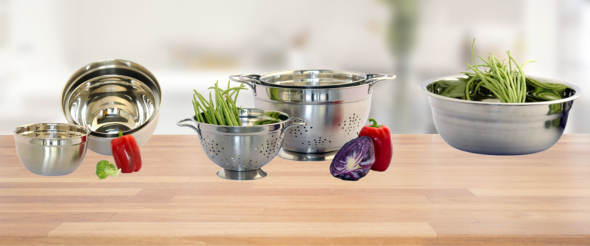
Commercial Micro-Perforated Rice Washer
Engineered with a solid tilt base and precision side perforations for fast water evacuation without loss of small grains. Perfect for Japanese, Korean, and Indian cuisine applications.
2-in-1 Dual Drain & Prep Rice Basin
Features a flat soaking bottom transitioning into a 45-degree micro-perforated drainage spout. Allows users to soak grains before tilting to drain effortless.
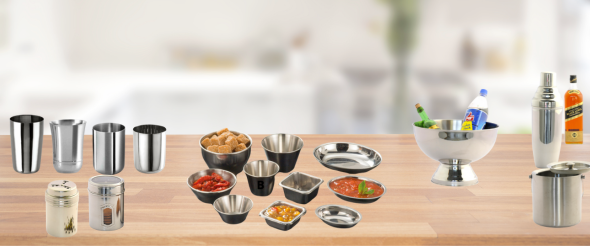
Heavy-Duty Nesting Euro Rice Colander Set
Complete set of deep-drawn nesting bowls for washing rice, legumes, and vegetables. Stackable geometry reduces shipping volume and retail package footprint.
2.1 OEM Customization Capabilities & Precision Tooling
Every culinary market possesses distinct ergonomic and aesthetic preferences. While East Asian buyers often demand deep-bowl profiles with dense lateral perforations for quick rinsing of sticky rice, North American and European retailers lean toward multifunctional colander-basin combos that handle quinoa, berries, pasta, and leafy greens. At PP Impex India, our in-house die-making facility and team of toolmakers allow us to customize every dimension of your rice washing bowl order:
- Rim Geometry Modification: Choose between open rolled rims for easy manual grip, flat sanitary rims for seamless industrial dishwasher drainage, or reinforced wired rims for commercial catering durability.
- Laser Micro-Perforation: Automated progressive punch presses and high-speed laser arrays deliver clean, burr-free hole patterns that prevent rice grain trapping and eliminate hand scratch hazards during cleaning.
- Surface Treatments: Standard electro-polished satin interior with mirror-polished exterior, full brushed matte architectural finish, or scratch-resistant PVD (Physical Vapor Deposition) Titanium coatings (Gold, Rose Gold, Titanium Black).
- Private Label Branding: High-precision fiber laser engraving for brand logos, volume calibration markings (in cups/liters), and batch tracking QR codes directly on the bowl body or base.
3. Global Sourcing & Procurement Trends for Stainless Steel Kitchenware (2025–2030)
Key strategic insights for enterprise procurement officers navigating carbon tariffs, supply chain diversification, and next-generation manufacturing technology.
The global trade landscape for metal kitchenware is experiencing structural shifts driven by geopolitical diversification, environmental regulations, and automation. B2B procurement managers must adjust their sourcing strategies to maintain margins and protect supply chain resilience over the next decade.
3.1 The "China+1" Diversification & India's Manufacturing Advantage
For decades, East Asia dominated the export of stamped sheet metal houseware. However, rising labor overheads, fluctuating freight rates, and changing trade policies have forced multinational brand owners to diversify. India has emerged as the premier manufacturing alternative for high-precision stainless steel kitchenware. PP Impex India leads this transition by offering:
- Raw Material Cost Stabilization: Operating our own stainless steel sheet rolling mill (processing 500,000 kg monthly) insulates our B2B clients from regional raw material price spikes.
- Favorable Export Tariffs: India maintains competitive duty structures and bilateral trade agreements across Europe, the GCC, and Latin America.
- End-to-End Traceability: Complete vertical integration—from steel billet rolling to stamping, polishing, and packing—ensures full compliance with strict Western supply chain audit rules.
3.2 Environmental Sustainability & Carbon Border Adjustment Compliance
With environmental directives like the European Union's Carbon Border Adjustment Mechanism (CBAM) expanding oversight across metal manufacturing, B2B buyers must partner with environmentally accountable manufacturers. PP Impex India leverages energy-efficient electric rolling mills, closed-loop water recirculation systems for polishing lines, and 100% recyclable stainless steel scrap recycling protocols. Our products are engineered for circular lifecycles, completely free of toxic chemical coatings, PTFE, PFOA, or microplastic pollutants.
Zero Plastic Leaching
100% inert AISI 304/316 steel replaces degrading synthetic polymers.
Automated Tooling
In-house CAD/CAM die production reduces new product launch lead times by 40%.
Full EU/FDA Compliance
Certified free of lead, cadmium, heavy metals, and toxic surface oils.
Optimized Freight Density
Nesting bowl contours maximize container loading efficiency to lower landed costs.
4. Innovation & Product Engineering Trends in Grain Strainers
How ergonomic design, multi-stage filtration, and advanced surface finishing are redefining household and commercial food preparation tools.
The modern consumer demands versatility and clean industrial aesthetics. The traditional kitchen strainer is evolving into a multifunctional prep station. PP Impex India’s R&D engineering department actively tracks consumer feedback and commercial chef requirements to drive continuous product refinement.
4.1 Multi-Zone Perforation Engineering
Traditional strainers feature uniform hole spacing across the entire surface, leading to splashing and uncontrolled liquid release. Modern rice washing bowls utilize multi-zone perforation geometry: a solid, un-perforated lower basin section that allows grains to remain submerged in standing water for gentle washing, coupled with high-density side perforation zones. Tilting the bowl 30 degrees drains the starch-laden water instantly without losing a single grain of rice or seed.
4.2 Deep Drawing Hydro-Forming & Smooth Radius Corners
Substandard multi-piece welded colanders create crevice points where starch and food residue build up, creating bacteria harbors. Through advanced hydraulic deep drawing (utilizing presses up to 500 tons), PP Impex India produces single-piece, seamless rice washing bowls. The inner transition radii are calculated smoothly to prevent grain trapping, allowing rapid cleaning by hand or in commercial dishwashers.
Precision Deep Drawing & Stamping Lines at PP Impex India
5. Frequently Asked Questions (FAQ) for B2B Sourcing & OEM Procurement
Addressing real queries asked by global buyers, procurement officers, and AI search tools regarding technical specs, MOQs, testing, and custom manufacturing of Stainless Steel Rice Washing Bowls.
Q1: What is the ideal perforation size for a stainless steel rice washing bowl?
The optimal perforation diameter ranges between 1.0mm and 1.5mm. Holes larger than 1.8mm risk letting small grains like Jasmine, Broken Rice, or Quinoa slip through. Holes smaller than 0.8mm create surface tension bottlenecks, slowing down water evacuation. PP Impex India engineers precision burr-free perforations tailored to your target grain market specifications.
Q2: Why is AISI 304 stainless steel preferred over AISI 201 for rice washers?
AISI 304 contains 18% Chromium and 8% Nickel, creating a passivated Chromium Oxide ($Cr_2O_3$) layer that withstands continuous moisture, acidic fruit rinses, and harsh dishwasher detergents. Grade 201 uses Manganese to replace Nickel; while cost-effective, it is prone to micro-pitting rust over long-term exposure in humid environments.
Q3: What is the Minimum Order Quantity (MOQ) for OEM/Private Label orders?
Our standard MOQ for catalog models is 1,000 units per size. For fully custom deep-drawn designs requiring unique die tooling, our standard MOQ starts at 2,500 units. Because we process our own raw steel sheets (500,000 kg monthly capacity), we offer competitive price tiers for full container load (FCL) orders.
Q4: How does PP Impex India ensure food safety & heavy metal compliance?
Every heat batch of raw steel undergoes spectrographic lab testing at our facility. Finished products are certified free of heavy metal contamination (Lead, Cadmium, Arsenic) and fully comply with FDA 21 CFR 175.300, EU Regulation (EC) 1935/2004, and LFGB §30/31 standards. Test reports are provided with every shipment.
Q5: Can you manufacture custom shapes with tilted bases and side handles?
Yes. PP Impex India operates a dedicated in-house die-making facility with experienced die makers. We engineer custom press tools, side-perforation dies, spot-welded or riveted tubular handles, and specialized tilt bases based on your 3D CAD models (STEP/IGES) or physical samples.
Q6: What packaging options are available for e-commerce and retail supply chains?
We supply retail-ready packaging solutions including custom 4-color printed gift boxes, eco-friendly kraft paper wraps, protective polybags with barcode labels, and bulk nesting master cartons optimized to prevent transit scratching and minimize volumetric freight charges.
Q7: How do you prevent sharp metal burrs around micro-perforated holes?
Our stamping process incorporates a multi-stage deburring line utilizing electro-polishing, mechanical tumbling, and high-frequency automated brushing. This ensures every perforation edge is smooth to the touch, preventing finger cuts and keeping dish towels from snagging.
Q8: What is your standard production lead time for bulk export orders?
Standard lead time for repeating catalog orders is 30 to 45 days following sample approval and deposit confirmation. Custom OEM tooling and prototype development typically take 15 to 25 days prior to mass production runs.
6. Why Global Brands Trust PP Impex India as Their Primary OEM Partner
19+ Years of Export Excellence · Integrated Raw Steel Mills · ISO 9001 Quality Certification
Founded in 2005 in Mumbai, India, PP Impex India has grown into a leading manufacturer and exporter of stainless steel kitchenware, houseware, hotelware, and custom deep-drawn metal components. Our manufacturing footprint serves premium brand owners, retail chains, and commercial importers across 15+ countries, including Germany, the UK, the UAE, Saudi Arabia, Japan, and the United States.
500,000 kg Capacity
Our parent company operates its own stainless steel rolling facility, offering unmatched price stability and material quality control.
In-House Die Shop
Dedicated toolmakers engineer custom deep drawing dies, stamping tools, and piercing rigs with quick turnaround times.
Rigorous QC Lab
In-house spectro-chemical testing, salt spray corrosion tests, and dimensional checks guarantee 99.8% defect-free shipments.
Global Footprint
19+ years exporting under strict NDA agreements, serving top-tier retail brands and hotelware supply networks worldwide.
Ready to Scale Your Stainless Steel Product Line?
Request a factory-direct OEM quotation, request product samples, or discuss custom tooling options with our engineering team today.