Choosing cookware is a practical decision, not just a matter of appearance. Aluminum Cookware Sets from China range from simple everyday collections to carefully finished sets with matching lids and comfortable handles. Yet a polished product photo cannot show how evenly a pan heats or whether a handle stays secure after repeated use. Small details matter.
This guide explores what to look for when comparing Chinese-made sets, including aluminum thickness, base construction, surface finish, handle attachment, and stovetop compatibility. It also considers whether a set’s pieces suit your routine: a large stockpot may be useful for family meals, while a small saucepan can earn its place every morning. Product specifications and supplier information deserve close attention, though they do not replace hands-on testing. That gap is worth admitting.
Rather than treating country of origin as a guarantee of quality, the guide focuses on verifiable features and clear questions to ask before buying. Buyers should check the care instructions, warranty terms, and available testing details for each product. Some claims may sound reassuring but remain difficult to compare without consistent evidence. The best choice is not necessarily the largest set or the lowest-priced one. It is the set whose construction, upkeep, and included pieces fit your kitchen—and whose maker can explain what you are buying.
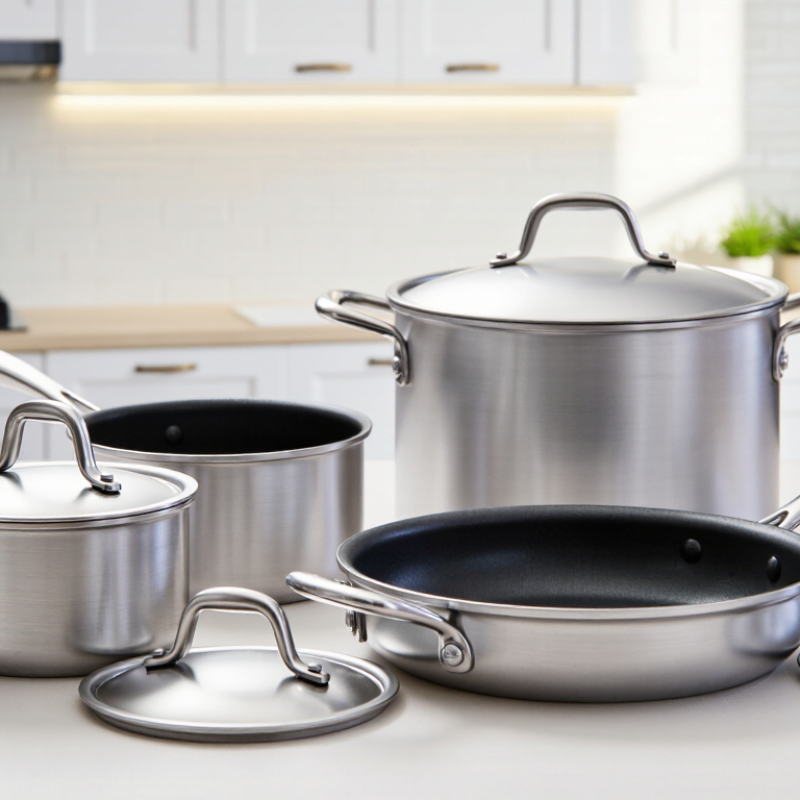
An aluminum cookware set is a coordinated group of pots and pans made with aluminum bodies. It may include saucepans, a frying pan, and matching lids. Aluminum spreads heat quickly and keeps cookware relatively light. The construction still matters: some pieces use a single aluminum layer, while others combine aluminum with stainless steel or use a treated surface. Handles, lid fit, and pan thickness also affect everyday use. A set can look complete but leave out a useful size.
China is a major manufacturing base for aluminum cookware, with production that can include forming, machining, surface finishing, and assembly. Factories may stamp or cast pan bodies, then add handles and lids. Their capabilities and quality controls vary, so “made in China” alone does not describe how a set performs. Buyers can compare body thickness, rim smoothness, handle attachment, and whether lids sit evenly. Small details matter.
A shiny finish can mislead. Ask for clear material and coating specifications, along with test documentation relevant to the intended use. Check that the cookware suits your stove, especially if you use induction, since plain aluminum is not magnetic. In practical use, a flat base and securely fastened handle matter more than a large piece count. Even careful checks cannot guarantee every item will feel right in your kitchen.
For aluminum cookware sets from China, conductivity and density are useful starting points, not quality grades. Engineering ToolBox’s engineering-property tables list aluminum at about 205 W/m·K and 2.70 g/cm³, or 2,700 kg/m³. These are reference values; cookware alloys and coatings can change performance. A quick-heating pan can bring water to a simmer promptly. It can also develop hot spots if its base is thin or uneven. A useful benchmark. Check the alloy and construction details, not just the headline number.
At 2.70 g/cm³, aluminum is relatively light, making a full set easier to lift and store than many stainless-steel sets. The density alone does not tell you whether a pan will feel sturdy. Wall thickness, handle attachment, and base design matter too. The Aluminum Association’s technical resources describe aluminum alloys as differing in composition and properties, so “aluminum” is not one uniform material. Not a guarantee. When comparing specifications, look for stated alloy, measured base thickness, and compatibility with your cooktop. On a gas burner, a broad, flat base helps distribute flame contact; on induction, the pan needs a compatible magnetic base. These details are easy to overlook.
When comparing aluminum cookware sets from China, inspect the base before judging the shine. ASM International’s ASM Handbook, Volume 2, lists thermal conductivity near 237 W/m·K for commercially pure aluminum and about 16 W/m·K for 304 stainless steel. These are material reference values, not guarantees of pan performance; alloy composition and construction change the result. That distinction matters.
Ask for measured base thickness, not a vague “heavy-duty” claim. A 3–5 mm base can be a useful screening range, but thickness alone proves little. Check whether the aluminum core extends across the cooking surface or sits in a bonded disk beneath it. Full cladding can support more even heating up the sidewalls; a disk base may leave cooler edges. Test with the same burner and a thin, even layer of water, noting where bubbling starts. Look for hot rings, slow edge response, and a base that rocks on a flat counter. Small details count.
Thicker is not always better. Extra mass can improve heat retention but slow temperature changes, and poor bonding can still create uneven spots. Ask suppliers for cross-section details and repeatable heat-spread test results. I would also verify these claims on a sample set; paperwork can look convincing, yet real pans sometimes surprise you.
| Construction Type | Typical Body and Base Construction | Indicative Base Thickness | Cladding or Bonding | Heat-Spread Performance | Cooktop Compatibility | Best Suited For | What to Check Before Buying |
|---|---|---|---|---|---|---|---|
| Light-gauge stamped aluminum | Pressed aluminum body; base is usually similar in thickness to the pan body. | About 1.0–1.5 mm for the body and base; specifications vary by piece. | Usually no separate bonded base or cladding. | Aluminum conducts heat well, but a thin pan has little thermal mass and can develop hot spots over a strong burner. | Gas and conventional electric; generally not induction-compatible unless fitted with a magnetic base. | Lightweight, budget-focused sets and everyday low-to-medium-heat cooking. | Check base flatness, handle attachment, coating specification, and whether the stated thickness refers to the body or only the base. |
| Forged or heavy-gauge aluminum | Thicker formed aluminum body and base, often with a nonstick interior coating. | Commonly about 2.0–3.0 mm; confirm the manufacturer's measurement method. | Typically a single aluminum body rather than a layered metal construction. | Good lateral heat conduction; additional thickness improves heat retention and resistance to warping compared with thin stamped cookware. | Gas and conventional electric; induction requires a bonded or attached magnetic plate. | Frequent home cooking where responsive heating and a sturdier feel are priorities. | Look for even wall thickness, a level base, secure handles, and clear instructions on oven and dishwasher use. |
| Aluminum body with bonded stainless-steel induction plate | Aluminum pan body paired with a magnetic stainless-steel disc bonded to the underside. | Aluminum body often about 1.5–2.5 mm; the added plate is commonly around 0.5–1.0 mm. Total base thickness depends on the design. | Stainless plate is bonded to the aluminum base; this is not the same as full-body cladding. | Aluminum spreads heat efficiently through the body. The plate enables induction use, but its size and bonding quality affect how evenly the base heats. | Gas, conventional electric, and induction when the plate is magnetic and properly bonded. | Multi-cooktop kitchens seeking an aluminum pan body with induction capability. | Verify induction compatibility, plate coverage, a smooth bond with no gaps, and a flat base that stays in contact with the cooktop. |
| Fully clad aluminum-core construction | Layered pan body with an aluminum core between stainless-steel layers; construction may extend across the sides as well as the base. | Overall base thickness is design-dependent and often around 2.5–4.0 mm; ask for the aluminum-core thickness separately. | Continuous bonded layers; confirm whether cladding covers the sidewalls or only the base. | The aluminum core spreads heat across the pan, while stainless-steel surfaces provide a durable cooking surface. Performance depends on core thickness and layer continuity. | Often suitable for induction when the exterior layer is magnetic stainless steel; confirm compatibility for the specific design. | Buyers prioritizing durable metal cooking surfaces and more uniform heating across the pan. | Request a cross-section or construction specification, confirm the cladding extent, and check handle, rim, and warranty details. |
How to interpret the figures: Thickness ranges are indicative construction ranges, not verified specifications for a particular set. Heat-spread descriptions are based on material and construction principles, not comparative laboratory testing. Aluminum's high thermal conductivity helps distribute heat, but burner size, pan diameter, base flatness, and core thickness also influence cooking results. Ask suppliers for measured body thickness, total base thickness, cladding details, and cooktop compatibility for each piece in the set.
When comparing aluminum cookware sets made in China, treat GB 4806.9-2023 as a food-contact safety checkpoint, not a quality ranking. The standard covers metal materials and articles intended to contact food. Ask for a test report tied to the exact cookware model, alloy, and surface finish—not a generic document for a similar pan.
Check what the report actually tested. Useful details include the tested food simulant, contact time and temperature, and measured migration of relevant elements. These conditions should reflect how the cookware is meant to be used. A report for one alloy or finish may not represent another. Small differences matter.
Look closely at the whole construction. Aluminum bodies may have coatings, handles, rivets, or exposed edges, and these parts can raise separate questions. Ask the supplier which applicable requirements cover each food-contact surface. A smooth, glossy pan proves little. Neither does a stamped claim of compliance. Request traceable test records and confirm the issuing laboratory and sample description. Paperwork can still be incomplete; that deserves a second look.
Durability is easier to judge from construction details than from polished product photos. Look for hard-anodized surfaces, solidly attached handles, and a base that sits flat on the counter. A thick base can reduce hot spots, though it does not make thin pan walls indestructible. Check whether lids and handles feel secure, especially if the set includes a large stockpot. Small details matter.
Warranty terms deserve a close read. Compare the length of coverage, what counts as a defect, and whether coating wear is excluded. A long warranty may offer less protection than its headline suggests. For induction cooking, confirm that the base is magnetic; aluminum alone usually will not work on an induction hob. A simple magnet test can help if the listing is unclear. Then calculate price per usable piece, not just the advertised total. A set with several lids or utensils may look like better value on paper. Divide the price by the pots and pans you will actually use. I would still check replacement-part availability; that detail is easy to miss. A lower price can be sensible, but a warped pan is no bargain.
It is a food-contact safety checkpoint for metal cookware, not a quality ranking. It does not tell you whether a pan is durable.
Look for the exact model, alloy, and surface finish. A report for a similar pan may not represent the one you are buying.
Check the food simulant, contact time, temperature, and measured migration of relevant elements. The conditions should match the cookware’s intended use.
Yes. Ask which requirements apply to each food-contact surface, including coatings and exposed edges. A glossy finish proves little.
Check for securely attached handles, a flat base, and sturdy construction. A thick base may reduce hot spots, but thin walls can still be damaged.
Usually not by itself. Confirm that its base is magnetic, or try a simple magnet test if the listing is unclear.
Compare coverage length, defect definitions, and coating exclusions. A long warranty may offer less protection than it seems.
Divide the price by the pots and pans you will actually use, not every listed piece. Check replacement-part availability too; I might overlook that detail. A cheap warped pan is no bargain.
Aluminum Cookware Sets are popular because aluminum is lightweight and transfers heat efficiently. Pure aluminum has a thermal conductivity of about 205 W/m·K and a density of roughly 2.70 g/cm³, though alloy composition and cookware design affect real-world performance. China plays a major role in manufacturing these sets, offering a wide range of construction options and price points. When comparing products, consider base thickness, whether the body is clad or layered, and how evenly heat spreads across the cooking surface.
Durability depends on material quality, construction, and care, so compare warranty terms as well as the stated features. For induction cooking, check that the set has a compatible magnetic base rather than assuming aluminum alone will work. Food-contact materials should be assessed against China’s GB 4806.9-2023 standard. Finally, compare the price per piece alongside the set’s usable components, construction, and intended cooktop compatibility to identify the best overall value.