Choosing Cookware Sets for a business is a purchasing decision, not just a matter of matching finishes. Restaurants, retailers, and hospitality buyers need products that suit their menus, customers, storage space, and replacement budgets. Grand View Research estimated the global cookware market at about USD 29.9 billion in 2023 and projected a 6.5% compound annual growth rate from 2024 to 2030. That growth signals opportunity, but it does not make every set a smart buy.
A useful expert perspective comes from Lisa McManus, executive editor of equipment testing at America’s Test Kitchen. Paraphrased, her cookware-testing approach is to judge pans by cooking performance and handling, not appearance or piece count. That distinction matters when a set includes small saucepans that rarely leave the shelf, or handles that become awkward during a busy service. Check how materials distribute heat, whether lids fit securely, and how easily staff can clean each piece. Then compare those details with your actual cooking tasks.
There is no perfect set for every business. A café cooking eggs, a retailer serving home cooks, and a catering team have different needs. Start with the work your cookware must do. Consider durability, compatibility with your heat sources, warranty terms, and the cost of replacing individual pieces. One detail is easy to overlook: storage. A wide pan can be excellent on the stove and troublesome in a crowded rack. Use the sections ahead to assess materials, construction, suppliers, and value before making a purchase.
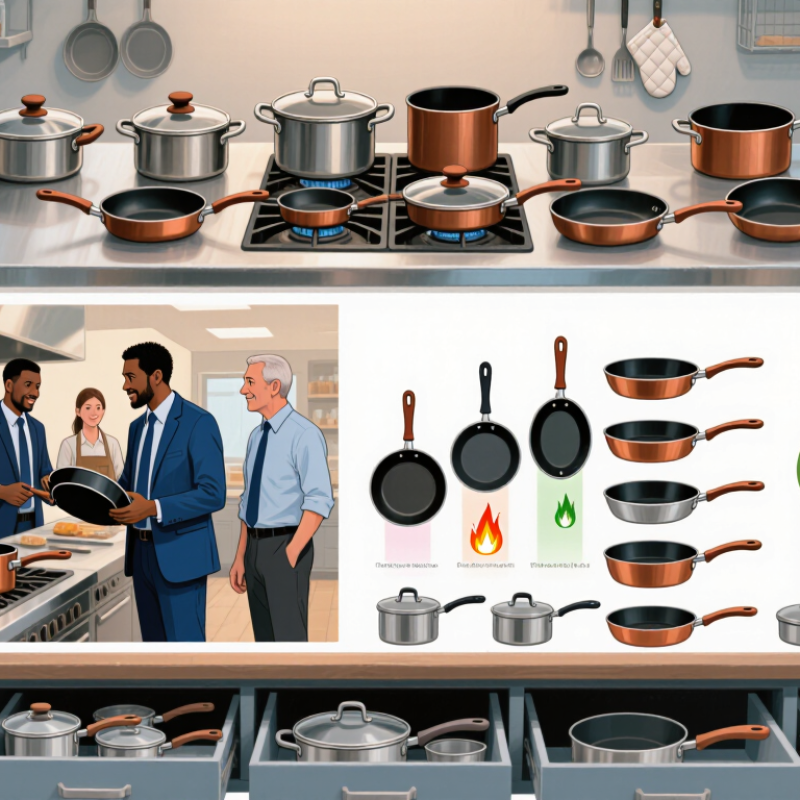
Before comparing cookware sets, map the work your kitchen actually does. A café serving eggs and soups needs different pieces from a catering kitchen preparing large batches. List your regular dishes, cooking methods, and busiest service periods. Be specific. Note whether staff use induction, gas, or oven finishing, and measure the available burners and storage shelves. A wide pan may suit your menu but crowd a small cooktop.
Estimate covers per hour, not just daily sales. During a lunch rush, several pans may need to be in use while others are being washed. Think about pot capacity, pan diameter, and how quickly staff can replace a damaged or dirty piece. More pieces are not always better. A large set can tie up storage space and leave rarely used items gathering dust. Match quantities to your actual stations and cleaning turnaround.
Check the forecast against a busy shift. If possible, ask cooks which pieces they reach for repeatedly and which stay untouched. I would leave a small buffer for growth, but avoid buying for an imagined rush that never arrives. Those estimates can be wrong. Review them after a few weeks of service, when real usage gives you better evidence.
Choosing business cookware starts with the heat source, not the finish. For induction, pans need a magnetic base; a quick magnet test can catch incompatibility before purchase. The U.S. Department of Energy estimates induction transfers about 85% of heating energy to cookware, compared with roughly 32% for gas. These figures describe cooking-system efficiency, not guaranteed kitchen savings. Still, they make burner compatibility an operational concern. On gas, check that flames stay beneath the pan base. On electric glass, look for flat bottoms that sit steadily and avoid scratching the surface.
Material affects response and upkeep. Aluminum heats quickly and weighs less, while stainless steel often tolerates frequent washing and rougher service. Multi-layer construction can pair a responsive aluminum or copper core with a durable stainless-steel cooking surface. Cast iron holds heat well, but its weight and slower response may complicate busy service. Check the manufacturer’s stated oven limit, handle construction, and dishwasher guidance; these vary by product. A heavy pan can feel reassuring in a sample test, yet become tiring during a full shift. I would compare sample pans on the actual burners and with the staff who will use them. Specifications help, but they do not fully predict daily handling. (U.S. Department of Energy, Energy Saver: Induction Cooking)
Choose cookware by station, not by the number of pieces in a box. A breakfast menu may need several shallow sauté pans, while a soup-heavy kitchen needs stockpots with enough capacity for batch volume. Keep common tasks in mind: a 2-quart saucepan for sauces, a broad skillet for eggs, and a pot that fits your largest burner. Measure first.
Check the equipment, too. Measure burner diameters, oven clearance, storage shelves, and sink basins before selecting pan sizes. A wide pan can crowd neighboring burners, and a tall stockpot may not fit beneath a low shelf. Match materials and handles to your heat sources and oven routines. Small details matter.
Budget pressure makes mismatched inventory costly. The National Restaurant Association’s 2024 State of the Restaurant Industry report found that 45% of operators said their restaurants were not profitable in 2023, while 38% were just breaking even. That finding does not prescribe a cookware set, but it reinforces the value of buying pieces your menu will use. One caveat: menus change, and a “perfect” set can become awkward after a seasonal shift. Leave room for a few task-specific replacements rather than buying every size upfront.
Representative commercial cookware capacity options, in liters. Match vessel sizes to your batch volumes, menu, and burner or oven capacity.
These are illustrative capacity examples, not a universal standard. Confirm actual capacity, dimensions, and equipment fit with the cookware specifications before purchasing.
Choose cookware with documented food-contact materials, clear temperature limits, and handles that stay secure during repeated service. For commercial food equipment, NSF/ANSI 51 outlines material and design criteria; ask suppliers which requirements apply to each item. Safety is more than a label. CDC estimates that 48 million Americans get foodborne illnesses each year, so sanitation deserves careful attention, even though cookware is only one part of food safety.
Check that pans have smooth interiors, accessible seams, and surfaces your team can clean without special tools. A warped base can wobble on a burner; thin handles may loosen after frequent washing. Compare weight, construction, and warranty terms—not just the purchase price. A set that looks sturdy in a catalog may feel different after a full shift. That detail is easy to miss.
Tips: Request a sample and test it during routine prep. Ask for written cleaning guidance, replacement-part availability, and typical support response times. Confirm whether lids and handles are covered by the warranty. Keep the answers on file. Supplier support varies. So does follow-through.
Source: CDC, “Estimates of Foodborne Illness in the United States”; NSF/ANSI 51, Food Equipment Materials.
When comparing cookware sets for a business, look beyond the price on the invoice. Include replacement lids, handles, delivery, and any pieces your kitchen must buy separately. A low-cost set can become expensive if pans warp under frequent heat or the sizes do not fit your burners. Check construction and weight in person when possible. A pan that feels manageable when empty may become awkward when full.
Warranty terms deserve a close read. Confirm which parts are covered, how long coverage lasts, and whether normal commercial use is included. Some warranties exclude damage from overheating, abrasive cleaning, or heavy daily use. Keep the written terms with the purchase records, and ask the supplier how claims are handled. A fast, clear repair process can matter more than an impressive-sounding coverage period.
Small detail. Big difference.
Estimate cost per month of expected service, not just cost per set. For example, compare two sets over three years, allowing for likely replacement pieces and downtime. Ask staff which pans they reach for most; their experience can reveal poor sizing or uncomfortable handles before those problems appear in a spreadsheet. Still, estimates are imperfect. Usage changes, and even durable cookware can fail earlier than expected. Track damage and replacements for a few months, then adjust your purchasing assumptions.
List regular dishes, cooking methods, and busiest service periods. Measure burners and storage shelves. A wide pan may crowd a small cooktop.
Estimate covers per hour, not only daily sales. During lunch, several pans may be in use while others are being washed. Check pot capacity and replacement needs.
Ask cooks which pans they use repeatedly and which stay untouched. Their feedback may reveal awkward handles or poor sizing. More pieces are not always better.
Include replacement lids and handles, delivery, and pieces bought separately. A low invoice can hide extra costs. Track the full amount.
An empty pan may feel manageable but become awkward when full. Check how it sits on your burners, too. Small detail. Big difference.
Confirm covered parts, coverage length, and whether commercial use qualifies. Check exclusions for overheating, abrasive cleaning, or heavy daily use. Keep written terms with purchase records.
Estimate monthly costs over an expected service period, such as three years. Include replacements and downtime. These estimates can still be wrong.
Track damage and replacements for a few months, then adjust your assumptions. Review actual use after several weeks of service. A small growth buffer seems sensible, though it may be a guess.
Choosing Cookware Sets for a business begins with understanding daily cooking demands, service volume, and the types of dishes on the menu. Consider how often each item will be used, which sizes and shapes are needed, and whether the set will work with the kitchen’s cooking equipment. Compare materials and construction for heat distribution, compatibility, durability, and ease of handling.
Before purchasing, assess safety features, cleaning requirements, and how well the cookware can withstand frequent commercial use. Check what support the supplier provides, including clear product information and warranty coverage. Compare the full cost of ownership—not only the initial price, but also expected lifespan, maintenance, and the cost of replacing essential pieces. A well-matched set can help a business maintain consistent cooking, use kitchen space efficiently, and achieve better long-term value.