China is a major sourcing destination for Aluminium Cookware, with manufacturers serving household brands, retailers, and food-service buyers. Yet “top” does not mean the same thing to every buyer. One company may excel at large-volume production, while another offers more flexible customization or closer quality oversight. The right choice depends on the product, order size, budget, and intended market.
This guide explains how to assess Chinese manufacturers using practical signals: product range, materials, forming and finishing capabilities, quality-control processes, export experience, and communication. Details matter. Ask how base thickness is checked, how handles are attached, and whether samples match production specifications. A polished catalog is useful, but it is not proof of consistent performance. Request current documentation and confirm claims directly with the supplier.
There is no perfect shortlist.
Company rankings can shift as capabilities, ownership, and customer requirements change. A factory suited to lightweight everyday pans may not be the best fit for heavy-duty cookware or private-label projects. Some comparisons also rely on incomplete public information, so a confident ranking should be treated with care. Use the profiles that follow as a starting point, then compare shortlisted suppliers against your own technical requirements, sample results, and expected order volumes. That extra checking takes time. It can prevent an avoidable mismatch later.
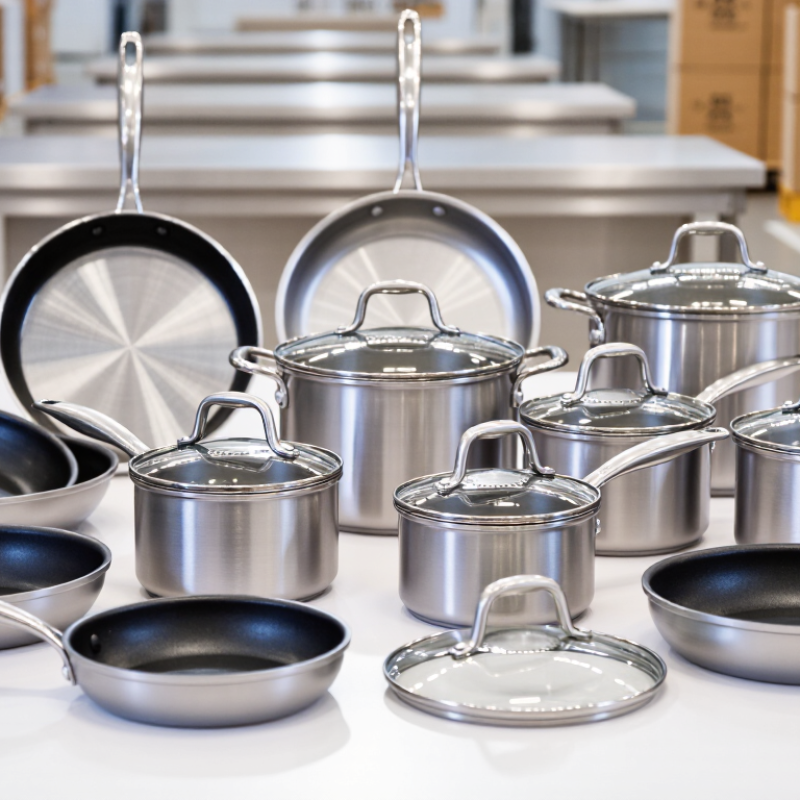
China’s Aluminium Cookware Industry at a Glance
China’s aluminium cookware industry draws on one of the world’s largest metal supply bases. The National Bureau of Statistics reported 41.59 million tonnes of primary aluminium production in China in 2023. The International Aluminium Institute reported a comparable figure of about 41.5 million tonnes. These are upstream metal figures, not cookware output. Still, they show the scale of the industrial ecosystem supporting cookware production.
Manufacturing capabilities vary across the country. Some factories focus on pressing and spinning aluminium sheet; others handle surface finishing, assembly, and quality checks. For buyers, production volume alone is not enough. Ask for cookware wall thickness, base flatness, coating adhesion results, and handle-strength test records. A polished sample can look convincing, but repeated heating may reveal uneven performance. That detail is easy to miss.
Tips: Request samples from the intended production line, not only showroom pieces. Check dimensions and finish across several units. Small inconsistencies matter.
| Industry Dimension | Typical Industry Practice | What Buyers Should Check |
|---|---|---|
| Manufacturing landscape | China has a substantial cookware manufacturing and export sector. Production capabilities and product focus vary by factory; this overview describes common industry practices rather than ranking individual manufacturers. | Confirm the factory’s actual production scope, equipment, quality controls, and experience with the specific product category. |
| Aluminium materials | Cookware may be made from formed aluminium sheet or cast aluminium alloy, depending on the design and intended use. | Request material specifications and verify that the material and any food-contact surfaces comply with the requirements of the destination market. |
| Forming methods | Common methods include stamping, spinning, and die casting. The suitable method depends on the pan’s shape, wall design, production volume, and performance requirements. | Review sample consistency, dimensional tolerances, base flatness, wall thickness, and handle attachment. |
| Surface finishes | Available finishes include mechanical or polished finishes, anodized surfaces, and applied non-stick coatings. These are different processes and should not be treated as interchangeable. | Ask for coating or anodizing specifications, test methods, care instructions, and evidence supporting any durability claims. |
| Cooktop compatibility | Aluminium is not ferromagnetic, so an aluminium pan generally needs a suitable magnetic base layer to work on an induction cooktop. | Check compatibility through product specifications and testing on the intended cooktop type; do not infer induction suitability from appearance alone. |
| Quality and compliance | Requirements depend on the destination market and product construction. Food-contact rules, chemical restrictions, and test procedures can differ between markets. ISO 9001 relates to quality-management systems; it is not, by itself, a cookware product-safety approval. | Specify the target country and request relevant, current test reports and documentation for the exact product and materials. |
| Product range | Common categories include frying pans, saucepans, stockpots, woks, and cookware sets, with construction and finish options varying by model. | Evaluate the exact model, including dimensions, usable capacity, weight, lid fit, handle design, packaging, and care requirements. |
| Export and sourcing | Export capability, order quantities, lead times, customization, and packaging options are supplier-specific rather than uniform across the industry. | Confirm production schedules, minimum order quantities, inspection arrangements, shipping terms, and responsibility for destination-market compliance. |
| Supplier comparison | There is no single product specification or public measure that establishes a universal “top manufacturer” ranking. | Compare suppliers against the same technical specification, sample-testing plan, compliance requirements, and commercial terms. |
FAQS
Start with factory processes, not catalogue photos. Ask who controls alloy sourcing, casting, forming, coating, and finishing. Request alloy certificates and batch records. Details matter.
Check wall thickness, a flat base, smooth rims, and secure handles. Place it on a level surface; it should not rock. A few tenths of a millimetre can affect heating.
Ask for documented coating adhesion, abrasion, corrosion, thermal-cycle, and handle-strength checks. Find out how often tests happen and whether records identify production batches. One sample is not enough.
No. It indicates a quality-management system, but does not guarantee each product performs well. Compare recent inspection records with samples from normal production. Paperwork can lag.
Request the stated recycled percentage and evidence supporting it. Recycling aluminium can use about 95% less energy than producing primary aluminium. That figure does not prove cookware quality.
Stamped, forged, and die-cast pans can differ in weight, wall thickness, and heat response. Match construction and finish to the intended cooking surface. I may be oversimplifying here.
Put material specifications, sample approvals, inspection criteria, and production changes in writing. Confirm custom sizes, colors, lids, and packaging. More options mean more coordination.
Compare samples from separate production runs, if possible. Review minimum quantities, tooling fees, sample charges, and realistic lead times. A factory visit or video tour helps, but independent testing still matters. No checklist catches everything.
Conclusion
China’s Aluminium Cookware industry brings together manufacturers with a range of production scales, product specializations, and export capabilities. Leading suppliers can be assessed by factors such as manufacturing experience, quality control, material consistency, production capacity, customization options, and communication. These criteria help buyers look beyond product appearance and understand whether a manufacturer can meet their requirements reliably.
Notable manufacturers may offer cookware such as pots, pans, and related kitchen products, using different forming, finishing, and coating processes. When comparing suppliers, buyers should review product specifications, sample quality, available certifications, order quantities, lead times, packaging, and after-sales support. A clear comparison of these details can help identify an Aluminium Cookware partner that fits a project’s budget, quality expectations, and delivery schedule.