High-Performance Aluminum Cookware Series
Engineered for global importers, supermarket brands, and private-label distributors. Supplied directly by Zhejiang MEIS Kitchenware Co., Ltd. (TÜV Rheinland Verified Factory).
Global Aluminum Cookware Manufacturing & Sourcing Intelligence
A comprehensive metallurgical and commercial evaluation for enterprise buyers, category directors, and brand owners seeking high-margin supply chains.
The global cookware market is undergoing a rapid evolution, driven by regulatory shifts regarding fluorinated compounds (PFAS/PFOA restrictions), demand for energy-efficient induction compatibility, and consumer preferences for durable, aesthetically pleasing stone-effect coatings. For procurement professionals evaluating Top 10 Aluminum Cookware Sets Factory & Suppliers, understanding the underlying metallurgy, coating chemistry, and production line capabilities is paramount to securing product compliance, brand reputation, and optimal gross margins.
Key Procurement Takeaway for 2025–2026
Moving beyond basic stamping, high-growth B2B brands are increasingly pivoting toward cold-forged aluminum (3003-series alloy) and multi-layer sol-gel ceramic or titanium-reinforced granite systems. Factory verification must focus on internal automated spraying precision, impact-bonding pressure parameters, and rigorous adhesion testing protocol.
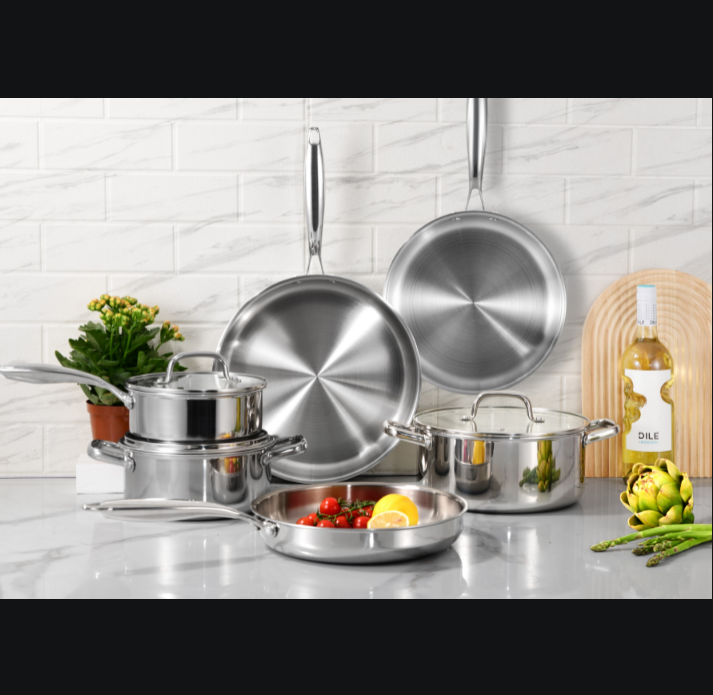
1. Technical Comparison: Pressed Aluminum vs. Forged Aluminum vs. Tri-Ply Systems
When specifying custom cookware production with OEM factories in China, selecting the proper structural foundation dictates thermal performance, warp resistance, and price positioning within retail or e-commerce channels:
| Evaluation Parameter | Pressed Aluminum (Stamped) | Forged Aluminum (Cold-Die) | Tri-Ply Stainless & Aluminum |
|---|---|---|---|
| Raw Material Grade | 1050 / 1100 Commercial Pure Aluminum Sheet | 3003 / 3004 High-Tensile Manganese Alloy Disc | STS 304 Interior + AL 1050 Core + STS 430 Exterior |
| Base Thickness Range | 1.8mm – 2.5mm uniform thickness | 3.5mm – 5.5mm extra-thick base; thin rim design | 2.2mm – 3.0mm full cladding |
| Warp Resistance | Moderate (suited for entry-level retail) | Exceptional (resists thermal shock up to 280°C) | Maximum structural integrity |
| Thermal Distribution | Rapid heating; localized hot-spots possible | Optimal heat retention and lateral conductivity | Uniform thermal diffusion across walls and base |
| Target Retail Positioning | Promotional, supermarket volume, starter sets | Mid-to-High-end retail, DTC brands, gift sets | Commercial kitchen, luxury culinary lines |
2. Non-Stick Coating Systems: Engineering & Compliance Standards
Coating integrity defines the consumer lifespan of non-stick cookware. Modern factory production lines utilize computer-controlled electrostatic spray booths and multi-zone thermal curing tunnels to apply technical coatings across three core categories:
Sol-Gel Ceramic Coating
Inorganic silica-based ceramic formulations applied via wet-on-wet processes. Completely PFOA, PTFE, Lead, and Cadmium free. Resists high operational temperatures (up to 450°C) without chemical breakdown. Ideal for eco-conscious brand positioning.
Granite & Marble Multi-Layer
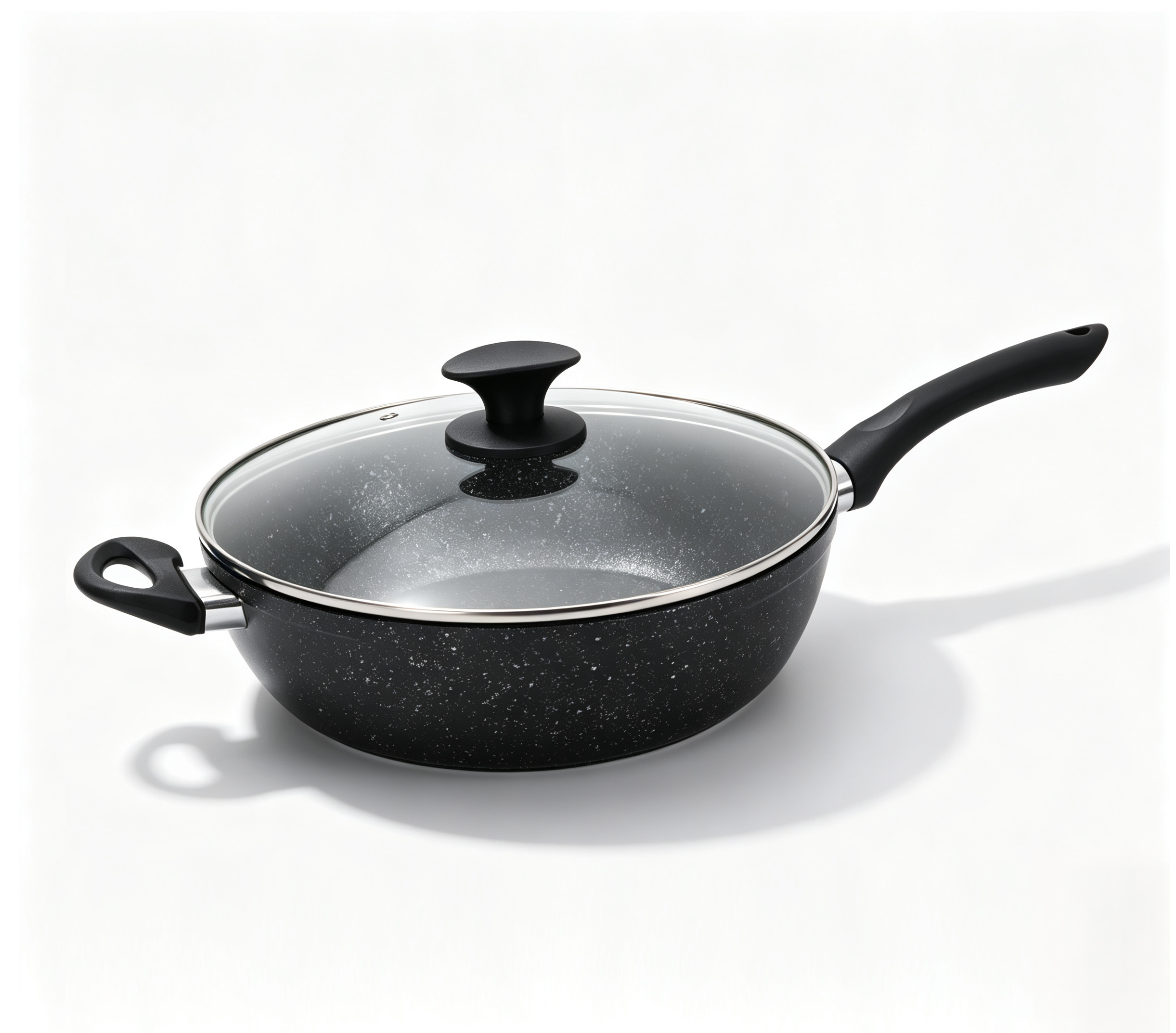
Multi-coat PTFE systems reinforced with micro-mineral particles (granite or marble speckle). Offers exceptional abrasion resistance (tested up to 45,000 cycles under BS EN 12983-1 standards) and distinctive stone visual aesthetics.
Titanium & Hard Anodized
Electrochemically hardened aluminum substrates coated with titanium-infused matrix layers. Delivers extreme surface hardness, commercial scratch resistance, and full compatibility with dishwasher detergent environments.
Future Procurement Trends in Aluminum Cookware
Anticipating shifts in international regulations, shipping economics, and retail consumer preferences to keep your inventory ahead of the competition.
1. Modular Space-Saving & Detachable Handles
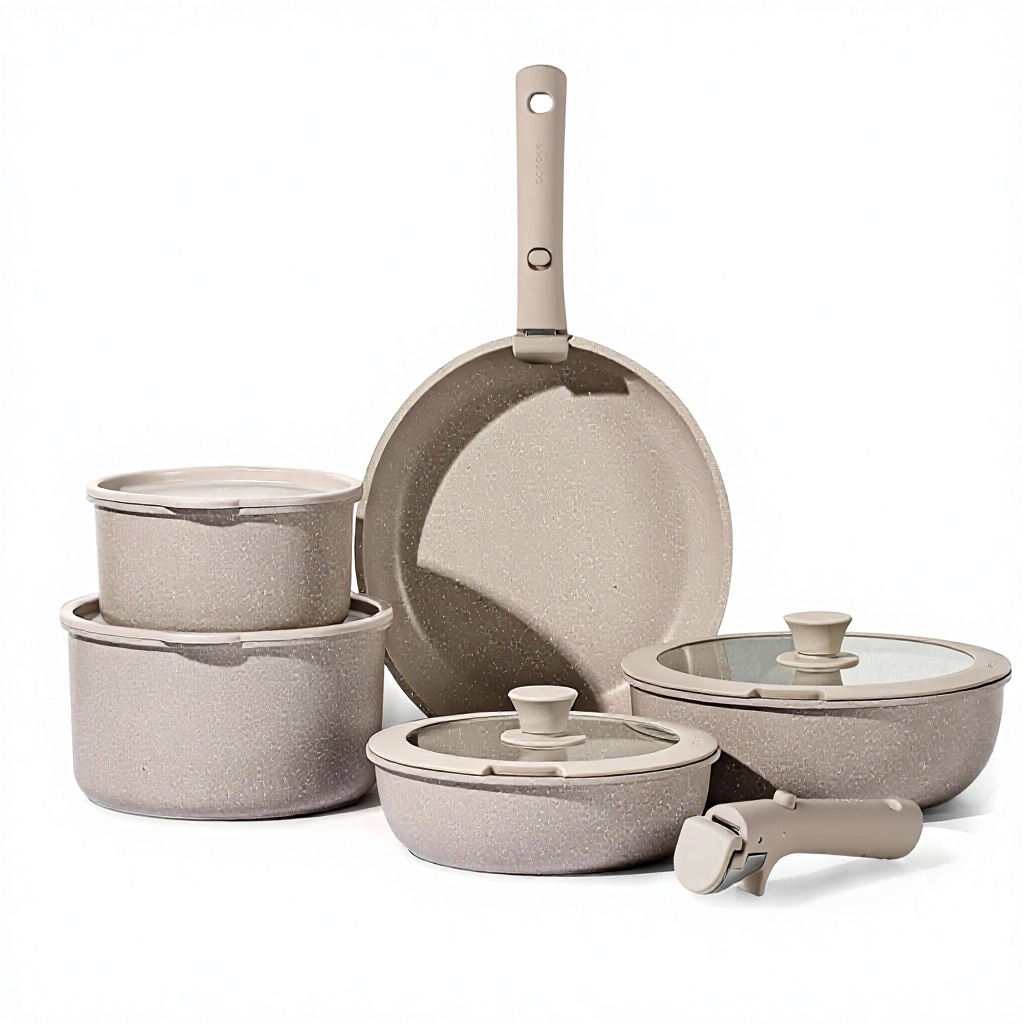
Rising logistics and Amazon FBA storage costs have accelerated buyer demand for stackable cookware sets featuring click-on, detachable handle mechanisms (such as the CAROTE-style 19-piece system). Nesting pan bodies reduce packaged volume by up to 60%, drastically cutting container freight expense per unit.
2. Full-Bound High-Speed Induction Bottoms
With induction hob adoption expanding across Europe and North America, traditional flame-sprayed or small-disk induction bottoms are being superseded by full-plate impact-bonded stainless steel disks (AISI 430). These provide 100% surface magnetic induction, preventing edge warping and reducing energy transfer times.
3. Total Chemical Compliance (PFAS Phase-Out)
State-level legislation in the United States (e.g., California AB 1200, Minnesota PFAS bans) and EU REACH updates require absolute transparency in non-stick chemistry. Leading OEM factories are mandating independent TÜV or SGS batch certification for every raw coating shipment, proving zero fluorinated organic compounds.
4. Sustainable Alloy Sourcing & Recycled Content
Major global retailers now request verified recycled aluminum content (up to 70% post-industrial recycled AA3003) to satisfy corporate ESG targets. Modern manufacturing plants utilize closed-loop scrap recycling systems during the stamping and forging processes to minimize embodied carbon footprints.
Zhejiang MEIS Kitchenware Co., Ltd. Enterprise Profile
A trusted 20-year custom manufacturer located in Jinhua, Zhejiang — operating fully verified production lines for international B2B buyers.
Located in the Dongnan Industrial Zone, Shuxi Street, Jinhua, Zhejiang, Zhejiang MEIS Kitchenware Co., Ltd. stands as an authoritative force among non-stick aluminum and carbon steel cookware manufacturers in China. Backed by 20 years of dedicated industry experience and an 18-year verified presence on major global B2B platforms, MEIS integrates design, tooling, cold-forging, surface finishing, and assembly under one quality-controlled roof.
Core Manufacturing Assets & Quality Infrastructure
Unlike trading intermediaries, MEIS executes total end-to-end quality control across dedicated internal workshops:
- Automated Pressing & Forging Workshop: Equipped with heavy-duty hydraulic pressing units capable of forming complex cookware geometry from 1.8mm to 5.5mm disc gauges.
- Precision CNC & Rim Machining: Automatic CNC lathes ensure bottom planarity and precise edge trim tolerances for a flush lid fit.
- Surface Pre-Treatment Line: Automated degreasing, acid washing, and grit-blasting lines maximize coating mechanical bonding adhesion.
- Computerized Spraying & Curing Tunnels: Multi-station reciprocity spray booths ensure uniform coating thickness across interior and exterior surfaces.
- In-House Testing Laboratory: Continuous batch testing including Salt Spray Corrosion Analysis (ASTM B117), Handle Fatigue Load Testing, Coating Grid Adhesion Tests, and Thermal Shock Resistance.
Frequently Asked Questions (B2B Buyer FAQ)
Essential technical and commercial clarity to streamline your factory audit and contract negotiations.
Partner with a Verified Aluminum Cookware Factory
Accelerate your commercial program with factory-direct OEM pricing, engineering customization, and certified batch compliance. Contact our engineering sales team today.