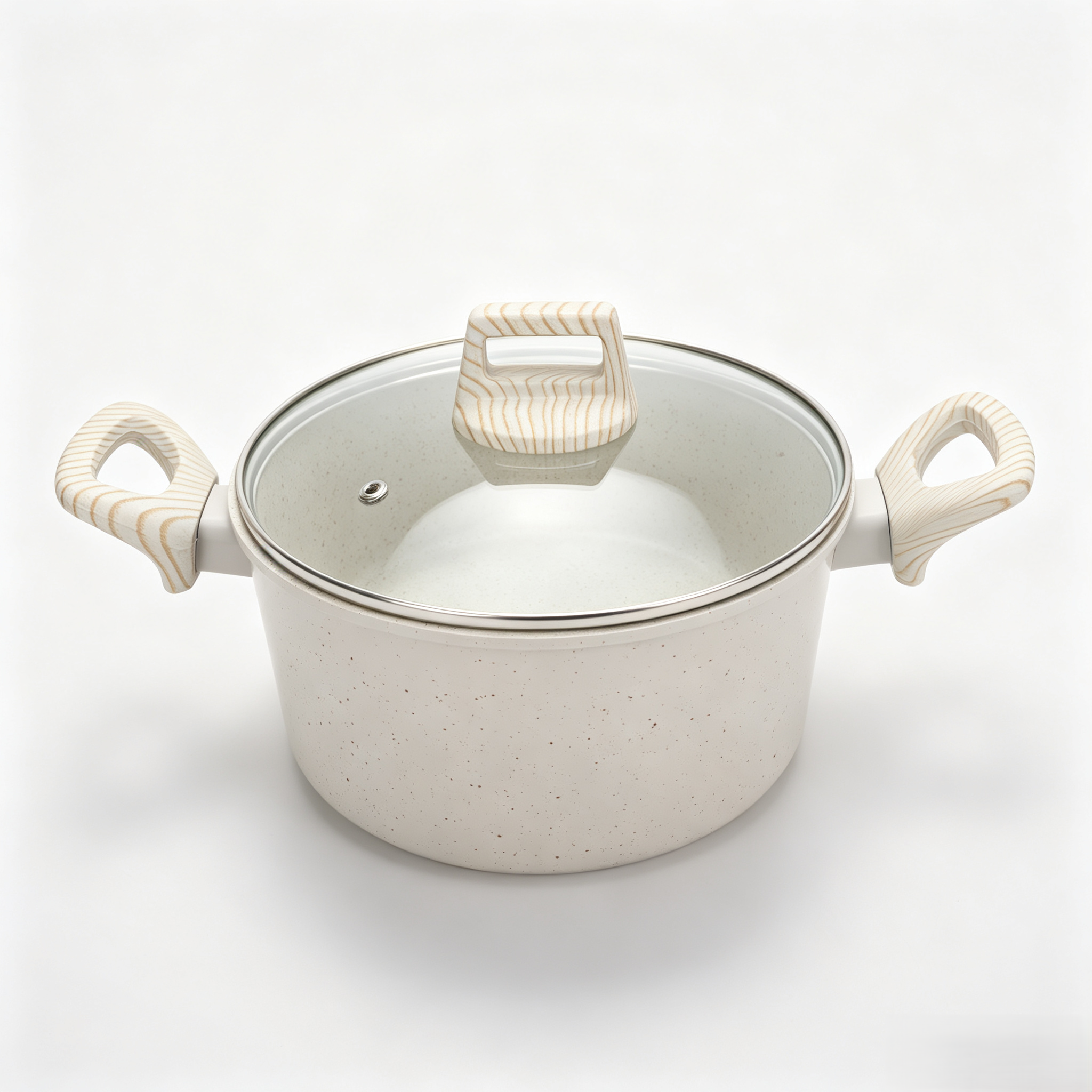
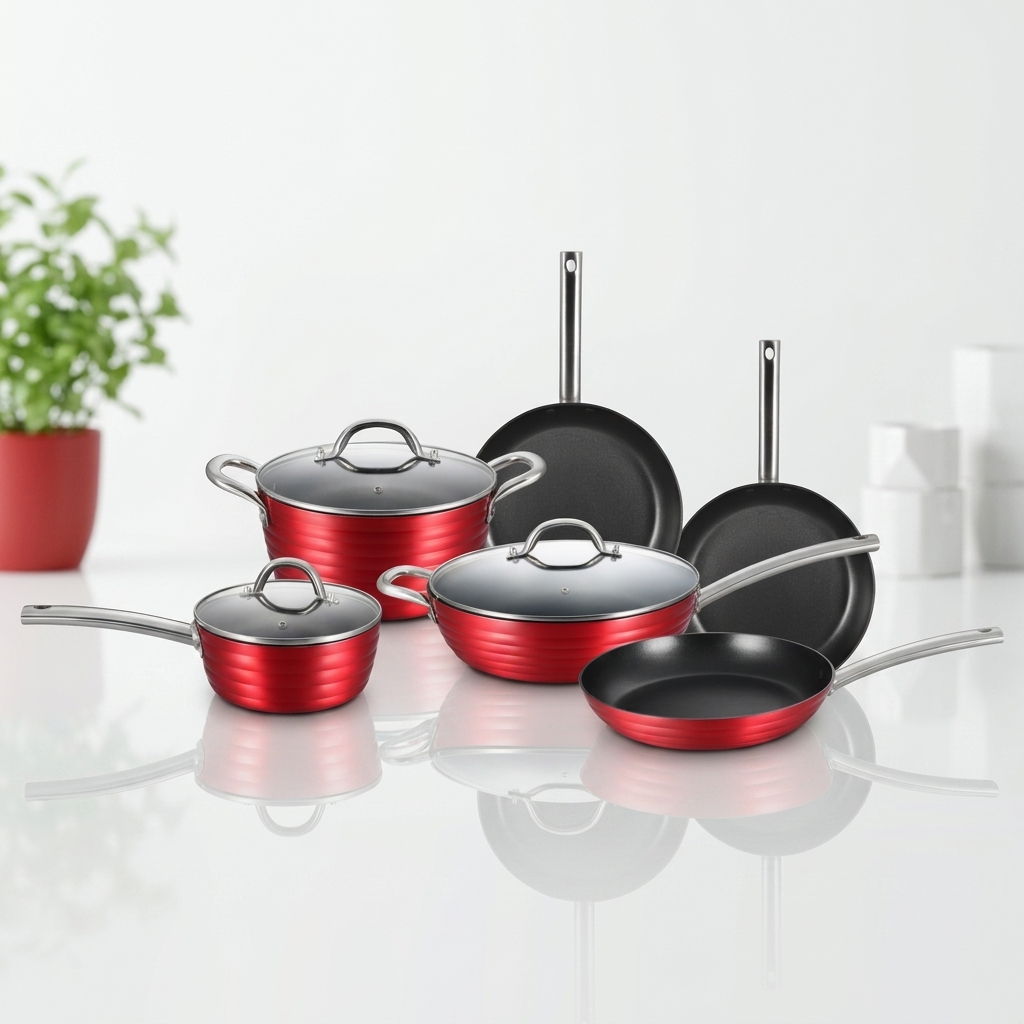
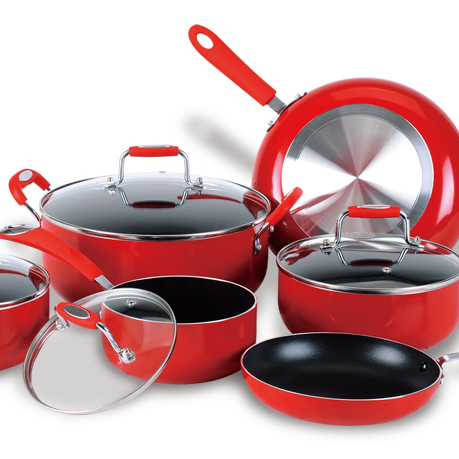
Large Capacity Durable Nonstick Aluminum Cookware Pot Casserole Induction Bottom Bakelite Handle Glass Cover Oven Safe
- Thick-gauge stamped aluminum core
- Full-surface magnetic induction plate
Precision stamping, die-forging, and induction bonding executed on dedicated automatic production lines in Jinhua, ready for Mediterranean distribution via Port de Barcelona.
Years Cookware Manufacturing
Verified Workshop Staff
Rheinland On-Site Assessed
Years Alibaba Gold Supplier
Batch Traceability & LFGB
A comprehensive engineering guide for Spanish brand directors, HORECA procurement executives, and retail chain buyers importing premium kitchenware into Catalonia.
Barcelona represents one of Southern Europe's most sophisticated gastronomic centers. The local cooking ethos—deeply rooted in Catalan heritage dishes such as Suquet de Peix (fisherman’s seafood stew), Fideuà, Escalivada, and complex reductions like Sofregit—places singular demands on cookware that conventional, generic pans simply cannot survive.
In traditional Mediterranean cooking, high thermal shocks are frequent. A chef or home cook initiates cooking by intensely sweating aromatic bases of onions, garlic, and ripe tomatoes over low-to-medium thermal input, followed by searing cuttlefish, prawns, or Iberian pork cuts at blistering surface temperatures exceeding 210°C. Standard nonstick coatings with weak chemical primers delaminate quickly under continuous exposure to acidic tomato purées and deglazing wines. Furthermore, the high moisture content of shellfish broths causes thermal micro-shock that buckles thin, stamped aluminum pans (under 2.5mm).
At Zhejiang MEIS Kitchenware Co., Ltd., based in the renowned hardware manufacturing hub of Jinhua, China, our 20-year engineering experience enables us to manufacture specialized cookware tailored precisely for these harsh thermal cycles. Operating from our Dongnan Industrial Zone facility, verified on-site by TÜV Rheinland, our technical team controls every phase of metallurgy, chemical surface passivation, automatic multi-coat electrostatic spray finishing, and CNC induction base milling.
We utilize 3003-grade high-purity aluminum discs cold-forged under 800-ton hydraulic presses. This closes internal crystalline porosity, ensuring zero hot spots during lengthy Catalan slow-simmering recipes like Fricandó.
Our dual-line spraying facilities apply specialized ceramic sol-gel matrices and multi-coat PTFE formulations reinforced with mineral granite and titanium particles, impervious to acidic tomato base degradation.
Catalonia boasts an induction hob penetration rate surpassing 68%. Our precision CNC base milling creates an intentional, scientifically calculated 0.15–0.25mm concave tolerance that flattens perfectly under heating, maximizing induction coil coupling.
When engineering private-label collections for Barcelona department stores (such as El Corte Inglés suppliers), specialized homeware boutiques across L'Eixample, or commercial HORECA distributors supplying restaurants around Barceloneta and Gràcia, choosing the ideal alloy structure is the single largest determinant of unit cost, landed margin, and end-user durability.
| Metallurgical Metric | Stamped / Pressed Aluminum | Cold Die-Forged Aluminum | Tri-Ply Clad Stainless Steel | Nitrided Carbon Steel |
|---|---|---|---|---|
| Alloy Composition | 1050 / 3003 Pure Sheet | 3003 Modified High-Density | SS304 + Pure Al + SS430 | Heavy-Gauge Cold Rolled Fe |
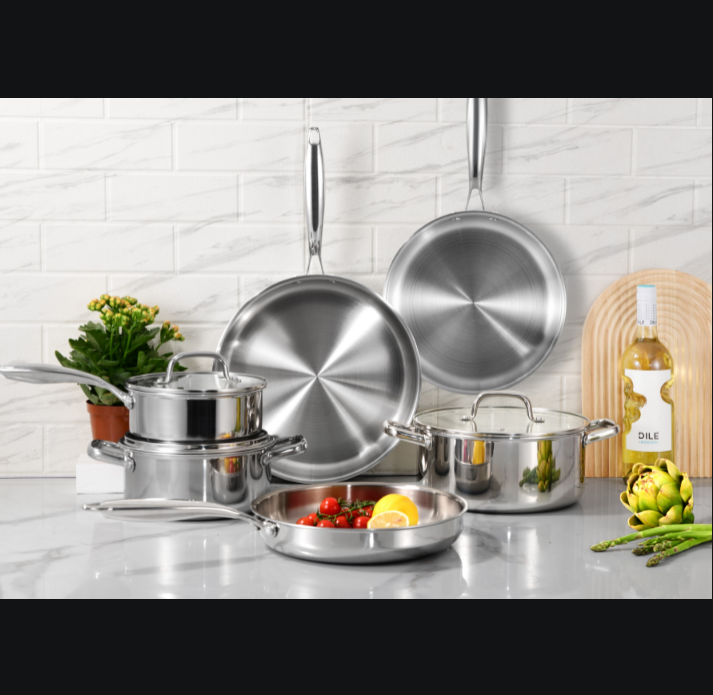
| Rim / Base Thickness | 2.0mm – 2.8mm Uniform | 4.5mm Base / 2.5mm Rim | 2.5mm – 3.0mm Tri-Ply Uniform | 1.6mm – 2.2mm Rigid Carbon |
| Thermal Conductivity | 210 W/m·K (Extremely Fast) | 195 W/m·K (Uniform Spread) | 160 W/m·K (Balanced Core) | 65 W/m·K (High Searing Heat) |
| Induction Method | Friction-Fitted Hole Plate | Impact-Bonded Full Disk | Continuous Magnetic Skin | Naturally Magnetic Body |
| Warp Resistance (at 250°C) | Moderate (Risk under cold wash) | Exceptional (Zero Distortion) | Virtually Indestructible | High (Subject to rapid quenching) |
| Target Barcelona Channel | Supermarket Chains / Flash Promo | Mid-to-High Retail & E-Commerce | Culinary Schools & Pro Kitchens | Tapas Bars, Paella Specialists |
By operating our own tool-and-die workshop with internal CNC machining centers, wire-cutting electrical discharge machining (EDM), and high-precision lathes, MEIS Kitchenware produces customized molds in-house. This gives Spanish importers an unrivaled speed-to-market advantage: custom rim configurations, specialized pour spouts for oils and broths, bespoke ergonomic handle tooling, and personalized base laser etchings can transition from CAD design to physical production prototypes within 14 to 21 working days.
Navigating EU consumer safety directives is paramount when clearing customs at the Port of Barcelona (Aduanas de Barcelona). Non-compliant kitchenware risks confiscation, steep commercial penalties, and immediate brand erosion. At MEIS, compliance is integrated into our manufacturing lines rather than treated as an afterthought.
Our coatings undergo rigorous third-party sensory extraction and overall migration tests using 3% acetic acid, 10% ethanol, and rectified olive oil food simulants, guaranteeing complete safety under strict German and Spanish sanitary scrutiny.
To align with evolving European Chemicals Agency (ECHA) restrictions, we provide certified water-based sol-gel ceramic interiors and GenX/PFOA/PFOS-free multi-layer fluoropolymer coatings engineered for extreme abrasion resistance.
Handles undergo pneumatic cycle fatigue testing (15,000 lifting cycles with 1.5x max water payload), torque resistance checks, and flame-impingement thermal isolation testing to eliminate loosening hazards.
In our in-house testing facility, our dedicated quality assurance team conducts continuous verification across every production batch: cross-hatch adhesion testing (ISO 2409), continuous neutral salt spray resistance (ASTM B117) exceeding 72 hours without blistering, pencil hardness testing up to 4H–9H, and real-world hot oil nonstick release evaluations.
To capture premium retail shelf space and high customer ratings across Spain, cookware must excel within specific local culinary environments. Here is how our four core product categories are deployed across Catalonia:
Compact, modern Catalan apartments require stackable cookware with detachable handles and multi-functional silhouettes. Our forged aluminum casseroles double as oven-safe roasting bakers, transitioning seamlessly from induction cooktop to dinner table.
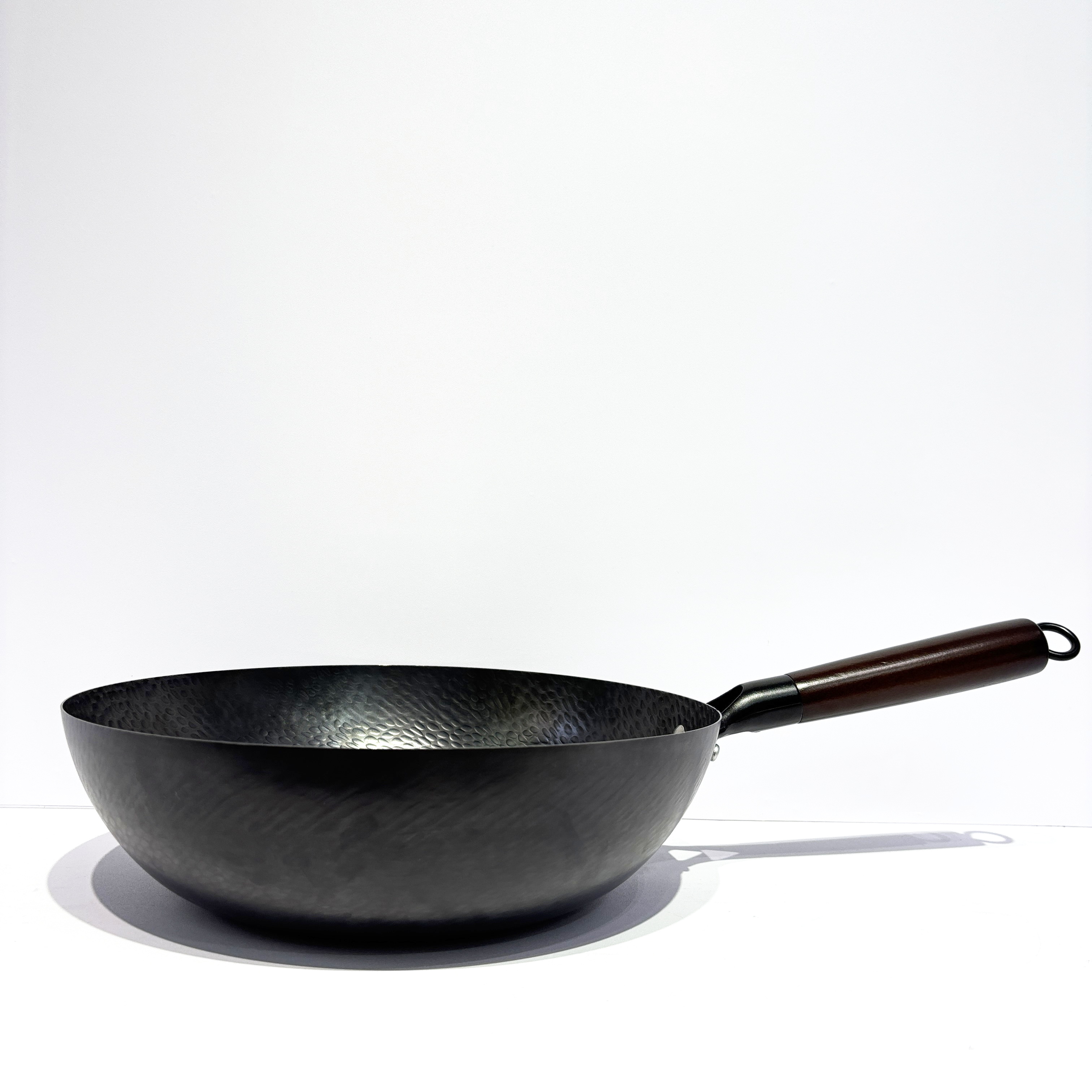
High-volume kitchens serving gambas al ajillo, pulpo a la plancha, and pimientos de Padrón rely on our 10-inch heavy-gauge carbon steel and nitrided woks. Their ultra-fast thermal response and metal-utensil resilience withstand continuous commercial dishwashing.
Simmering rich fumet fish broths without sticking or burning requires our induction-bottom nonstick casseroles with tempered aroma-valve glass lids, allowing chefs to monitor fluid reduction without losing volatile aromatic essences.
Sourcing directors planning long-term purchasing strategies for Iberian wholesale must align their catalogs with several accelerating consumer and technological macro-trends:
Critical operational answers regarding factory verification, minimum orders, shipping routes, and OEM customization capabilities.
With over two decades of focused kitchenware manufacturing in Jinhua, Zhejiang, MEIS Kitchenware represents the ideal blend of heavy industrial capability, rigorous quality management, and agile Western business communication.
From aluminum disk stamping and punching to automatic electrostatic coating, handle riveting, and final master carton packaging, our entire production cycle runs under our direct management across dedicated specialized workshops.
We do not rely on third parties for day-to-day quality control. Our internal testing laboratory is equipped with salt spray chambers, thrust testers, torsion gauges, curing ovens, and handle fatigue rigs ensuring zero-defect export consignments.
Having supplied leading retailers, supermarket chains, and private labels throughout Europe, North America, and Latin America for over 18 years on Alibaba, we understand international packing standards, palletization, and customs compliance.
Collaborate directly with Zhejiang MEIS Kitchenware’s dedicated engineering and export team. Receive detailed OEM/ODM production matrices, factory unit pricing, sample lead times, and comprehensive LFGB compliance dossiers tailored for the Spanish culinary market.